US has 11 export officers abroad as China rents Nvidia chips
US export rules license the chip, not the login, so Chinese firms can lawfully rent restricted Nvidia processors abroad, and checking where the chips sit falls mostly to sellers.
Washington restricts exports of Nvidia’s most advanced AI chips to China, but Chinese companies can still use the same processors by renting computing power in data centres overseas.Reuters via The Manila Times: China’s AI firms seek Nvidia chip capacity (13 Nov 2026). Reuters reported on 12 November, citing people familiar with the matter, that Chinese AI companies are trying to rent Nvidia-powered capacity outside China. It also reported that a major Chinese cloud provider has discussed locking in overseas capacity. Nvidia was already under scrutiny in Washington: its board opened an investigation into a reported foreign intelligence effort aimed at its chief executive, as we reported on 9 November.The S-Curve: Nvidia opens spy probe as AI’s first espionage conviction falls (9 Nov 2026).
What the rules cover
US export controls license the export, re-export and in-country transfer of a controlled item.Baker McKenzie: US House passes Remote Access Security Act (14 Jan 2026). The law firm Baker McKenzie wrote in January 2026 that the Bureau of Industry and Security (BIS) has not broadly regulated mere remote access to such items.
The gap has edges. BIS guidance of 13 May 2025 says a licence may be required when an exporter knows that a data-centre provider will use chips to train AI models for or on behalf of parties headquartered in China, and the model serves a weapons-of-mass-destruction or military-intelligence end use.BIS industry guidance to prevent diversion of advanced computing integrated circuits (13 May 2025). The trigger is the exporter’s knowledge and the end use, not the rental. The same guidance lists as a red flag a cloud customer that “does not or cannot affirm that users of its services are not” headquartered in China.
Commerce rescinded the January 2025 AI Diffusion Rule on 13 May 2025, two days before its compliance requirements were due to take effect, and said BIS would issue a replacement rule in the future.Commerce press release: rescission of the AI Diffusion Rule (13 May 2025). A January 2026 BIS rule on licences for chip exports to China makes applicants list the intended remote users in China and seven other countries.Federal Register 2026-00789 (15 Jan 2026). It governs licensed shipments, not chips already installed in third countries.
US rules tend to follow the object. As we reported on 11 November, US rules cover chips, named buyers and personal data, not purchased expertise.The S-Curve: Chinese AI labs and US training data (11 Nov 2026).
Who counts the chips
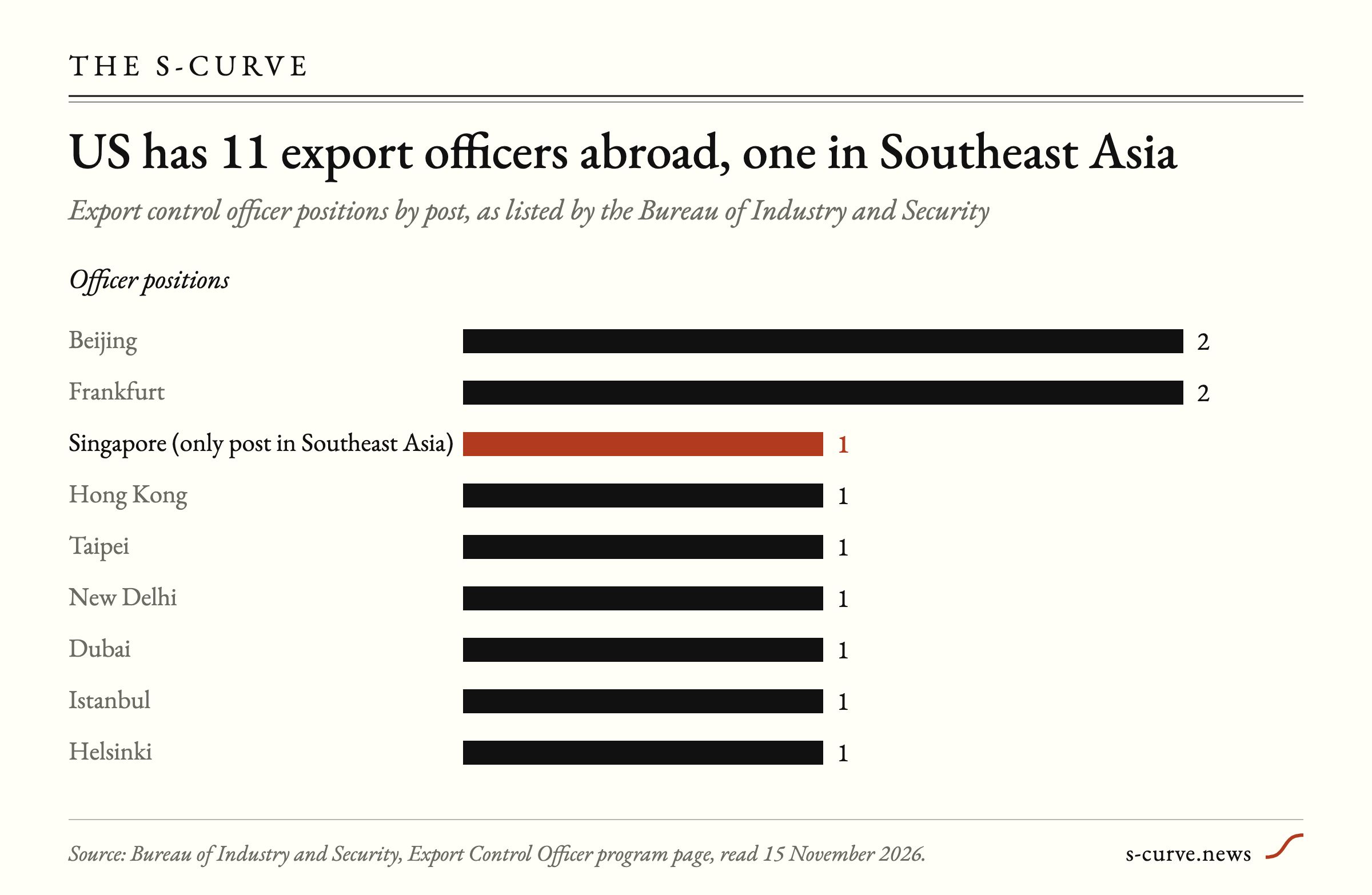
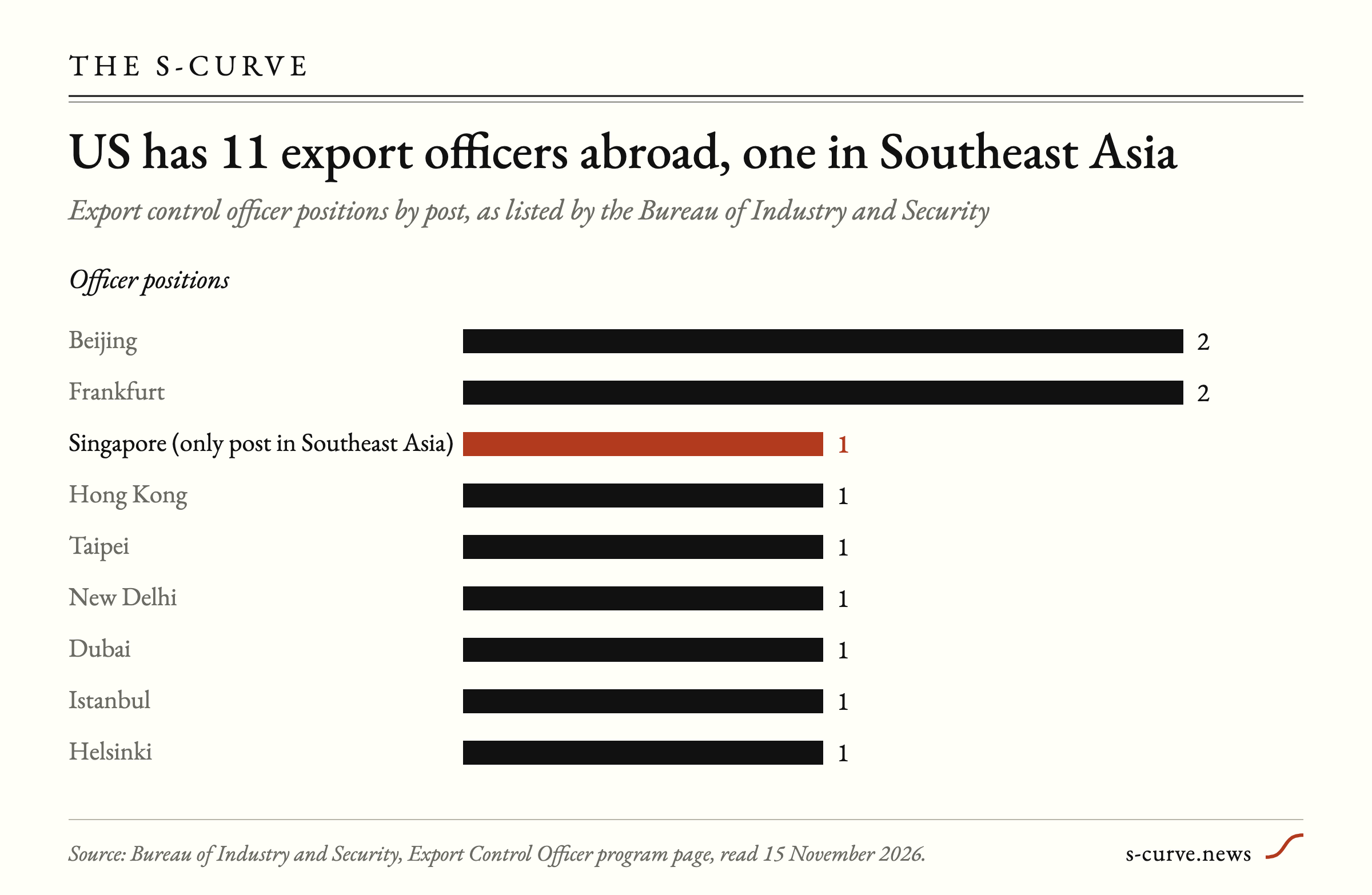
BIS says it has eleven export control officer positions abroad.BIS Export Control Officer program page. They sit in Beijing (two), Frankfurt (two), Singapore, Hong Kong, Taipei, New Delhi, Dubai, Istanbul and Helsinki. Singapore is the only post in Southeast Asia, and there is none in Malaysia or Indonesia.
In fiscal 2025 BIS completed 1,840 end-use checks in 73 countries, for every kind of controlled item.BIS annual report, fiscal year 2025. Of those, 1,786 were post-shipment verifications, and about 88% were done by its export control officers at embassies and consulates.
So the first line of checking is the seller and its partners. The red flags in BIS guidance are addressed to exporters. Erich Grunewald of the Institute for AI Policy and Strategy told Fortune that chip distributors and resellers often spend too little effort vetting customers, usually relying on paperwork the customer provides.Fortune via Yahoo Finance: how Megaspeed built its network in Singapore and Malaysia.
Sales records do not settle where a chip sits either. Nvidia’s fiscal 2025 annual report said Singapore was 18% of revenue by billing location but less than 2% by shipment, because customers use Singapore to centralise invoicing while products are almost always shipped elsewhere.Nvidia Form 10-K, fiscal year 2025 (filed 26 Feb 2025).
Malaysia has its own control. Since 14 July 2025 it requires a Strategic Trade Permit for exports, transhipments and transits of high-performance AI chips of US origin.Malaysia MITI press statement: Malaysia regulates trade of US AI chips (14 Jul 2025). The measure covers chips leaving or passing through the country, not who uses chips installed there. The ministry said it “will not tolerate the misuse of Malaysia’s jurisdiction for illicit trading activities”.
The Megaspeed count
The case now in the news turns on a count the seller made. Bloomberg reported that, after visits to 12 facilities owned by eight companies in three Southeast Asian countries, Nvidia sent inventory checks to BIS and said in mid-November 2025 that everything was where it should be.Bloomberg via Yahoo Finance: Nvidia intervened in US probe of Megaspeed. Bloomberg also reported that trade records it analysed showed Nvidia had undercounted the chips it sold to Megaspeed through hardware partners by 50,000 units. Nvidia told Bloomberg in December 2025 that it had checked additional Megaspeed warehouses that contained the missing hardware.
Nvidia says it works to resolve diversion allegations promptly, “to help government and our partners halt any would-be smugglers while serving the critical market of lawful customers”.
The Information reported, according to Fortune, that at least $7.5 billion of Nvidia chips moved through Megaspeed and its Malaysian subsidiary, Speedmatrix. Megaspeed has “categorically denied the chip diversion allegations” and says Singapore’s investigation concluded this year with no adverse action against it. It said in a statement that it operates fully within the bounds of all applicable export control regulations.
A BIS spokesperson told Bloomberg that BIS “enforces aggressively across the board” and that “enforcement is at an all-time high”. On 10 November 2026, Malaysia’s trade minister Johari Abdul Ghani said the government had yet to receive evidence that Speedmatrix violated Malaysian law and had not begun an investigation.The Edge Malaysia: minister on Megaspeed and Speedmatrix (10 Nov 2026). He said Malaysia would act on credible evidence or a formal foreign request.
What would change
Congress has one answer. The House passed the Remote Access Security Act 369 to 22 on 12 January 2026.The Register: Congress votes to kick China off remote GPU services (13 Jan 2026). The bill would amend the Export Control Reform Act of 2018 so that Commerce can regulate a foreign person’s remote access, over a network or a cloud computing service, to items under US jurisdiction, where the Secretary finds a serious risk to national security or foreign policy.H.R. 2683, Remote Access Security Act, as passed by the House (119th Congress). Rep. Mike Lawler, the bill’s sponsor, said: “Our export controls are only as strong as the weakest link, and right now, the CCP has a real tool to sidestep these prohibitions”. As of mid-November 2026 the bill is before the Senate, and it is not law.
A second bill tracks the chip itself. The Chip Security Act, introduced by Sen. Tom Cotton in May 2025, would require exported advanced chips to carry location verification within 180 days of enactment.The Register: senator’s Chip Security Act (9 May 2025). Nvidia’s company blog says its GPUs do not and should not have “kill switches and backdoors”, which it says would be a gift to hackers and hostile actors.Nvidia blog: No Backdoors. No Kill Switches. No Spyware. (5 Aug 2025). CNBC reported on 12 November 2026 that lawmakers are pressing to include chip-control bills, the Chip Security Act among them, in this year’s defence policy bill.CNBC: push to tighten China chip curbs (12 Nov 2026).
Commerce may act first. The Information reported, according to CNBC, that Commerce is finalising a rule aimed at stopping Chinese AI firms from remotely accessing advanced chips in data centres in other countries. Press summaries of that report say the rule would put a licence requirement on data-centre operators in seven countries: Singapore, Malaysia, Thailand, Brazil, Indonesia, Norway and South Africa.Tech Times: Chinese firms rush to reserve Nvidia chip capacity (13 Nov 2026). Commerce has published nothing.
The Financial Times reported on 3 November 2026, according to Fortune, that Oracle cancelled a $7 billion deal to give Tencent access to 100,000 AI chips in Southeast Asian data centres after US officials raised concerns. The paper also reported that Nvidia is telling cloud clients they must sell at least 51% of their services to non-Chinese companies.
What is still missing is a Senate vote on the Remote Access Security Act and the text of a Commerce rule that so far exists only in press reports.
Sources
- Bloomberg via Yahoo Finance: Nvidia intervened in US probe of Megaspeed
- Fortune via Yahoo Finance: how Megaspeed built its network in Singapore and Malaysia
- H.R. 2683, Remote Access Security Act, as passed by the House (119th Congress)
- The Register: Congress votes to kick China off remote GPU services (13 Jan 2026)
- Nvidia blog: No Backdoors. No Kill Switches. No Spyware. (5 Aug 2025)
- CNBC: push to tighten China chip curbs (12 Nov 2026)
- The Register: senator's Chip Security Act (9 May 2025)
- Federal Register 2026-00789 (15 Jan 2026)
- BIS industry guidance to prevent diversion of advanced computing integrated circuits (13 May 2025)
- Commerce press release: rescission of the AI Diffusion Rule (13 May 2025)
- Tech Times: Chinese firms rush to reserve Nvidia chip capacity (13 Nov 2026)
- Reuters via The Manila Times: China's AI firms seek Nvidia chip capacity (13 Nov 2026)
- Baker McKenzie: US House passes Remote Access Security Act (14 Jan 2026)
- BIS Export Control Officer program page
- BIS annual report, fiscal year 2025
- Malaysia MITI press statement: Malaysia regulates trade of US AI chips (14 Jul 2025)
- The Edge Malaysia: minister on Megaspeed and Speedmatrix (10 Nov 2026)
- Nvidia Form 10-K, fiscal year 2025 (filed 26 Feb 2025)
- The S-Curve: Nvidia opens spy probe as AI's first espionage conviction falls (9 Nov 2026)
- The S-Curve: Chinese AI labs and US training data (11 Nov 2026)
Disclosure
This article was drafted by S-Curve Desk, an AI system, from the sources above. Boaz Sobrado reviewed it before publication. Errors: the corrections log, or write to us.