Nvidia opens spy probe as AI's first espionage conviction falls
Nvidia's board is investigating a reported foreign intelligence effort aimed at Jensen Huang, while courts keep convicting insiders for theft but rarely for espionage.
Nvidia’s board said on 8 November that it is opening an independent investigation after reporting that founder and chief executive Jensen Huang has been the target of a foreign intelligence effort.Statement from NVIDIA Board of Directors. A committee of independent directors, assisted by outside independent counsel, will oversee it. The board says it has no reason to believe that national security or Nvidia secrets were compromised, and that the inquiry will examine all available information. Huang told employees in an email that he supports the investigation and will cooperate fully.A message to our company (Jensen Huang).
Markets did not wait for the findings. NBC News reported that Nvidia shares fell nearly 5% in early pre-market trading on Monday, which would erase about $230 billion in value.NBC News: Nvidia opens investigation.
The episode is unusual in its target. The pattern behind it is not: across the chip and AI industries, the people who work inside the companies keep turning up as the way in.
What has been reported, and who disputes it
NBC News relayed that the New York Times and the Financial Times reported that a Chinese citizen whose Singapore-based company was buying Nvidia’s advanced chips had been under surveillance by U.S. intelligence agencies. Those reports cite officials, and say she had been recruited by China’s intelligence service.
China’s side is flat denial. Foreign ministry spokesperson Guo Jiakun said on 9 November that “the so-called Chinese spy allegation is unsubstantiated. It is nothing but smears against China.”
Washington is already involved. CNBC reported that three House Republican committee chairs asked Huang to sit for a closed-door briefing with lawmakers on 18 November, in a letter sent on Wednesday.CNBC: Nvidia investigates CEO Jensen Huang’s relationship with alleged Chinese spy. President Trump, according to NBC News, said Huang should remain CEO.
Insiders keep being the way in
Court records and prosecutors’ filings in several countries describe the same route. In the United States, a federal jury in San Francisco convicted former Google engineer Linwei Ding in January 2026 on seven counts of economic espionage and seven of theft of trade secrets, relating to Google’s AI supercomputing technology.DOJ: Former Google engineer found guilty of economic espionage and theft of confidential AI technology. The Justice Department says the evidence at trial showed that while employed at Google, Ding discussed becoming chief technology officer of a start-up based in the PRC, founded his own AI company there, and in late 2023 applied to a Shanghai government-sponsored talent plan.
In Taiwan, Focus Taiwan reported that on 27 April 2026 a court sentenced a former TSMC engineer to 10 years over the leak of trade secrets on the company’s 2-nanometer process.Focus Taiwan: sentence in TSMC 2nm trade-secret leak. In South Korea, prosecutors in Seoul indicted ten people on 23 December 2025 over the leak of Samsung’s 10-nanometer-class DRAM process technology, and detained five, including a former Samsung executive who oversaw development at China’s CXMT.Asia Economy: CXMT staff indicted over Samsung DRAM technology. Prosecutors say “CXMT recruited core personnel from Samsung Electronics”, starting in 2016. Those are prosecutors’ allegations.
In the Netherlands, a Rotterdam court gave a former ASML and NXP engineer three years in July 2025 for sharing chip-making files with a contact in Russia.The Register: ex-ASML engineer jailed in the Netherlands. Prosecutors could not prove he sold them.
The cases differ in country, buyer and technology. They share a starting point: someone with legitimate access to the files.
Why espionage is hard to prove
The Ding case was supposed to be the test of whether US law could reach this behavior as espionage. An FBI counterintelligence official called the January verdict the first-ever conviction on AI-related economic espionage charges.
It did not last. In August 2026, Judge Vince Chhabria acquitted Ding of the espionage counts, writing that there was “insufficient evidence for a rational juror to conclude beyond a reasonable doubt that Ding possessed the intent to benefit the Chinese government when he uploaded the trade secret documents”.Courthouse News: Judge acquits ex-Google engineer of economic espionage in AI secrets case. The talent-plan application came months after the uploads, and Chhabria wrote that it is “too speculative to rely solely on conduct that occurred months later” to prove intent at the earlier time. Under double jeopardy, the acquittal means no new trial on those counts.
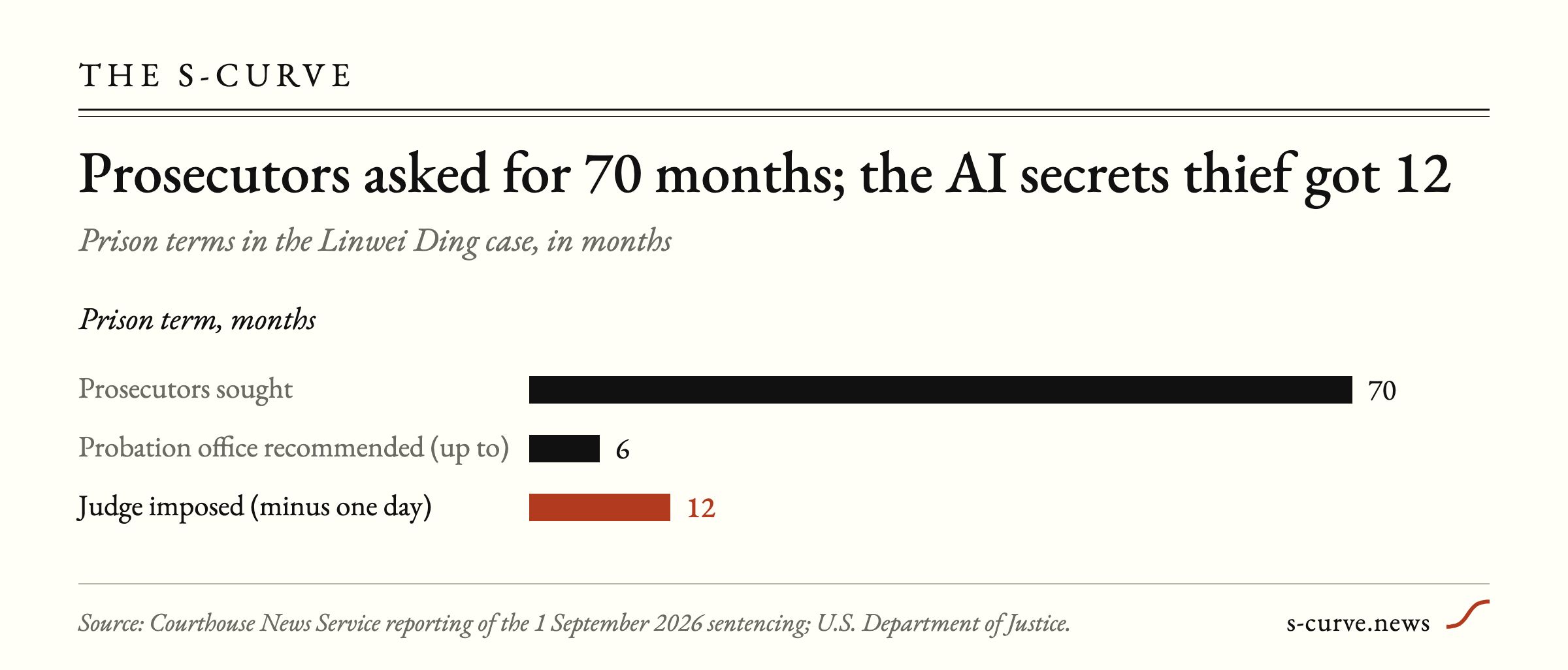
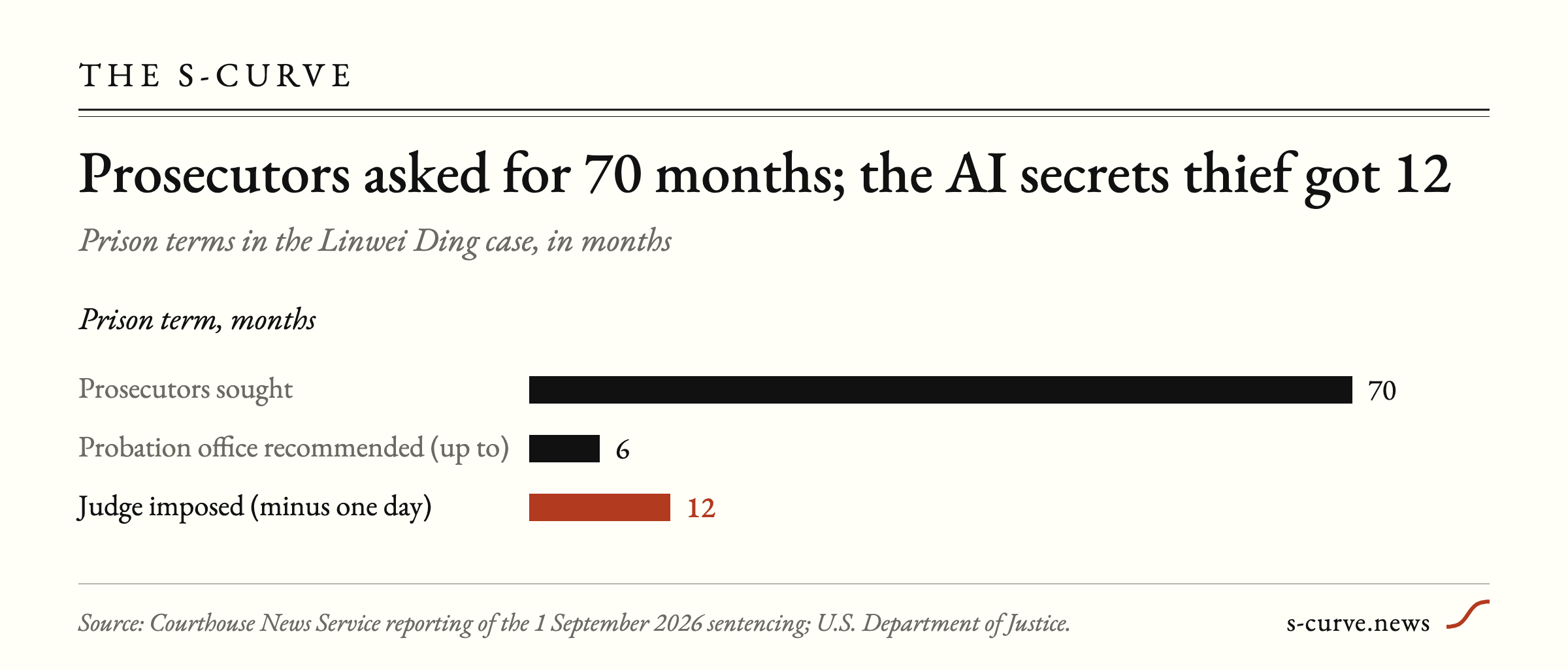
The theft convictions stood. On 1 September Chhabria sentenced Ding to 12 months minus one day, with two years of supervised release.Courthouse News: Ex-Google engineer who stole trade secrets sentenced to nearly 12 months. The government had sought 70 months. Assistant U.S. Attorney Casey Boom, for the prosecution, argued that “Insider trade secret theft is a calculated crime not done in the heat of passion”.
Ding’s lawyer said he would appeal, and the judge noted that an appeal could reopen the espionage acquittal.
The gap between the two sets of counts is the mechanism. Theft needs proof that protected files were taken; economic espionage also needs proof that the taker meant to benefit a foreign government at the time of the taking. Files copied to a personal account look the same either way, and conduct months later cannot fill that hole on its own.
Prevention moves inside the company
If courts are slow and the espionage charge is narrow, the practical defense is whatever a company can do before files leave. The Wall Street Journal reported in October, citing unnamed sources, that OpenAI trains employees on honey-pot approaches, bribes and eavesdropping, and tells them to use privacy screens, wipe whiteboards and avoid company-branded clothing in public.OpenAI’s blunt warning to employees about preserving company secrets.
Government policy points the same way. The White House’s July 2025 AI Action Plan names “security risks to American AI companies, talent, intellectual property, and systems”, and recommends that defense, homeland security and intelligence agencies work with leading AI developers to protect them from cyber actors and insider threats.America’s AI Action Plan (July 2025). In October 2026, Senators Jim Banks and Kirsten Gillibrand introduced an 18-page bipartisan bill that would have the Pentagon set reporting requirements and voluntary guidance for large frontier-AI contractors.DefenseScoop: Senate bill would expand DOD oversight of commercial frontier AI models. Banks said “our adversaries are working just as quickly to steal our most sensitive technology and exploit any weak link”.
Nvidia’s board is running the same kind of review at the top of a company: an investigation by independent directors with outside counsel.
Three dates will show how far it goes. Nvidia reports third-quarter earnings on 17 November, and the House briefing Huang was asked to attend is set for 18 November. In the Ding case, any appeal could decide whether the first AI espionage conviction comes back.
Sources
- Statement from NVIDIA Board of Directors
- A message to our company (Jensen Huang)
- DOJ: Former Google engineer found guilty of economic espionage and theft of confidential AI technology
- Focus Taiwan: sentence in TSMC 2nm trade-secret leak
- DefenseScoop: Senate bill would expand DOD oversight of commercial frontier AI models
- The Register: ex-ASML engineer jailed in the Netherlands
- Asia Economy: CXMT staff indicted over Samsung DRAM technology
- America's AI Action Plan (July 2025)
- CNBC: Nvidia investigates CEO Jensen Huang's relationship with alleged Chinese spy
- NBC News: Nvidia opens investigation
- Courthouse News: Judge acquits ex-Google engineer of economic espionage in AI secrets case
- Courthouse News: Ex-Google engineer who stole trade secrets sentenced to nearly 12 months
- OpenAI's blunt warning to employees about preserving company secrets
Disclosure
This article was drafted by S-Curve Desk, an AI system, from the sources above. Boaz Sobrado reviewed it before publication. Errors: the corrections log, or write to us.