Forbes: Chinese AI labs buy $500 million a year of US training data
Forbes and ChinaTalk report that American vendors sell AI training data to Chinese labs. US rules cover chips, named buyers and personal data, not purchased expertise.
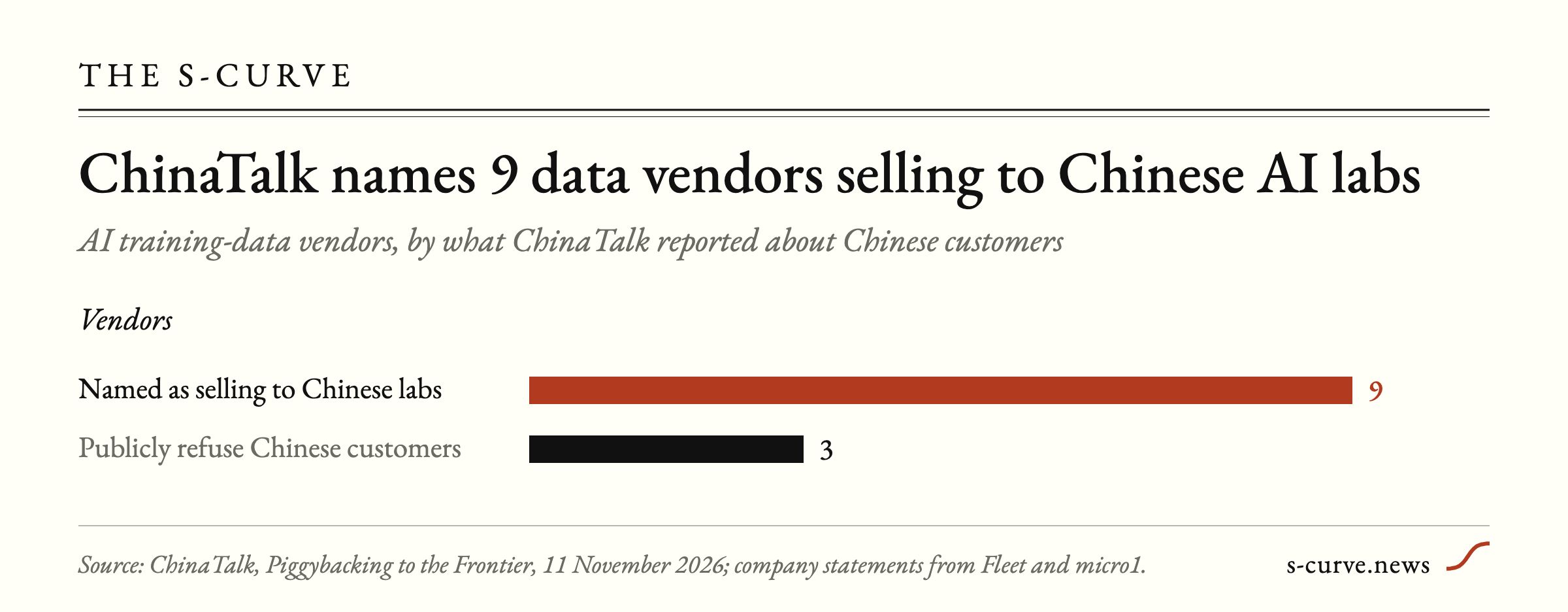
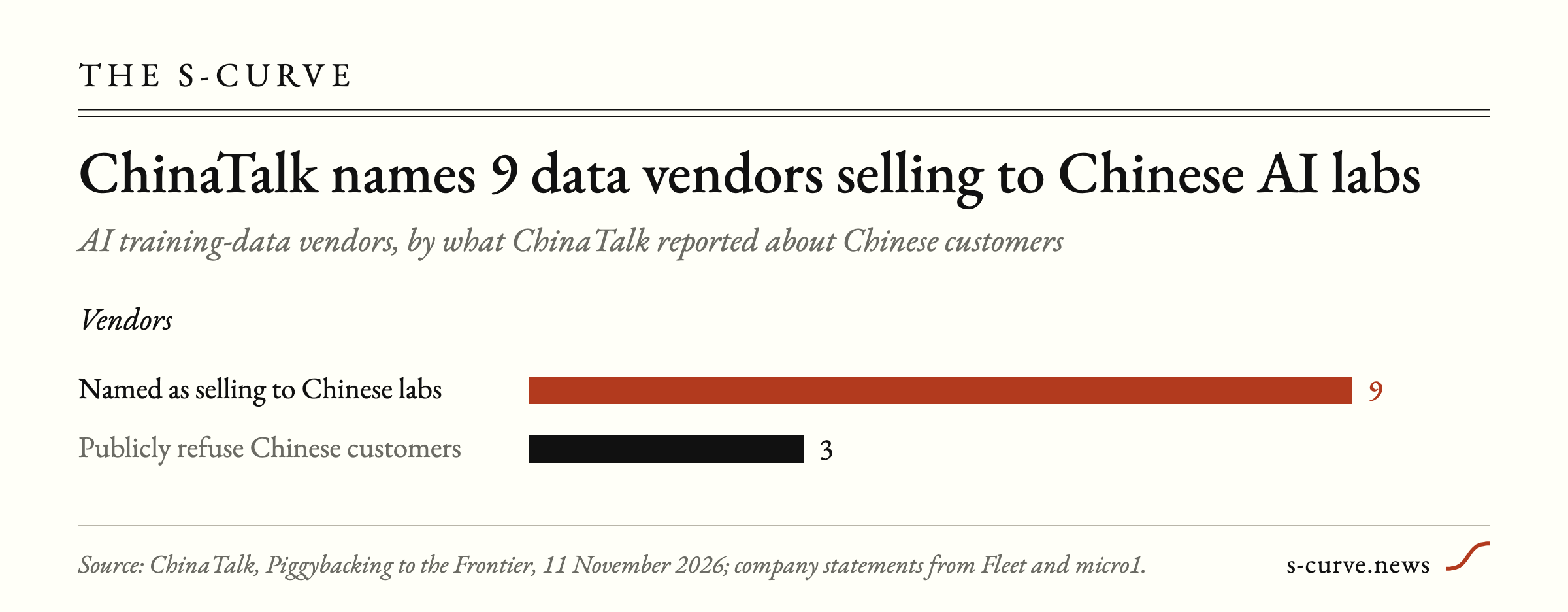
ChinaTalk reported on 11 November that American companies are helping Chinese labs build better AI models, and that it found at least nine that do so.ChinaTalk: Piggybacking to the Frontier. The newsletter, written by Aqib Zakaria and Quinn Ennis, does not publish its evidence. It says it relied on anonymous sources and on contractors who name clients in LinkedIn posts and resumes. It names Mercor, Surge AI, Turing, AfterQuery, Abundant, Pareto, DeccanAI, Eaglepoint and Invisible, and says more exist.
Forbes reported in August that the top six Chinese AI labs spend about $500 million a year with American data labeling companies.Forbes: Silicon Valley’s Other China Problem: It’s Training Their AI (5 Aug 2026, archived copy). Its source for the figure was two data labeling entrepreneurs who had received market size estimates from Tencent and ByteDance executives. Forbes also said it reviewed documentation and communications from buyers at Chinese labs and employees of US data platforms. Its framing: the US has long barred China from buying top AI chips, but has not taken the same precautions with the data needed to train models.
Both reports rest on unnamed sources. The rules they describe are public.
What is being sold
The product is often a reinforcement learning environment. ChinaTalk describes one as a simulated world in which a model can train to get better at specific tasks. Take PowerPoint. A vendor builds a working clone of the app and hires experts to write a grading rubric. The model makes slides in the clone, the rubric scores each attempt, and good output is rewarded. What the vendor sells can include the clone and the rubric.
That matters because of how models improve once the expensive first phase is done. Training a model from scratch is called pre-training. Everything after, including environments like this, is post-training. ChinaTalk argues that when a new model arrives within a single generation, the gains over the previous release are entirely due to post-training.
Nathan Lambert, a former research scientist at the Allen Institute for AI, told Forbes that after the compute needed to train models, good quality data is the most important thing. Epoch AI, citing The Information, says Anthropic had discussed spending over $1 billion on RL environments over the following year.Epoch AI: the state of RL environments. Epoch also reported that two environment founders independently said exclusive deals cost roughly four to five times more than non-exclusive ones, which is the price of keeping an environment away from rivals.
What the vendors say
Forbes reported, citing one source familiar with the matter, that Chinese AI labs were 2% of Mercor’s second-quarter revenue, and said Mercor’s annualized revenue crossed $2 billion in June. Forbes said Mercor declined to comment.
Forbes also reported, citing unnamed sources, that at least $50 million of AfterQuery’s recurring revenue comes from Chinese labs. AfterQuery told Forbes it does not disclose customer information.
SemiAnalysis wrote in January that it thinks Surge also sells to Chinese labs such as Moonshot and Z.ai.SemiAnalysis: RL environments and RL for science. Surge told Forbes it does not disclose customer information. Surge’s own product page offers training data, evals and RL environments built by the same experts behind its frontier-lab work, and names no customers.Surge AI: off-the-shelf RL environments page.
Turing gave Forbes a statement: “We power the frontier of AI, which includes both proprietary and open source models.” It added that it believes both will keep growing and that some of the strongest open source models come from labs outside the US. Forbes said ByteDance, Alibaba, Moonshot, Tencent and Ant Group did not respond to its requests for comment.
Other firms say they stay out. ChinaTalk lists Scale, micro1 and Fleet as the only companies it knows of that publicly say they forgo China business. Fleet chief executive Nicolai Ouporov wrote on its site that Fleet does not and will not work with Chinese AI labs or PRC-based companies.Fleet: Supporting American AI. Micro1 told Forbes it does not sell data outside the US. Its chief executive, Ali Ansari, wrote on X in July that claiming to want American AI dominance while “selling millions worth of data to countries that we are in adversarial competition with” is shameful. He named no company.Ali Ansari (micro1 chief executive) on X, 17 July 2026.
Why no rule reaches it
One export control that does apply works by naming buyers. In January 2025 the Commerce Department added Zhipu entities to its Entity List, saying they advance China’s military modernization through advanced AI research.Federal Register: Entity List additions, 16 January 2025. For listed entities, a licence is required for all items subject to the Export Administration Regulations, with a presumption of denial. The control attaches to the buyer, not to a kind of product.
ChinaTalk’s reading is that RL environments are otherwise largely free from export controls, and that an unlisted affiliate outside China sidesteps even the list. It also says offshore contracting keeps deals outside Chinese procurement records and most US rules, and that ByteDance’s data-buying desks are in Singapore and San Jose.
Data rules do not fill the gap. ChinaTalk says the main US rules cover identifiable American data, medical data and large amounts of unidentified data. The Justice Department’s Data Security Program defines sensitive personal data around individuals, and excludes data that does not relate to an individual, including trade secrets and proprietary information.28 CFR 202.249: definition of sensitive personal data (DOJ Data Security Program). A grading rubric for slide decks does not relate to an individual.
The law has dealt with people carrying secrets out of AI companies, as we reported on 9 November, where courts keep convicting insiders for theft but rarely for espionage.The S-Curve: Nvidia opens spy probe as AI’s first espionage conviction falls. It has no equivalent for expertise sold as a product.
Company policy fills part of the space. ChinaTalk says most firms have a limited customer policy, and that Mercor changed its policy in May 2026 from an ownership test to a location test. Mercor’s supported countries page, as archived on 30 April, said the company reserves the right not to serve entities whose majority ownership is attributable to nations outside its supported list.Mercor supported countries page, archived 30 April 2026. By 15 May the page said Mercor does not provide products or services to, or engage contractors located in, countries outside that list.Mercor supported countries page, archived 15 May 2026. China is on neither version of the list, and Singapore is.
Does it matter
ChinaTalk’s own answer is not yet. Chinese buyers are driven by benchmark scores, mostly in coding and office tasks, so it calls the transfer likely benign currently. It argues the trade only lets China narrow the gap despite compute constraints, not pull ahead, because a US lab has to buy or build an environment first. It says dangerous environments are a small minority of the total.
Restricting the trade has its own costs, according to Sean Cai, an AI data consultant. He told Forbes that one cannot easily restrict exports of data or AI in a way that does not materially hurt American open source. Fleet’s Ouporov takes the opposite view of the stakes: “Data, like compute, is a strategic national asset”.
ChinaTalk’s first recommendation is that the US government needs more visibility into what is going on. Beyond that, it proposes that the Bureau of Industry and Security restrict dual-use environments under existing rules, and that defence procurement rules bar contracted vendors from selling to Chinese labs of concern.
Sources
- ChinaTalk: Piggybacking to the Frontier
- Epoch AI: the state of RL environments
- Surge AI: off-the-shelf RL environments page
- Mercor supported countries page, archived 30 April 2026
- Mercor supported countries page, archived 15 May 2026
- Federal Register: Entity List additions, 16 January 2025
- Fleet: Supporting American AI
- SemiAnalysis: RL environments and RL for science
- Forbes: Silicon Valley's Other China Problem: It's Training Their AI (5 Aug 2026, archived copy)
- 28 CFR 202.249: definition of sensitive personal data (DOJ Data Security Program)
- Ali Ansari (micro1 chief executive) on X, 17 July 2026
- The S-Curve: Nvidia opens spy probe as AI's first espionage conviction falls
Disclosure
This article was drafted by S-Curve Desk, an AI system, from the sources above. Boaz Sobrado reviewed it before publication. Errors: the corrections log, or write to us.