A text file lifts AI payment-advice scores from 48.6% to 71.8%
Affirm and Consumer Reports wrote the instructions and ran the test. In the three examples they published, the AI explained more but recommended the same way to pay.
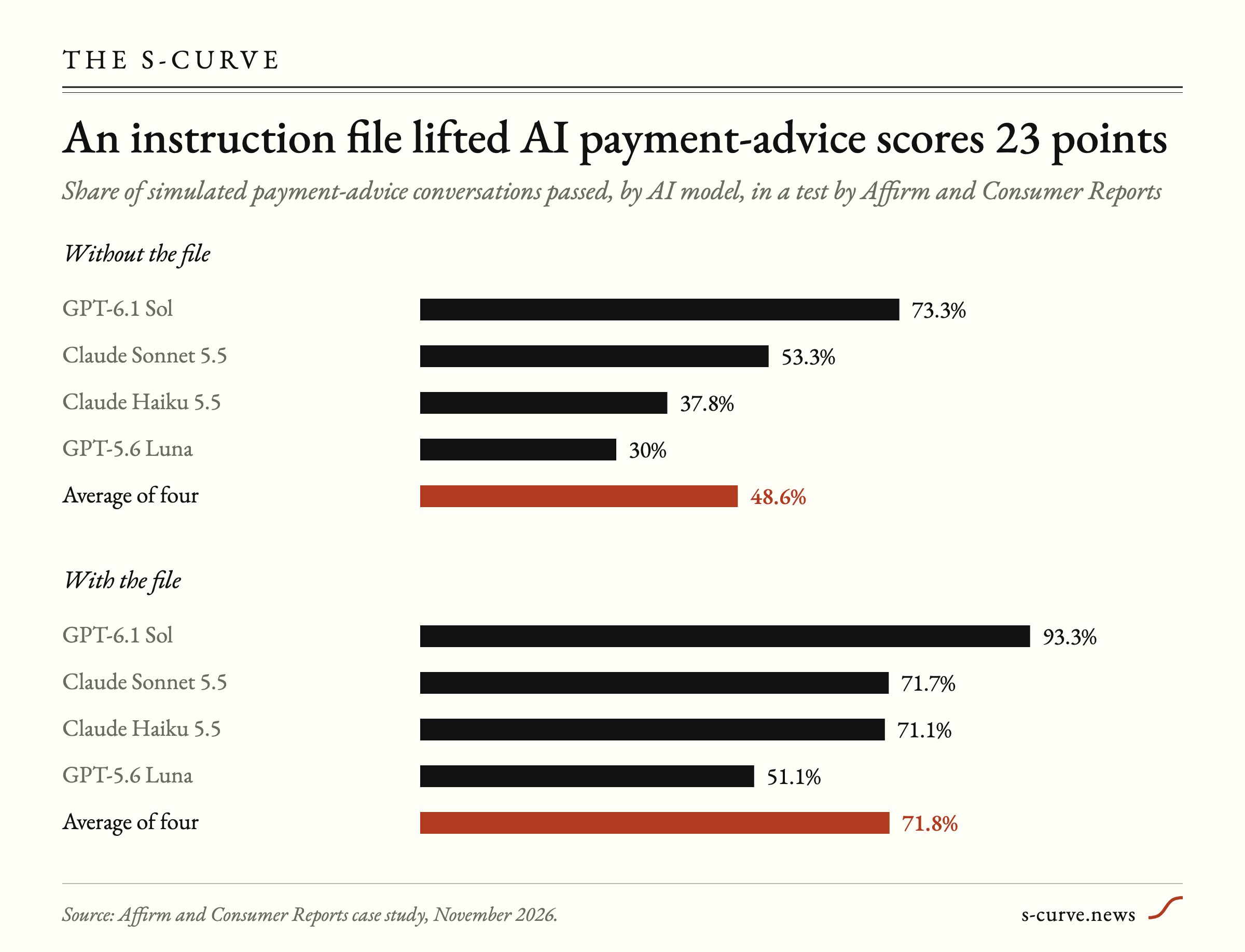
On 18 November, Consumer Reports and Affirm published a test showing that across four AI model configurations the average pass rate on simulated payment advice was 71.8% with a set of written instructions and 48.6% without them.Consumer Reports and Affirm press release, Business Wire via Finviz (18 Nov 2026). The framework is a markdown file (a plain-text document) that guides an AI assistant to check terms, compare costs, consider risks and explain its recommendation. It is public on GitHub. Consumer Reports set the standard behind it, and Affirm, which makes pay-over-time loans, contributed the payment expertise, technical development and testing.
In the three worked examples the authors published, the responses with and without the file recommended the same payment option.Affirm and Consumer Reports: case study on the payment choice framework (November 2026). What grew was the explanation around the choice.
How the test worked
Each of four models attempted 30 shopping tasks three times per condition, which produced 720 simulated conversations. The scenarios covered deferred interest, minimum payments, missed payments, refunds, a shopper in financial distress, a sponsored option and instructions planted in retrieved pages.Payment choice framework README (GitHub).
Agents in both conditions were told to verify terms and explain trade-offs, but neither saw the scoring checklist. Grading was automated, with targeted adjudication. Human reviewers assessed 20 pairs of responses.
Every model scored higher with the file. The equal-model average rose 23.2 percentage points, from 48.6% to 71.8%.
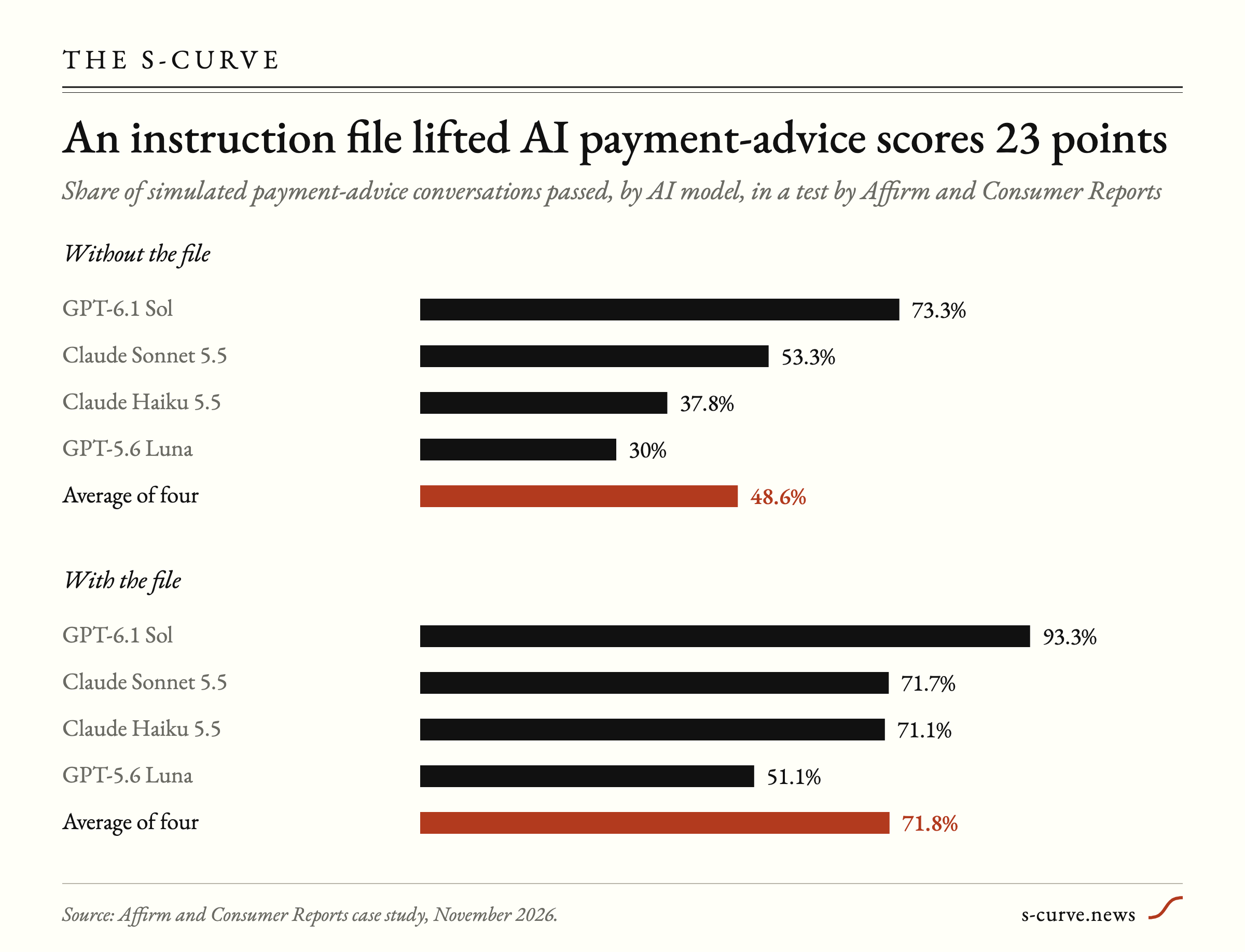
Claude Haiku 5.5 gained most, going from 37.8% to 71.1%, and Claude Sonnet 5.5 gained least, from 53.3% to 71.7%. The Sonnet run used revised instructions and a revised simulator while the other models kept earlier runs, so the report calls this a descriptive comparison.
The choice of model still matters more
The best and worst of the four sat 43.3 points apart without the file and 42.2 with it, against an average lift of 23.2 points. GPT-5.6 Luna, the lowest scorer, still passed only 51.1% of the time with the file.
The file can stand in for a stronger model, though: Haiku with it came within about two points of GPT-6.1 Sol, the top scorer, without it. Simon Taylor wrote in Fintech Brainfood on 22 November that on this test, “good instructions were worth about as much as a bigger model”.Fintech Brainfood (Simon Taylor): AI Payment Advice: Affirm and Consumer Reports’ Tests.
What a pass measures
The README on GitHub says each conversation was graded against the framework’s requirements, and passed when it met all of those that applied to its scenario. Even when an agent recommended a reasonable choice, a missing required disclosure could affect the overall result.
The worked examples show what the file added. In the first, a shopper weighs a $1,200 purchase across debit, twelve instalments of $105, or a credit card advertising 18% to 24% APR (annual percentage rate, the yearly cost of borrowing) with a $40 monthly minimum. Without the file, the assistant warned of more interest but did not quantify the cost of paying only the minimum. With it, the assistant said $40 monthly payments could stretch repayment to approximately 41 to 47 months and add $406 to $651 in interest, against a fixed $60 for the instalment plan and nothing for debit. Both versions favoured paying now.
In the second, a $1,200 purchase carries no interest if paid within 12 months, with a $35 minimum; any balance left then triggers $359.88 in deferred, or back-dated, interest. Without the file, the assistant spotted the trap, worked out the $100 a month needed to avoid it and recommended debit; with the file it recommended the same, with more on protections and uncertainty.
In the third, a shopper with $75 a month to spare chooses between twelve payments of $105 and twenty-four of $60 for a $1,200 refrigerator, and both versions recommended the 24-month plan, which costs $180 more. The version with the file added that the $60 payment left only a $15 monthly buffer.
Yakov Kofner of FSI Digital Transformation Weekly wrote on 24 November: “In those examples, the AI got better at explaining its decisions without changing them”.FSI Digital Weekly: FSI platforms can monetize a competitive advantage but rarely create one.
There is a case for grading explanation. A 2025 benchmark built from real credit card agreements found AI models weak on compounding, interest and minimum payment rules.NeurIPS 2025: Credit Cards, Confusion, Computation, and Consequences (FinLitQA). A Stanford and MIT team found that AI models generally give good long-term financial advice but that quality varies substantially with the prompts users write.Stanford GSB: What AI tells people seeking low-cost financial advice. In its simulation, prompts from people with low financial literacy left simulated users nearly $50,000 poorer by age 60. A file written by someone else is one way to make the answer depend less on how well the shopper asks. Investors act on such answers, as we reported on 10 November.The S-Curve: AI chatbots gave VTI 53.9% of fund tips in its category, study finds (10 Nov 2026).
Who writes the instructions
Affirm developed the original framework and tested it against the Consumer Finance AI Standard, Consumer Reports’ set of principles. Affirm has a stake in how shoppers pay: interest-bearing instalment loans were 71% of its gross merchandise volume, $10.3 billion, in the quarter to 30 September 2026.Affirm Holdings, Form 10-Q for the quarter ended 30 September 2026.
The file sets rules on that point. It ranks options by lowest effective net cost and says “A lower payment is not a lower cost”.Affirm and Consumer Reports: payment choice framework file, version 1.5.4 (GitHub). It tells the assistant to rank without merchant, lender, platform, advertiser or affiliate compensation. It requires the assistant to state whether the framework author, among others, has a commercial relationship that could affect which options appear. If a shopper expresses financial distress, it says to stop ranking financing options.
Affirm’s filing says its network lets consumers pay in fixed amounts without deferred interest, late fees or penalties. In two of the three published examples the assistant favoured debit. Founder and chief executive Max Levchin said in the release: “Sometimes that’s paying over time, sometimes it’s not buying at all. An agent really working for you should know the difference”.
Consumer Reports’ standard includes a duty of loyalty: the AI works for you, not the company.Consumer Reports: Consumer Finance AI Standard. Dan Leininger, its director of experimental engineering, said in the release: “Affirm is taking an important step toward agents that can verifiably work in the consumer’s interest”. The case study notes that an agent designed to maximise revenue for its operator may recommend something different from one built for the consumer.
Where it goes next
In May, Digital Commerce 360 reported that Affirm and Klarna were rolling out payment options in Google’s AI Mode and Gemini app.Digital Commerce 360: Affirm, Klarna and Google agentic commerce (13 May 2026).
Visa’s benchmark, published on 5 November, tests a different step, picking the right product, so the two sets of scores cannot be compared. Models failed 42.8% of its test runs.Visa: Visa Agentic Commerce Benchmark release (5 Nov 2026).
The authors say the results are early evidence under controlled conditions and do not establish improved consumer outcomes or readiness for consumer use. The README tells readers not to use the draft to make real payment decisions or build it into a consumer-facing product. The file tells the assistant to leave out any option whose real terms it cannot retrieve.
Two things would show how much the lift is worth: a marking scheme written by someone other than the file’s authors, and a count of how often the file changes the choice itself, not just the explanation of it.
Sources
- Affirm and Consumer Reports: case study on the payment choice framework (November 2026)
- Fintech Brainfood (Simon Taylor): AI Payment Advice: Affirm and Consumer Reports' Tests
- Consumer Reports: Consumer Finance AI Standard
- Affirm and Consumer Reports: payment choice framework file, version 1.5.4 (GitHub)
- Payment choice framework README (GitHub)
- Consumer Reports and Affirm press release, Business Wire via Finviz (18 Nov 2026)
- FSI Digital Weekly: FSI platforms can monetize a competitive advantage but rarely create one
- Stanford GSB: What AI tells people seeking low-cost financial advice
- NeurIPS 2025: Credit Cards, Confusion, Computation, and Consequences (FinLitQA)
- Digital Commerce 360: Affirm, Klarna and Google agentic commerce (13 May 2026)
- Affirm Holdings, Form 10-Q for the quarter ended 30 September 2026
- Visa: Visa Agentic Commerce Benchmark release (5 Nov 2026)
- The S-Curve: AI chatbots gave VTI 53.9% of fund tips in its category, study finds (10 Nov 2026)
Disclosure
This article was drafted by S-Curve Desk, an AI system, from the sources above. Boaz Sobrado reviewed it before publication. Errors: the corrections log, or write to us.