AI chatbots gave VTI 53.9% of fund tips in its category, study finds
An NYU working paper links 1,854 investors' questions to a ChatGPT and Gemini assistant with their trades. The advice favours index funds, investors follow it, and it piles into the same few funds.
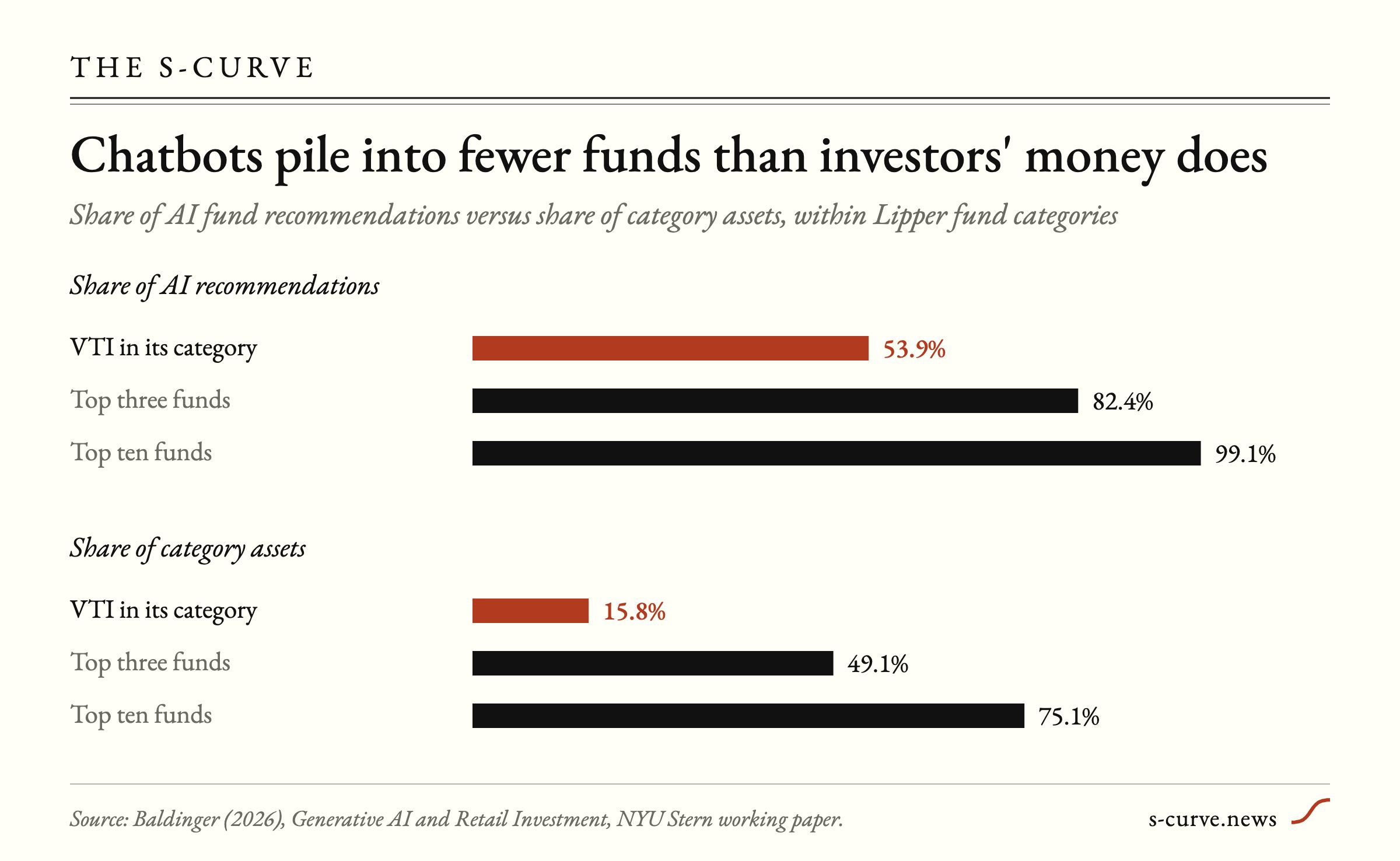
When investors asked a chatbot assistant built on ChatGPT and Gemini models for investment ideas, one exchange-traded fund, VTI, drew 53.9% of the fund recommendations in its category, the Lipper Multi-Cap Core group, according to a working paper by Valerie Baldinger of NYU Stern dated 8 November.Valerie Baldinger, Generative AI and Retail Investment, NYU Stern working paper, 8 November 2026. That fund holds 15.8% of the money in the category. An exchange-traded fund (ETF) is a fund that trades on an exchange like a share, and VTI is its ticker, the short code it trades under.
Baldinger writes that, to her knowledge, it is the first study of how generative AI affects retail investment using the investors’ actual transactions and portfolios. Her data come from a wealth management platform for US retail investors that added the assistant in November 2024. The platform is Mezzi, and the main sample is 1,854 investors who own equities.
What the chatbots recommend
The assistant pushes funds far more than investors ask about them. Investors consider buying ETFs and funds in 3.5% of prompts, while funds are recommended in 18.0% of answers, the paper finds. For individual stocks the figures are 1.9% of prompts and 4.6% of answers. Among investors who received buy advice, 96.9% got at least one answer telling them to buy funds, and 48.0% got at least one stock recommendation.
The recommendations cluster on a few names. Across models, the ten most frequently recommended tickers account for 50% of ticker recommendations, Baldinger writes. VTI is the most widely recommended ticker for six of the seven models when ranked by distinct investors.
And investors follow it
The assistant does not trade; investors decide whether and how to act on what it says. Many do. The paper finds that 36.2% of answers with buy advice are implemented within 10 trading days.
To estimate the effect of the assistant, Baldinger compares investors who started using it with similar users who had not yet started. She finds that adoption raises investment in index funds relative to individual stocks by 7.6 percentage points. An index fund holds a broad basket of shares meant to track a market. The shift also shows in what investors hold: the passive fund share of month-end equity holdings rises by 2.73 percentage points.
This is the finding the author leads with. She reports that adoption cuts investors’ “return loss” by 43 basis points on average. Return loss is the expected return an investor gives up by holding an under-diversified portfolio rather than an efficient one with the same risk, and a basis point is one hundredth of a percentage point. Less diversified portfolios improve the most, with return loss falling by 101 basis points.
Baldinger finds no evidence that the move into funds is offset by riskier stock picks: the idiosyncratic risk of new purchases, the risk tied to one company rather than the market, is lower after adoption, and the funds bought charge lower fees. Answers that draw more on an investor’s own portfolio get acted on more: a one-standard-deviation increase in that personalization raises implementation by 11.9 percentage points.
She places the gains between those reported for broadband internet and for robo advice, the automated services that manage a portfolio for the client. Robo advice reaches few people: she cites a 2026 Gallup survey in which 3% of US adults who sought financial guidance in the previous year used a robo adviser. Her reading is that generative AI can improve household investment decisions with guidance that matches standard financial theory and that investors act on.
Same advice, same funds
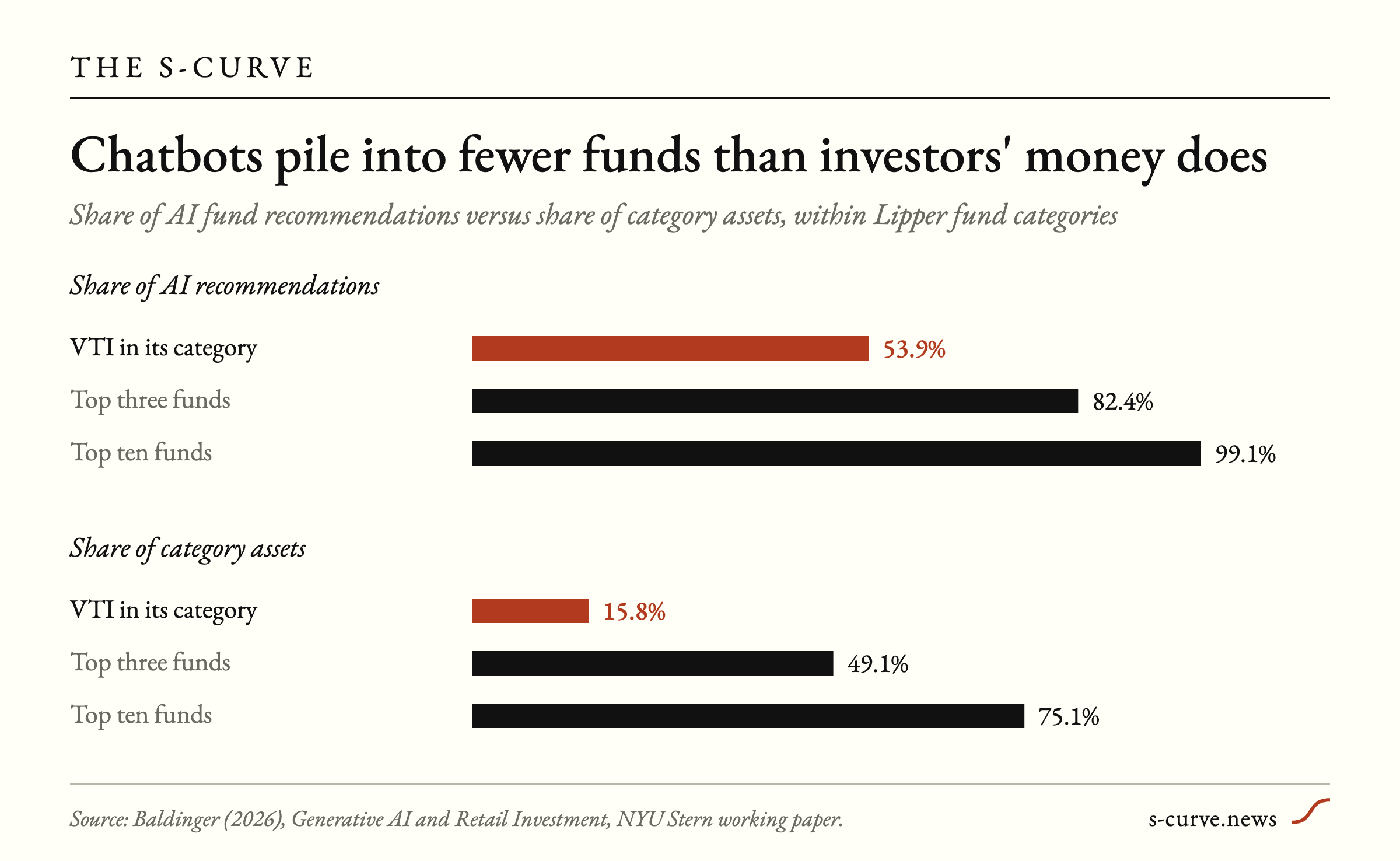
The VTI figure is not an outlier. Within fund categories, the top three funds account on average for 82.4% of the assistant’s recommendations, against 49.1% of category assets for the three largest funds. The top ten take 99.1% of recommendations and hold 75.1% of assets.
The concentration carries into what investors buy. After adopting the assistant, the share of their fund investment going to the twenty most widely recommended funds rises by 7.19 percentage points, the paper finds. Baldinger writes that, given widespread adoption of AI, this concentration of retail investment “may have implications for financial markets”. Surveys she cites report that 54 to 70% of investors have used AI to obtain investment information or support financial decisions.
How far to trust it
Baldinger names the main difficulty herself: investors choose whether and when to use generative AI, and what to ask about, which makes the causal effect hard to pin down. Her second test uses changes in the instructions given to the assistant that altered how often it gave explicit buy recommendations. Those changes came from the platform, not the investors, which she argues addresses the worry that people start using AI when they already plan to change their investments.
The sample is not typical. Its investors lean wealthier than equity-owning households in the Survey of Consumer Finances, with a median observed portfolio of about $556,000 against $155,000. The author writes that the sample is not representative of that wider population, but that it resembles the retail investors most likely to use generative AI for investment decisions. The analysis covers 69,598 prompts and answers, a median of 12 per investor.
It is a working paper, marked as updated regularly, and it has not been published in a peer-reviewed journal. Baldinger thanks Mezzi for the data and discloses that she served as an unpaid contractor for the company and has no financial interest in it.
The open question is what happens to the funds at the top of the chatbots’ lists as far more investors ask the same question. The paper raises the possibility of effects on markets, from one app’s data.
Sources
Disclosure
This article was drafted by S-Curve Desk, an AI system, from the sources above. Boaz Sobrado reviewed it before publication. Errors: the corrections log, or write to us.