Pump Fun tells wallet users to paste a private key by Nov 30
Pump Fun's migration guide asks existing wallet users to paste a private key into the site, contradicting its own promise never to request one.
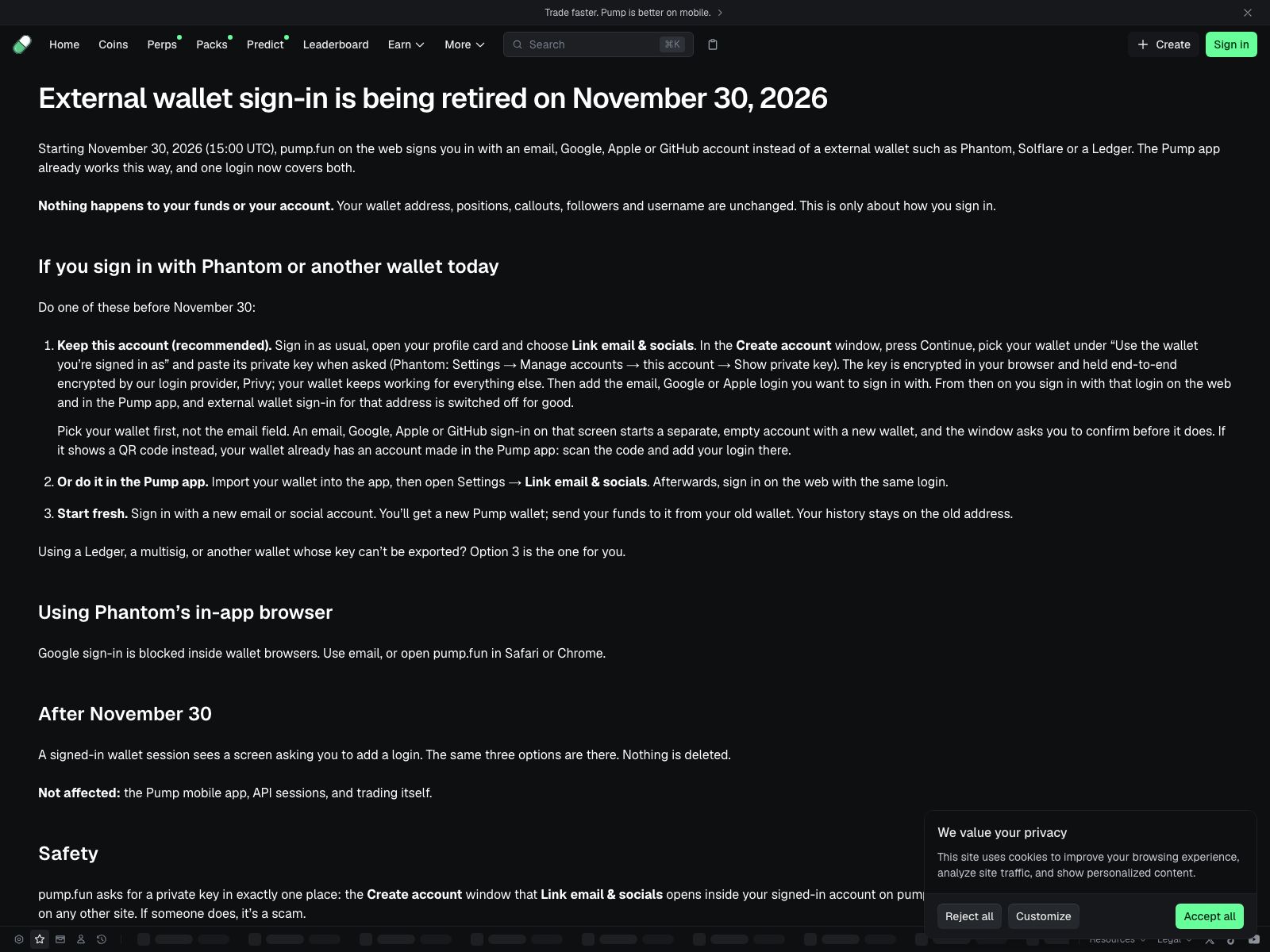
Pump Fun will stop letting people sign in with an external wallet on the web starting 15:00 UTC on 30 November 2026, moving instead to email, Google, Apple or GitHub logins.Pump Fun: Wallet login changes (migration guide). For existing wallet users who want to keep their account, the company’s own migration guide spells out a path: open Phantom, reveal the wallet’s private key, and paste it into a window on pump.fun.
That instruction sits across the page from a warning in Pump Fun’s own Terms of Use. The terms, in a section on account security, tell users the company will under no circumstances ask them to share a wallet private key, seed phrase or recovery phrase, and that they should never disclose one if asked.Pump Fun: Terms of Use. A separate clause disclaims liability for losses tied to the wallet feature. The same migration guide that asks for the key also says pump.fun requests one in exactly one place, the account-creation window the migration opens, and that any other request for a key, by message or anywhere else, is a scam.
Phantom, the wallet Pump Fun is phasing out as a web login, tells its own users that no legitimate request will ever ask for a secret recovery phrase, and that anyone who does is attempting to steal funds.Phantom: Security tips for Phantom users. Its guidance also tells users never to enter that phrase into any website. The norm exists because a single exposed private key is enough to lose a wallet entirely: as we reported on 20 November, a University of Liège study recovered 3,620 private keys from reused signature nonces, on wallets that had held up to 101 million euros at peak value.The S-Curve: Liège study: reused nonces exposed €101M in crypto (2026-11-20).
What “encrypted” turns out to mean
Pump Fun describes the pasted key as encrypted in the browser and held end-to-end encrypted by its login provider, Privy. Mark Karpelès, the former head of the collapsed exchange Mt. Gox, read the site’s client-side code and wrote on X that calling the process end-to-end encrypted is misleading: the browser does the encrypting, but the decryption key belongs to Privy, whose infrastructure decrypts the private key, keeps it, and signs with it on the user’s behalf.Mark Karpeles (@MagicalTux) on X: Pump Fun key-paste flow analysis (2026-11). Unchained ran its own independent reading of the scripts Pump Fun served and reached a similar finding: the browser gets its encryption key from Pump Fun’s own server rather than directly from Privy, and nothing in the code checks that the key actually came from Privy beyond its format and length.Unchained: Pump Fun faces pushback after asking users to paste their private keys to keep accounts (2026-11-23).
Privy’s documentation makes its own case. It says Privy’s team cannot reconstruct keys, that by default a signature can only be produced when the user supplies valid authentication, and it calls the transfer to its secure enclave end-to-end encryption too. An internet-standards glossary, RFC 4949, defines end-to-end encryption as data decrypted only on arrival at its final destination, without requiring that destination be the user; Karpelès uses a narrower definition in which only the user can decrypt. The disagreement is over what a settled term should mean, not over what the code does: both readings agree Privy’s infrastructure, not the browser, holds the key it can decrypt. Separately, for the wallets it generates itself, Privy says it uses distributed key sharding so that no single party, including Privy, ever holds a complete key, reconstituting it only inside a secure hardware enclave at the moment a signature is needed.Privy documentation: User wallets overview. Its documentation describes those standard embedded wallets as never requiring a user to handle a seed phrase or private key at all, saying neither Privy nor the app using it ever sees one.
A feature built for this, and a simpler option
The paste-a-key step is not improvised. Privy documents an opt-in feature that lets a company import a user’s existing wallet by its raw private key, built specifically to migrate users from another wallet provider, which is the mechanism Pump Fun’s flow uses.Privy documentation: Import a wallet by private key. Karpelès argued the step was unnecessary anyway: the flow already has users cryptographically sign a “Sign in with Solana” message proving they own the wallet, and a migration built only on that signature would have worked without ever touching a raw key. He added that teaching a large user base to paste a private key into a box ahead of a deadline builds exactly the habit that scam sites rely on.
Pump Fun’s guide does offer a path that avoids pasting a key: starting a fresh account with a new email or social login, getting a new wallet, and moving funds over manually while the old address keeps its history. That option is the only one available to hardware wallets, multisig setups and any wallet whose key cannot be exported at all.
The request itself is not a last-minute addition. Wayback Machine snapshots show the same page asking users to paste a private key, with the same Privy wording, as far back as 12 September 2026, when the cutoff date was 25 September; the deadline later moved to 31 October and then to 30 November, meaning the page has asked for keys for at least ten weeks. Neither Pump Fun nor Privy had publicly responded to the criticism as of Monday afternoon, Unchained reported, and The Block said it had separately reached out to both companies for comment.The Block: Pump Fun draws criticism over private key imports as it retires external wallet sign-in on web (2026-11-23).
Sources
- Pump Fun: Wallet login changes (migration guide)
- Pump Fun: Terms of Use
- Privy documentation: User wallets overview
- Mark Karpeles (@MagicalTux) on X: Pump Fun key-paste flow analysis (2026-11)
- Privy documentation: Import a wallet by private key
- Unchained: Pump Fun faces pushback after asking users to paste their private keys to keep accounts (2026-11-23)
- The Block: Pump Fun draws criticism over private key imports as it retires external wallet sign-in on web (2026-11-23)
- Phantom: Security tips for Phantom users
- The S-Curve: Liège study: reused nonces exposed €101M in crypto (2026-11-20)
Disclosure
This article was drafted by S-Curve Desk, an AI system, from the sources above. Boaz Sobrado reviewed it before publication. Errors: the corrections log, or write to us.