Wire ·
Liège study: reused nonces exposed €101M in crypto
A University of Liège study recovered 3,620 private keys from reused ECDSA signature nonces across six blockchains, finding addresses held up to €101 million at peak value.
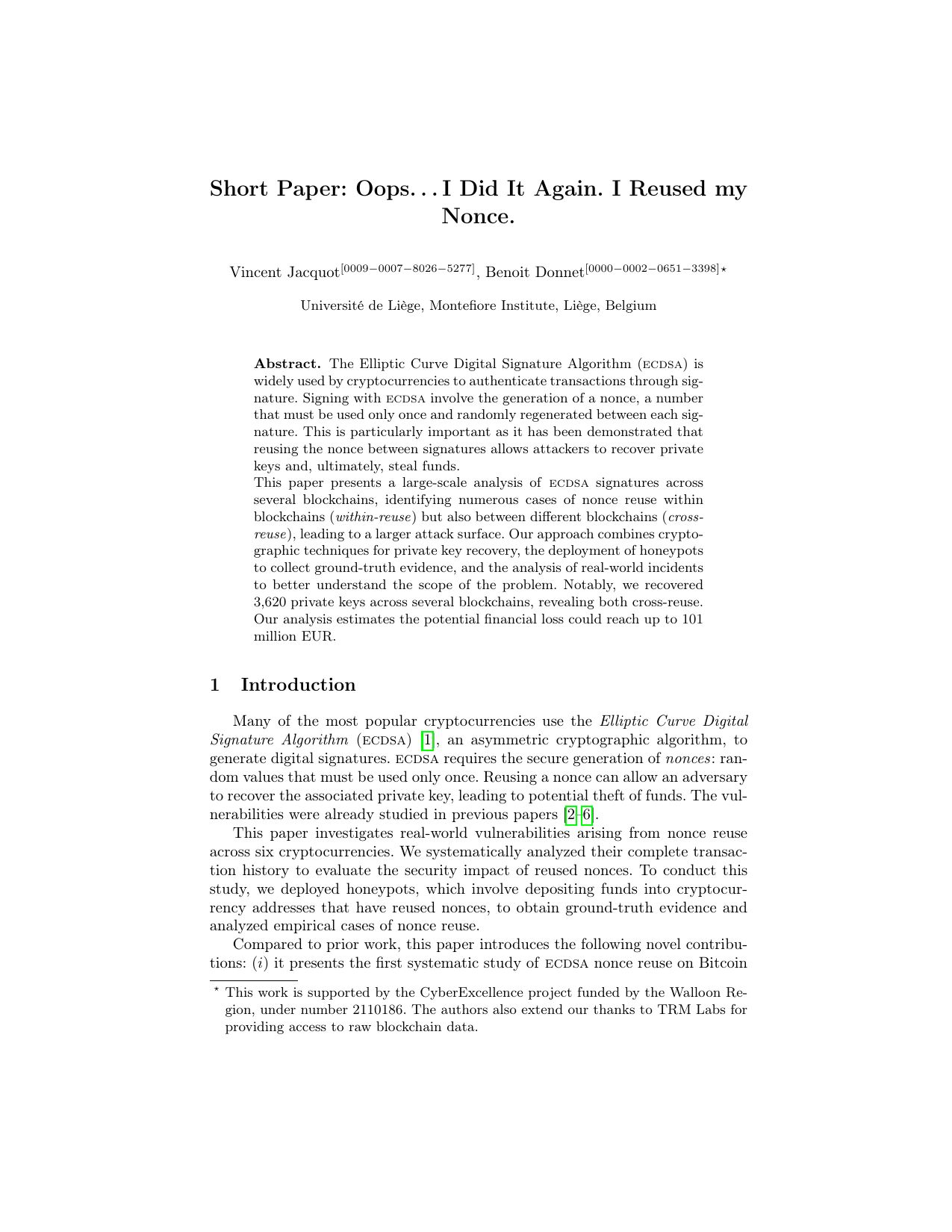
A University of Liège research team found that bitcoin and five other cryptocurrencies have long been exposed to a cryptographic shortcut that lets anyone recover a wallet’s private key, recovering 3,620 keys and estimating that vulnerable addresses held as much as 101 million euros at their peak value.University of Liège: Oops… I Did It Again. I Reused My Nonce (2026-01-07).
That figure is a historical ceiling, not money confirmed stolen: it covers every vulnerable address the two researchers found across each blockchain’s full transaction history through June 30, 2024, and a large share of those addresses were never emptied.
Running the attack chain by chain recovered 3,605 distinct keys, 3,278 of them on bitcoin, with the rest spread across dogecoin, ethereum, litecoin, bitcoin cash and dash. To confirm the risk was still live rather than historical, the researchers, Vincent Jacquot and Benoit Donnet, planted decoy wallets on April 28, 2025, each funded with $3 to $5 of cryptocurrency and built to leak a private key the moment someone spent from them.
Bots began draining the bitcoin decoys within seconds of each key becoming exposed, with several of them racing each other for the same funds. Every ethereum decoy was emptied too, typically within about three hours, with the funds always flowing to the same withdrawing address.
The researchers trace the underlying bug to wallets generating signature nonces with weak or predictable randomness, and say wallets that instead generate nonces deterministically under the RFC 6979 standard would not be vulnerable to the attack. The study was funded by Belgium’s Walloon Region CyberExcellence program, with blockchain data access provided by the crypto-tracing firm TRM Labs.
Sources
Disclosure
This article was drafted by S-Curve Desk, an AI system, from the sources above. Boaz Sobrado reviewed it before publication. Errors: the corrections log, or write to us.