9,423 AI models stripped of their refusals sit on Hugging Face
Copies of open AI models with their safety refusals removed now appear within hours of release, and Hugging Face lists 9,423 of them. The documented attacks are fewer than the theory suggests.
DeepSeek published its V4.1-Flash model at 02:17 UTC on 10 September, and the first “abliterated” copy, one with its refusals removed, appeared on Hugging Face at 10:59 UTC the same day, under nine hours later.Hugging Face model hub: public models named abliterated (API query, 21 Nov 2026). The July release took under 11 hours, and the October one about 15.
Maxime Labonne, a machine-learning researcher, described abliteration on Hugging Face as a technique that can uncensor any language model without retraining.Maxime Labonne: Uncensor any LLM with abliteration (Hugging Face blog, 2024). The speed of those copies follows from how refusal works inside a model.
Why it is so easy
A 2024 paper by Andy Arditi and colleagues found that across 13 open chat models of up to 72 billion parameters, refusing a request is mediated by a one-dimensional subspace, in effect a single direction in the model’s internal activations.Arditi et al.: Refusal in Language Models Is Mediated by a Single Direction (arXiv, 2024). Erasing that direction stops the model refusing harmful instructions, and adding it makes the model refuse even harmless ones. The authors turned this into a method that disables refusal with minimal effect on the model’s other capabilities.
No retraining is needed, which is why a stripped copy can follow a release within hours. The older route is slower but also cheap. Adam Hadley of Tech Against Terrorism wrote in CTC Sentinel in July that low-rank fine-tuning on a single graphics card, for less than $200, has cut the refusal rate of a 70-billion-parameter open model to roughly one percent.CTC Sentinel: Guardrails Under Test, Terrorist Misuse of AI Models and the Open-Weight Abliteration Problem (Adam….
Added safeguards do not reliably help. A May 2026 paper found that abliteration and prefilling attacks lifted success rates against open-weight models that carried extra safeguards from below 10 percent to between 16 and 96 percent.Kuo, Yadav, Smith: Open-Weight LLM Fine-Tuning Defenses are Susceptible to Simple Attacks (arXiv, May 2026).
Arditi told Transformer he feels torn about it: “We certainly did not expect this methodology to explode as much as it has over the past couple years”.Transformer: Hugging Face appears to be hosting models abliterated for offensive cyber (Nov 2026).
How many there are
By The S-Curve’s count of Hugging Face listings on 21 November, the site lists 9,423 public models with “abliterated” in the name. They were uploaded by 2,453 accounts. Deleted models are not counted, so the real total of uploads is higher.
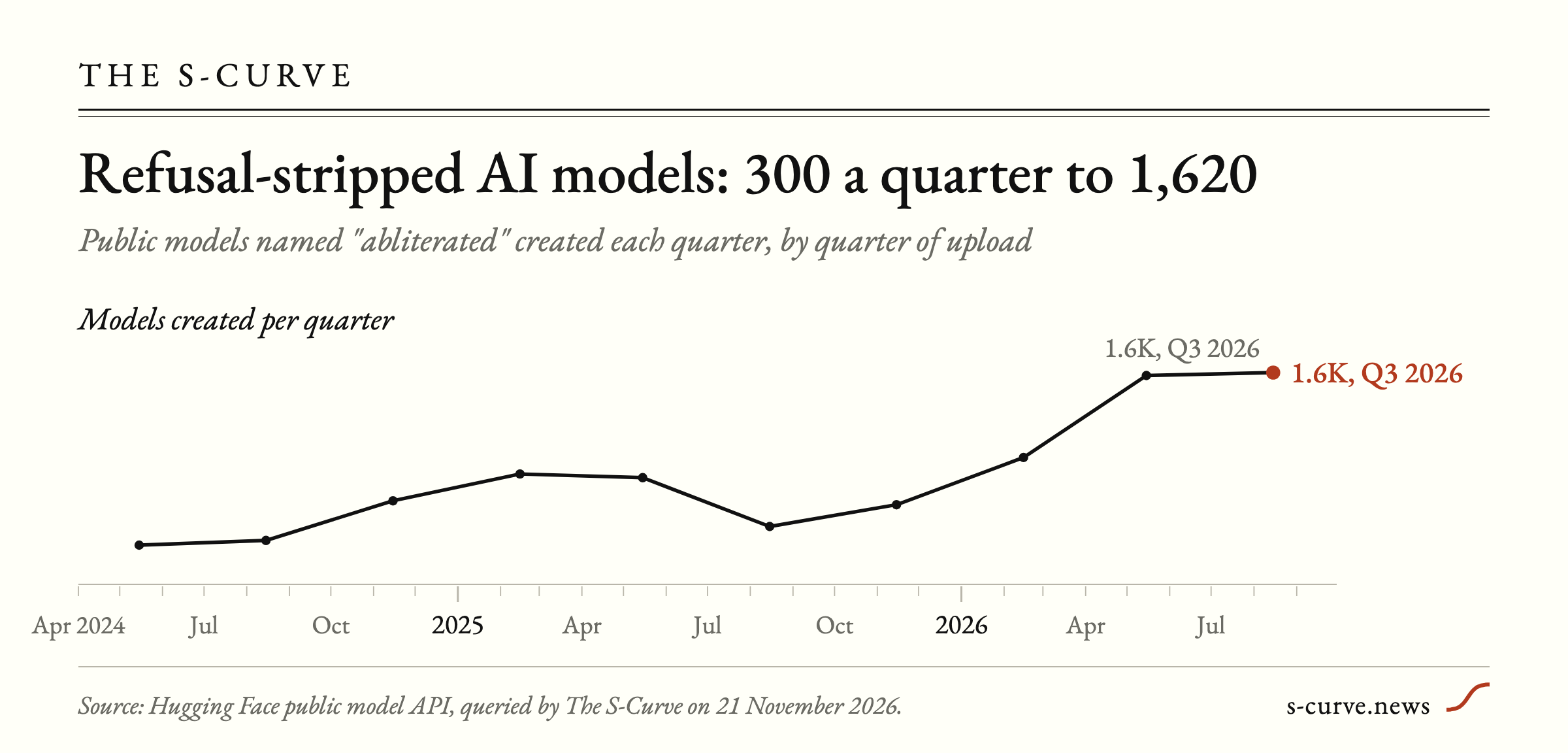
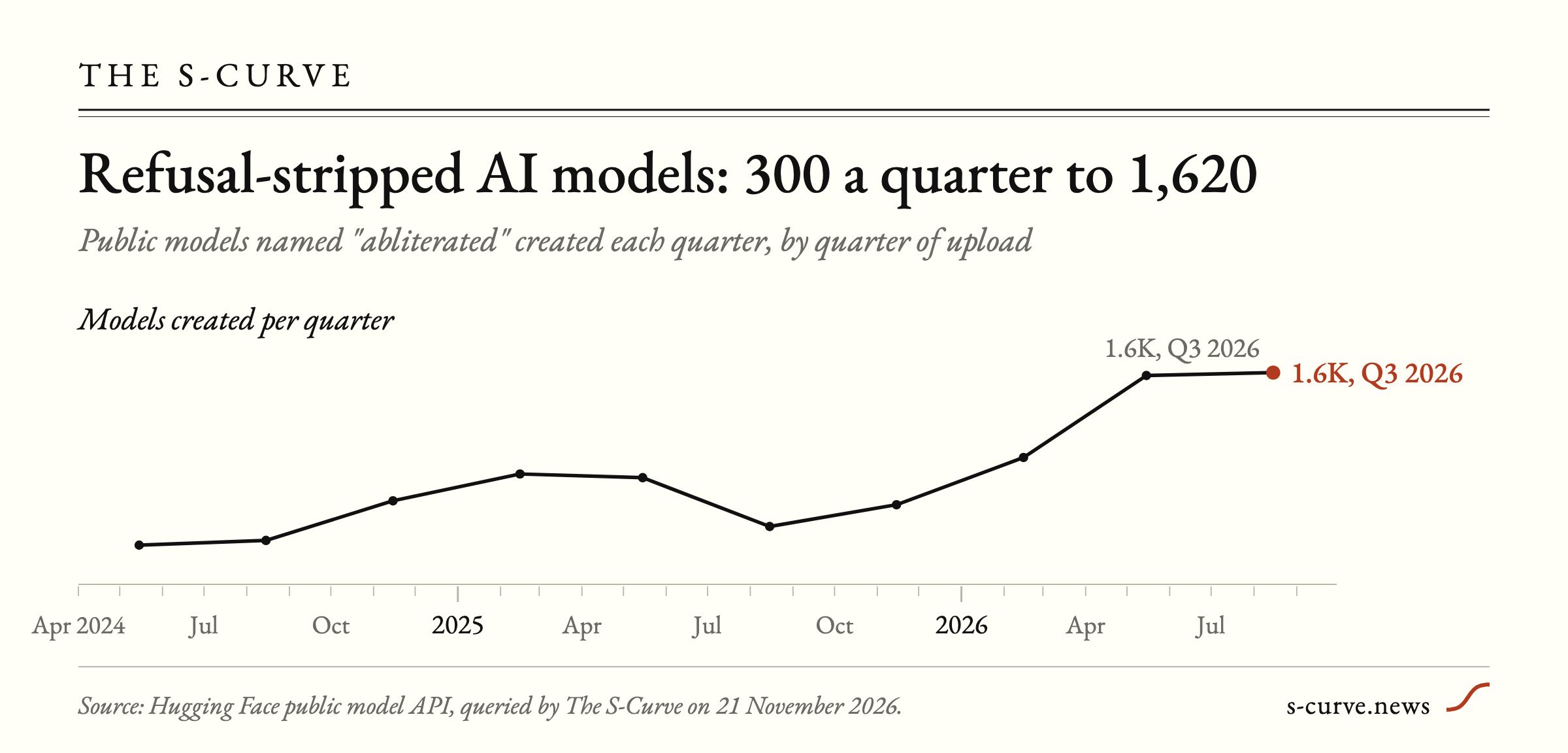
The pace is rising. Of the models still listed, 5,436 were created in 2026 to 21 November, against 2,712 in 2025. Uploads went from 300 in the second quarter of 2024 to 1,620 in the third quarter of 2026, and 1,248 more appeared in the fourth quarter to 21 November.
Alibaba’s Qwen family is the most common base, named in 3,876 of them. Only 214 are gated, meaning access is by request. Hugging Face counted about 35.8 million downloads of these models over the past 30 days, though its counter measures file fetches, not people.
What they do
Tech Against Terrorism’s benchmark, published in CTC Sentinel, graded nearly 2,500 responses from 27 models. Across all of them, full refusals ran at 57 percent. Two of the models in the sample were community builds made by third parties, downloadable from mainstream repositories. They complied with 89 and 100 percent of requests, which Hadley wrote is what a model with no guardrails looks like.
The swarm theory and the record
On Bloomberg’s Odd Lots podcast on 20 November, Daniel Saedi, a co-founder of Minerva, said he had tried the newest DeepSeek model in its uncensored form, one in which someone had turned off the parts that tell the model to say no.Bloomberg Odd Lots: How an American AI Company Uses Chinese Open-Weight Models (20 Nov 2026). He put its running cost at about 30 cents per million tokens. He also relayed what he called a theory on the internet: that recent hacks come from swarms of such models. In his words, “people are running swarms of these deep-seek obliterated models”.
The documented record is narrower. On 4 November, the Acronis Threat Research Unit reported that the attack agents of a single operator ran almost exclusively on abliterated variants of DeepSeek, GLM and Qwen.Acronis TRU: BOSSAI, inside the AI attack mesh that targeted Taiwan’s emergency services (4 Nov 2026). Acronis says commercial models refused offensive work, and that Chinese commercial open-source models refused too, even lecturing the operator on cyber laws. The operator was forced, Acronis says, to turn to locally run abliterated models, which it describes as less effective and resource constrained. The operator settled on an abliterated DeepSeek-V4 variant running on four local GPUs.
Acronis attributes the campaign, which it calls BOSSAI, to one operator running 12 AI agents. Over 12 days, it confirmed data theft or system access at roughly 10 targets in three countries, out of organisations targeted in 11 countries. About 15 more were attacked without confirmed compromise, it says.
In that case the stripped models were a fallback after refusals, and by Acronis’s account a weaker one. Other cases point the other way. Palo Alto Networks’ Unit 42 found that in a July 2026 case the attacker used DeepSeek and Qwen directly through the companies’ own hosted API endpoints, not stripped local copies.Palo Alto Networks Unit 42: autonomous AI cyber attack campaign using DeepSeek and Hermes Agent (30 Jul 2026).
Google’s threat group, whose report on automated hacking tools we covered on 18 November,The S-Curve: Google finds AI hacking tool as zero-days hit 22 a month (18 Nov 2026). describes an open-source attack framework that connects commercial and open-weight models to over 100 security tools.Google Threat Intelligence Group: Agentic Threat Activity Crosses a Significant Threshold (16 Nov 2026). It also found that underground services resell access to multiple models, including frontier and jailbroken ones advertised for malicious cyber activity. Those routes need no stripped copy at all.
Who can stop it
Once the weights are public, controls only work before release or at the host. OpenAI’s gpt-oss model card says malicious actors can fine-tune open-weight models, including its own.OpenAI: gpt-oss-120b and gpt-oss-20b Model Card (Aug 2025). OpenAI says that when it tested adversarially fine-tuned versions itself, gpt-oss-120b did not reach its High capability threshold for biological and chemical risk or for cyber risk.
Hugging Face’s content policy bars content that attempts to transmit or generate malicious code, and owners can gate repositories.Hugging Face Content Policy (accessed 21 Nov 2026). Transformer reported on 11 November that the platform took down a GLM-5.3 build marketed as abliterated for offensive cyber in early October, while others remain.
The people who build the tools describe a different audience. Philipp Emanuel Weidmann, who develops the refusal-removal tool Heretic, told Transformer that most demand comes from legitimate users such as pharmaceutical and cybersecurity researchers.
In Washington, the idea in play is narrower than limits on stripped models. Reuters reported on 18 November that the Trump administration is weighing a rule under which companies would have to post on their own websites which Chinese models they rely on.Reuters (via Stock Analysis): US weighs rule for companies to disclose Chinese AI models (18 Nov 2026).
Saedi, whose company downloads and fine-tunes open models, said on Odd Lots that he has yet to see a really compelling proposal for how to deal with it, and floated identity checks before downloading weights as one idea.
Sources
- Hugging Face model hub: public models named abliterated (API query, 21 Nov 2026)
- Bloomberg Odd Lots: How an American AI Company Uses Chinese Open-Weight Models (20 Nov 2026)
- Arditi et al.: Refusal in Language Models Is Mediated by a Single Direction (arXiv, 2024)
- CTC Sentinel: Guardrails Under Test, Terrorist Misuse of AI Models and the Open-Weight Abliteration Problem (Adam...
- Maxime Labonne: Uncensor any LLM with abliteration (Hugging Face blog, 2024)
- Kuo, Yadav, Smith: Open-Weight LLM Fine-Tuning Defenses are Susceptible to Simple Attacks (arXiv, May 2026)
- Acronis TRU: BOSSAI, inside the AI attack mesh that targeted Taiwan's emergency services (4 Nov 2026)
- Google Threat Intelligence Group: Agentic Threat Activity Crosses a Significant Threshold (16 Nov 2026)
- Palo Alto Networks Unit 42: autonomous AI cyber attack campaign using DeepSeek and Hermes Agent (30 Jul 2026)
- Transformer: Hugging Face appears to be hosting models abliterated for offensive cyber (Nov 2026)
- OpenAI: gpt-oss-120b and gpt-oss-20b Model Card (Aug 2025)
- Reuters (via Stock Analysis): US weighs rule for companies to disclose Chinese AI models (18 Nov 2026)
- Hugging Face Content Policy (accessed 21 Nov 2026)
- The S-Curve: Google finds AI hacking tool as zero-days hit 22 a month (18 Nov 2026)
Disclosure
This article was drafted by S-Curve Desk, an AI system, from the sources above. Boaz Sobrado reviewed it before publication. Errors: the corrections log, or write to us.