Google finds AI hacking tool as zero-days hit 22 a month
Google's threat researchers say they found an AI framework that fully automates finding and exploiting software bugs, with zero-day exploits up sharply this year.
Google’s threat intelligence researchers say they found a hacking tool that finds a software bug, writes an exploit for it and fires that exploit, with no person involved at any step.Google Threat Intelligence Group: Agentic Threat Activity Crosses a Significant Threshold (16 Nov 2026). The Google Threat Intelligence Group (GTIG) and Mandiant call it the first time they have seen the whole chain, from discovery to weaponization, fully automated.
GTIG found the tool, which its operator named exploit_agent, sitting on an exposed staging server. It is a multi-agent framework built to work with several frontier and local AI models at once. Its job is to continuously compare a piece of popular web software’s code from just before and just after a patch comes out, work out from that difference which bug the patch fixed, then draft and run a working exploit against it. A configuration file on the server carried comments in Russian; one, translated by Google, reads “LLM API keys for auto-exploitation (exploit_agent pilot)”. Google stops short of tying the tool to a government, saying only that the comments point to a Russian-speaking operator. Victim data left on the server suggests whoever ran it was focused on French media, entertainment and education websites. Google says this focus on patched bugs, rather than undiscovered ones, is the efficient path for an attacker: a patch hands over a finite, ready-made set of material to study, the code from just before and after the fix, release notes and proof-of-concept writeups, while hunting a true zero-day from scratch means casting a far wider net.
The window is shrinking, in Google’s own numbers
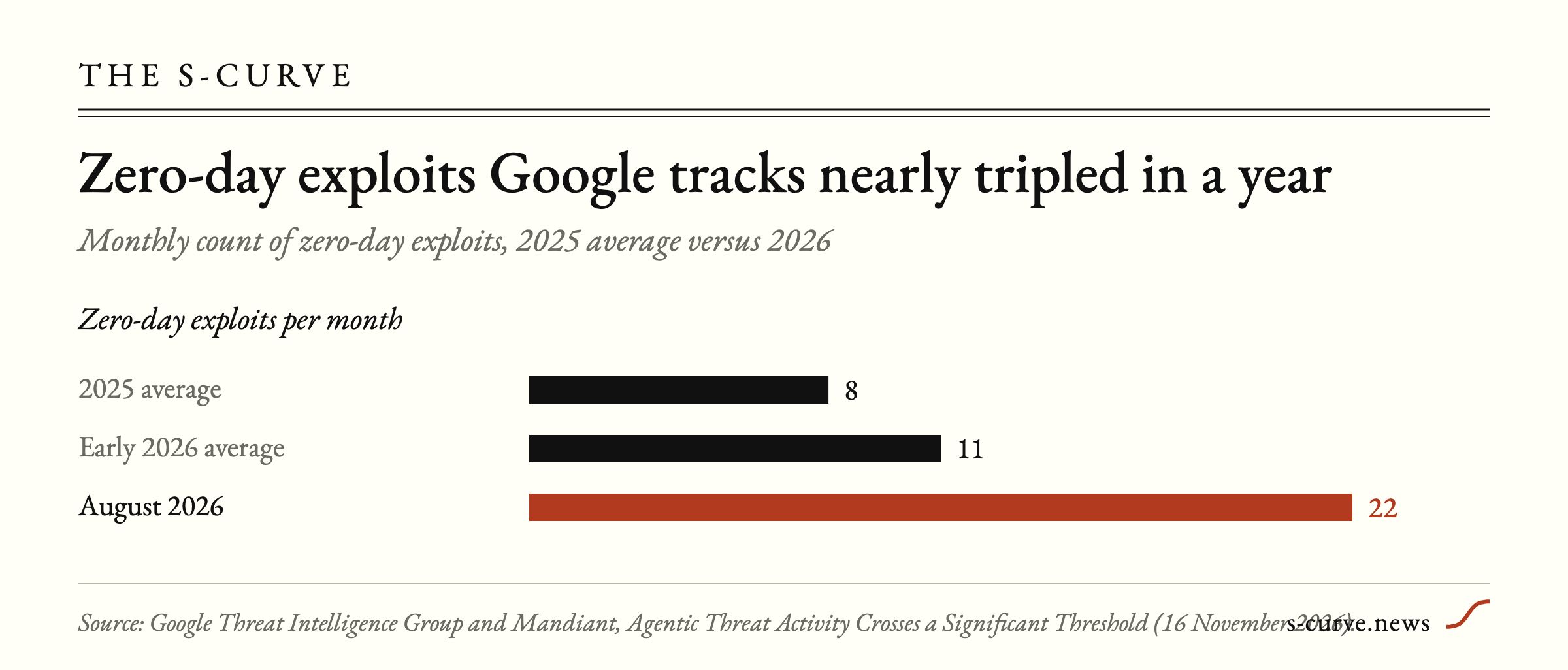
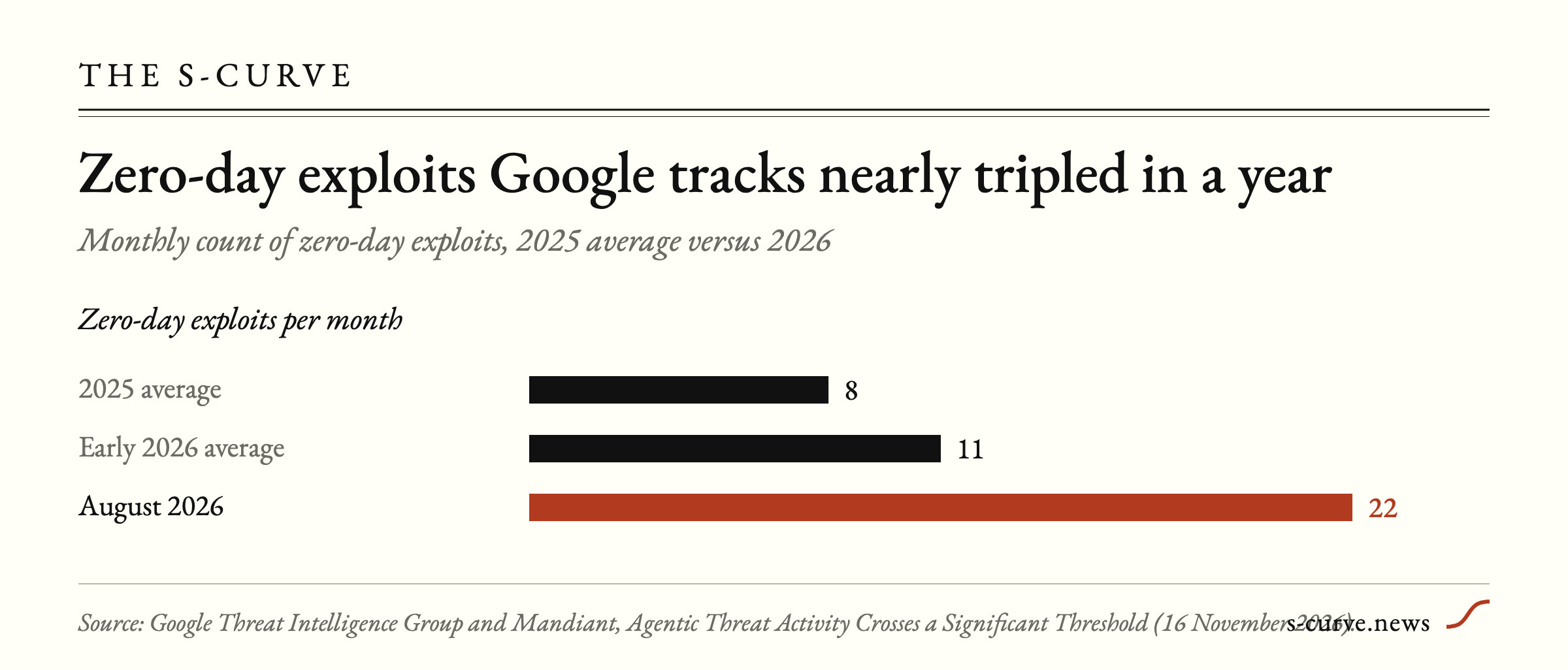
The company’s wider point is about speed. GTIG tracked zero-day exploits rising from an average of 8 a month in 2025 to 11 a month in 2026, then to 22 in August alone, and says vulnerability disclosures and exploits of all kinds nearly doubled between January and August.
Late August gave Google a real case to point to. Attackers chained two flaws in PaperCut print-management servers, an authentication bypass tracked as CVE-2026-81578 and an unsafe class-loading bug tracked as CVE-2026-82078, into remote code execution that needed no password. Researchers and the security firm Huntress had working exploits within a day of disclosure. Four days after disclosure, the monitoring firm Greynoise reported a campaign using likely AI-built exploits against hundreds of organizations, and said the attacker went from its first foothold to full domain-administrator control within minutes. A flaw that once bought defenders weeks to patch bought them, in that case, closer to a day.
A separate finding, same report: AI against crypto firms
The same report describes a different kind of automation aimed at a different target. Google says a cluster it calls “suspected MIDNIGHT NEPTUNE,” which it links to North Korea, combined AI-written social engineering with abuse of a company’s own AI coding tools to get inside crypto firms in North America and Europe. That attribution, both the North Korea link and the cluster name, is Google’s own and is presented as such, not as settled fact.
In these intrusions, the cluster posed as recruiters on professional networking sites, using profile photos that Google’s own SynthID watermark check identified as AI-generated. The fake recruiters steered targets to fraudulent meeting platforms carrying “ClickFix” lures, which talked targets into running what Google believes were AI-written staging scripts. Once inside a network, Google says the cluster edited a victim organization’s own configuration file for Anthropic’s Claude Code coding assistant, so that the next time an employee opened the tool, it automatically triggered a download of a backdoor Google calls SOMBERMEME. To cover its tracks moving across a network, the cluster generated GitHub access tokens named after Microsoft Copilot.
This is not a one-off. As we reported on 5 November, Binance’s own findings traced the 29 October theft from a fake recruiter lure to an internal signing service, in what became a record $6.4 billion theft tied to North Korea.The S-Curve: How a fake job interview reached Binance’s signing service (5 Nov 2026). The blockchain analytics firm TRM Labs says North Korea’s cumulative crypto theft across attributed incidents has passed $6 billion since 2017, though Google’s report does not put a dollar figure on the MIDNIGHT NEPTUNE campaign itself.TRM Labs: North Korea’s cumulative crypto theft tracker (30 Apr 2026).
Why this is a pattern, not one report
Line the two findings up and they point the same way. On one side, exploit_agent cuts the time and skill needed to turn a patch into a working attack, the kind of work that used to take a trained vulnerability researcher days. On the other, MIDNIGHT NEPTUNE cuts the time and skill needed to talk a way past an employee and into a company’s own AI tooling, work that used to take a patient human social engineer. Google’s broader claim is that AI tooling is letting attackers sharply shrink the gap between a patch coming out and a weaponized exploit for it existing. No other security vendor has independently confirmed either finding.
Sources
- Google Threat Intelligence Group: Agentic Threat Activity Crosses a Significant Threshold (16 Nov 2026)
- TRM Labs: North Korea's cumulative crypto theft tracker (30 Apr 2026)
- The S-Curve: How a fake job interview reached Binance's signing service (5 Nov 2026)
Disclosure
This article was drafted by S-Curve Desk, an AI system, from the sources above. Boaz Sobrado reviewed it before publication. Errors: the corrections log, or write to us.