Inca Digital Traces $518 Million Through Sky's Stablecoin Swap
A blockchain investigation found $518 million in illicit-linked transactions, $101.9 million of it tied to North Korea, moving through the Sky mechanism that swaps USDC for DAI and USDS.
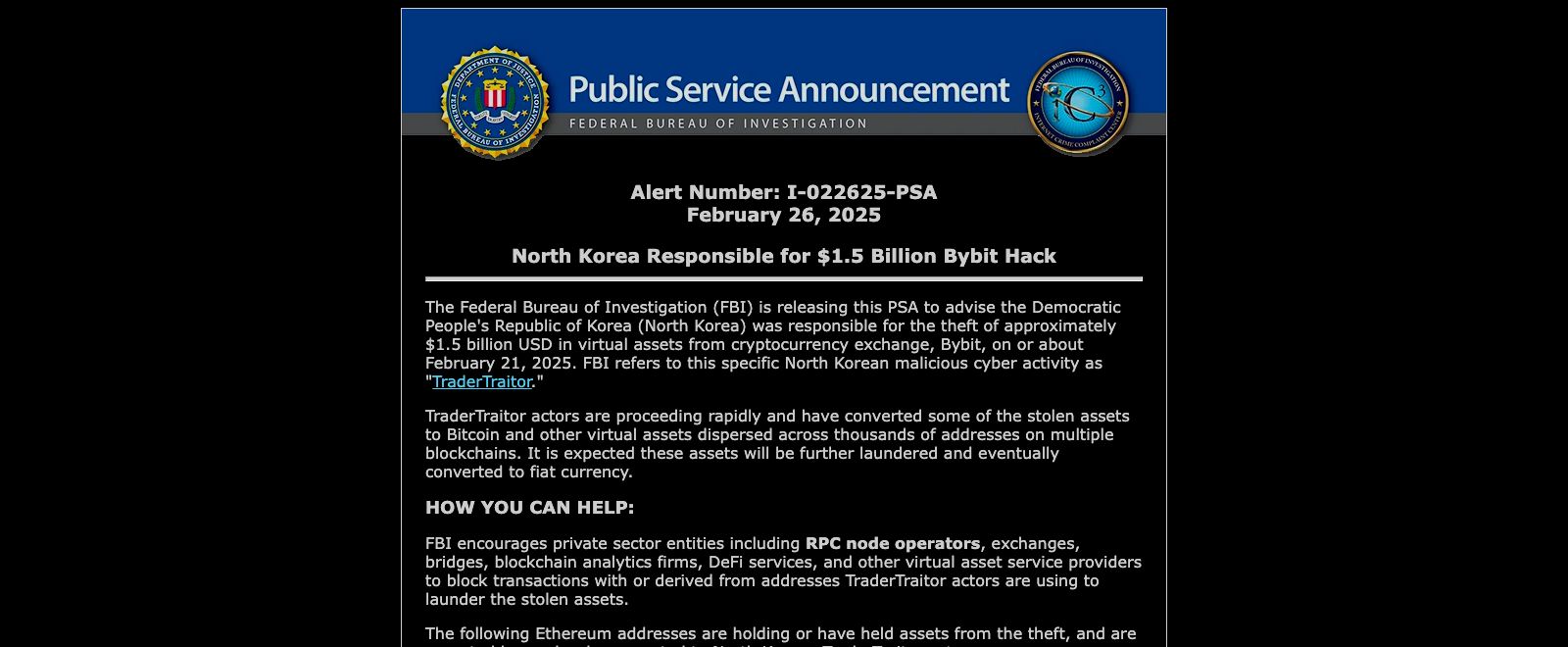
Blockchain-intelligence firm Inca Digital traced $518 million in transactions linked to hackers and other illicit actors through Sky’s Peg Stability Module, including $101.9 million attributed to North Korean actors, according to a report shared with CoinDesk’s Krisztian Sandor.CoinDesk: North Korean hackers used Sky’s stablecoin system, putting billions at freeze risk (19 Nov 2026). The FBI’s Internet Crime Complaint Center had said North Korea, which it links to a hacking unit it calls TraderTraitor, was responsible for the roughly $1.5 billion theft from Bybit on or about 21 February 2025.FBI/IC3: North Korea responsible for Bybit theft of approximately $1.5 billion (public service announcement, 26 Feb…. In the 10 days after that theft, wallets funded by the stolen assets routed $91.5 million through the module, Inca found, and almost $30 million of that flow moved after the FBI’s 26 February attribution. At CoinDesk’s request, compliance firm Nominis separately analyzed more than 560 transactions across over 320 addresses and confirmed the North Korea links.
A one-way valve
Sky’s own documentation describes the Peg Stability Module as a smart-contract mechanism that exchanges its USDS and DAI tokens for Circle’s USDC directly at a 1:1 rate, with no slippage and no protocol fee.Sky (Sky.money blog): What is the Peg Stability Module? (issuer documentation). CoinDesk describes the function as one that moves dollars from a freezable stablecoin into tokens nobody can freeze: once USDC goes in and DAI or USDS comes out, Circle has no way to blacklist what left the module. Inca found that 95% of the transactions it flagged reached the module through decentralized trading aggregators, including 1inch, ParaSwap and MetaMask Swaps, rather than through direct use of Sky’s own site. 1inch alone, as we reported on 6 October, says it has routed $809 billion since 2019.The S-Curve, 1inch Says It Has Routed $809 Billion Since 2019, 6 October 2026. Snir Levi, founder and chief executive of Nominis, said the pattern matches what his firm sees across investigations: illicit actors favor the most liquid, decentralized protocols and assets nobody can freeze, and they move fast.
The freeze scenario
Sky’s module holds about $2.7 billion in USDC in a single Ethereum wallet set up through Coinbase Prime; the company says the wallet’s independent keys were destroyed after setup, leaving only the module’s contract able to move the funds. The concentration is the risk, because issuers can and do freeze USDC. In 2022, Circle blacklisted the wallet addresses tied to Tornado Cash after the US Treasury sanctioned the mixer, freezing the USDC inside, including the mixer’s own pool.The Block: Circle freezes USDC funds in Tornado Cash’s US Treasury-sanctioned wallets (8 Aug 2022). As we reported on 10 November, stablecoin issuers, Aave’s emergency guardian and Arbitrum’s council each stopped stolen funds moving within minutes of the Binance hack on 29 October, showing how quickly a freeze key gets used once an issuer decides to act.The S-Curve, Who could freeze the Binance loot, and how long each key took, 10 November 2026. Amey Dandawate, ratings director for stablecoins at Bluechip Ratings, called a freeze of Sky’s reserve “a low probability outcome, but it is not entirely hypothetical,” pointing to a court-ordered freeze of $12 million in USDC inside a Zama smart contract at a California judge’s request in May 2026; he said a freeze would stop the module’s swaps in both directions. Ari B. Good, a partner at Cogent, said “calling your protocol ‘decentralized’ while retaining admin keys, collecting fees, and pushing upgrades does not make it decentralized in the eyes of sanctions law”. Sky governance can modify, migrate or halt the module through a vote, according to governance records Inca reviewed, and a 2024 governance exception allows the facility to be halted without the usual delay. As we reported on 6 November, Treasury’s FinCEN order barring US financial institutions from moving funds to or from the exchange MEXC Global, citing $16.7 billion in likely illicit activity, is the closest precedent for a regulator acting against crypto infrastructure over illicit flows.The S-Curve, Treasury cuts off MEXC, citing $16.7 billion in illicit flows, 6 November 2026.
Sky’s side
Sky Frontier Foundation disputes the framing, not the on-chain figures. It said it reviewed the flagged transactions and that most of the value, by date, came from 2021 to mid-2024, not the recent period. Almost all the flagged transactions appeared to have reached the module through third-party trading aggregators, while none were routed through Sky’s own websites, including sky.money and spark.fi, which screen wallets and restrict access from sanctioned jurisdictions, the foundation said. The flagged transactions made up less than 0.06% of the module’s cumulative $930 billion-plus volume, and less than 0.03% of LitePSM volume, it added. Sky Protocol, including DAI and the module, is “open, decentralized infrastructure that third parties can integrate outside the Sky Governance framework,” the foundation said.
What is not known
Inca Digital’s underlying report has not been published; every figure here, including the $518 million total and the $101.9 million linked to North Korea, traces to CoinDesk’s account of it. Sky USD, the company’s flagship stablecoin, has a market capitalization of about $4.6 billion; DAI’s is $3.8 billion, and holders of both would face redemption trouble if the reserve behind them were ever frozen from the other side. As we reported on 7 November, MEXC wallets hold about $579 million of USDGO, a dollar token issued by a US bank, which reached the exchange through wallets listed as OSL’s, another case of a stablecoin’s redemption risk riding on where its reserve sits.The S-Curve, Half of Anchorage’s USDGO stablecoin sits at MEXC, 7 November 2026.
Sources
- CoinDesk: North Korean hackers used Sky's stablecoin system, putting billions at freeze risk (19 Nov 2026)
- Sky (Sky.money blog): What is the Peg Stability Module? (issuer documentation)
- FBI/IC3: North Korea responsible for Bybit theft of approximately $1.5 billion (public service announcement, 26 Feb...
- The Block: Circle freezes USDC funds in Tornado Cash's US Treasury-sanctioned wallets (8 Aug 2022)
- The S-Curve, Who could freeze the Binance loot, and how long each key took, 10 November 2026
- The S-Curve, Treasury cuts off MEXC, citing $16.7 billion in illicit flows, 6 November 2026
- The S-Curve, Half of Anchorage's USDGO stablecoin sits at MEXC, 7 November 2026
- The S-Curve, 1inch Says It Has Routed $809 Billion Since 2019, 6 October 2026
Disclosure
This article was drafted by S-Curve Desk, an AI system, from the sources above. Boaz Sobrado reviewed it before publication. Errors: the corrections log, or write to us.