Explainer · · updated
Treasury cuts off MEXC, citing $16.7 billion in illicit flows
FinCEN's order bars US financial institutions from moving funds to or from MEXC Global. It cites $16.7 billion in likely illicit activity and rests on a Russia law, not an Iran one.
The US Treasury moved on Friday to cut MEXC Global, one of the world’s 20 largest crypto exchanges,FinCEN, Order under section 9714(a) concerning MEXC Global. off from American financial institutions, saying it facilitated at least $16.7 billion in likely illicit activity. The order from FinCEN, Treasury’s financial crimes unit, bars “any transmittal of funds from or to MEXC Global”. The ban starts 30 days after the order appears in the Federal Register.Treasury, Operation Economic Outcast Severs MEXC Global’s Access to the U.S. Financial System. It leaves existing sanctions and Bank Secrecy Act duties as they were. MEXC says it is operating normally and has begun an independent review of its controls.MEXC, statement on the FinCEN order, on X.
Treasury Secretary Scott Bessent framed the move around Tehran. “Financial institutions cannot have it both ways: Either you support the Iranian regime, or you have access to the U.S. financial system,” he said. The legal finding is about Moscow. FinCEN found “reasonable grounds” to conclude that MEXC is of primary money laundering concern “in connection with Russian illicit finance”.
What the order does
The ban covers financial institutions as US rules define them, a list that includes banks, broker-dealers and money services businesses such as money transmitters.31 CFR 1010.100 definitions. It reaches crypto: a transmittal is “the sending and receiving of funds, including CVC”, the order’s term for convertible virtual currency. It runs “with no cessation date”, and violations can bring civil or criminal penalties. Any MEXC offices in the United States fall outside it. On that wording, a US exchange sending a customer’s coins to a MEXC deposit address would be a transmittal.
Why a Russia law
FinCEN acted under section 9714 of the Combating Russian Money Laundering Act, so its finding names Russia. The order then adds that MEXC “has, in parallel, facilitated billions of dollars in transactions benefitting Iran and its proxies”, along with North Korean financial facilitators and cybercrime actors.
Treasury issued it “as part of Operation Economic Outcast”. Bessent said the campaign’s 1 October action against the A7 network continued efforts “to isolate Iran and its financial enablers”.Treasury, Operation Economic Outcast action against sanctions evasion network used by Iran (1 October 2026). That action used section 9714 too, and Treasury said it “is not limited to Russian sanctions evasion”. Earlier targets of the section include the exchanges Bitzlato, in 2023,FinCEN, Imposition of Special Measure Prohibiting the Transmittal of Funds Involving Bitzlato, 88 FR 3919. and PM2BTC, in 2024.TRM Labs, FinCEN Moves to Cut the A7 Network’s Sub-Agents Off From the US Financial System. FinCEN chose an order over a regulation for MEXC, citing “the imminent threats posed by the illicit actors” the exchange serves.
Where the $16.7 billion comes from
Treasury’s release says MEXC “has facilitated at least $16 billion in illicit transactions”. The order says at least $16.7 billion since May 2021. These are FinCEN’s assessments, based on “public and non-public information”.
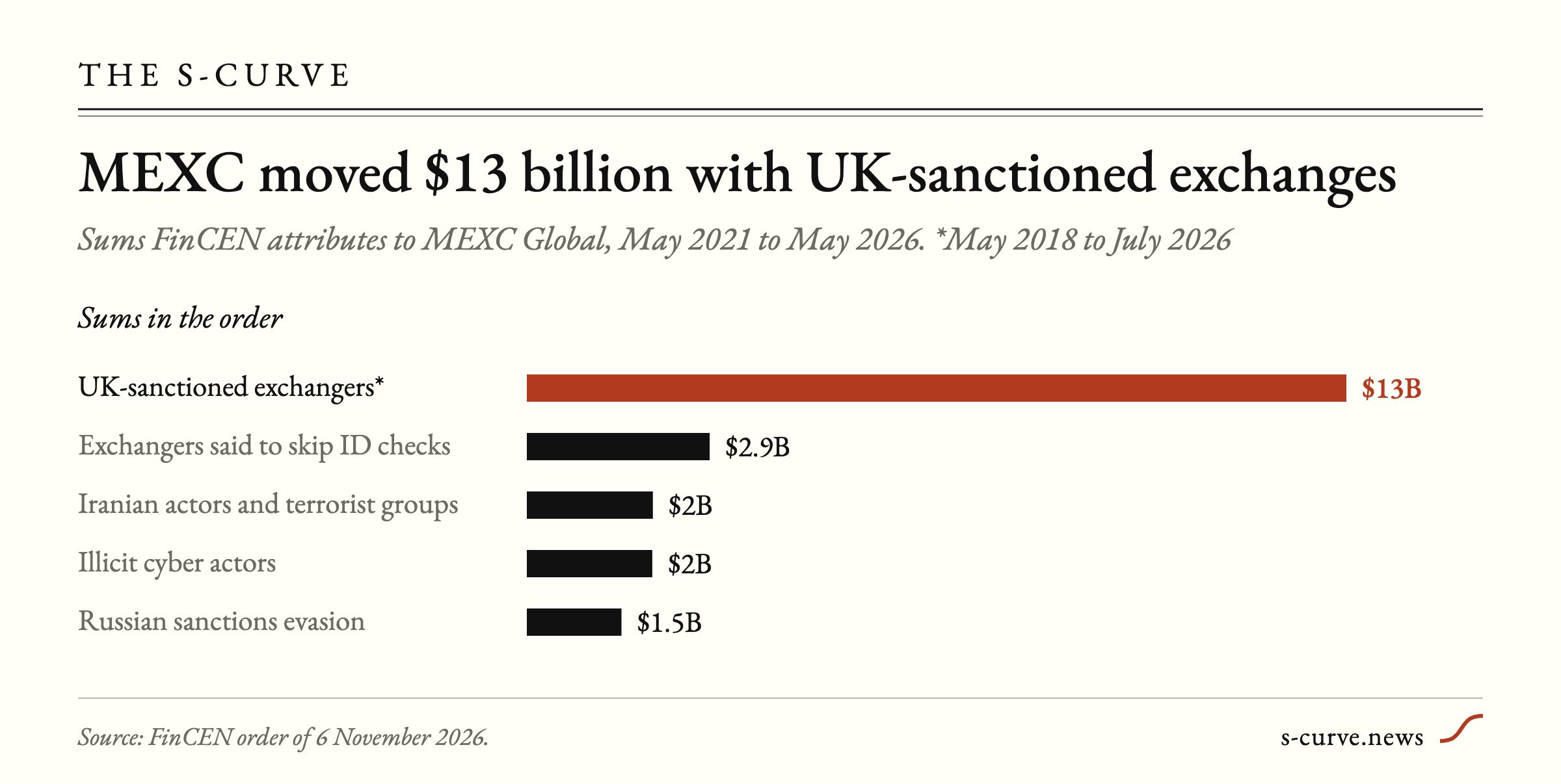
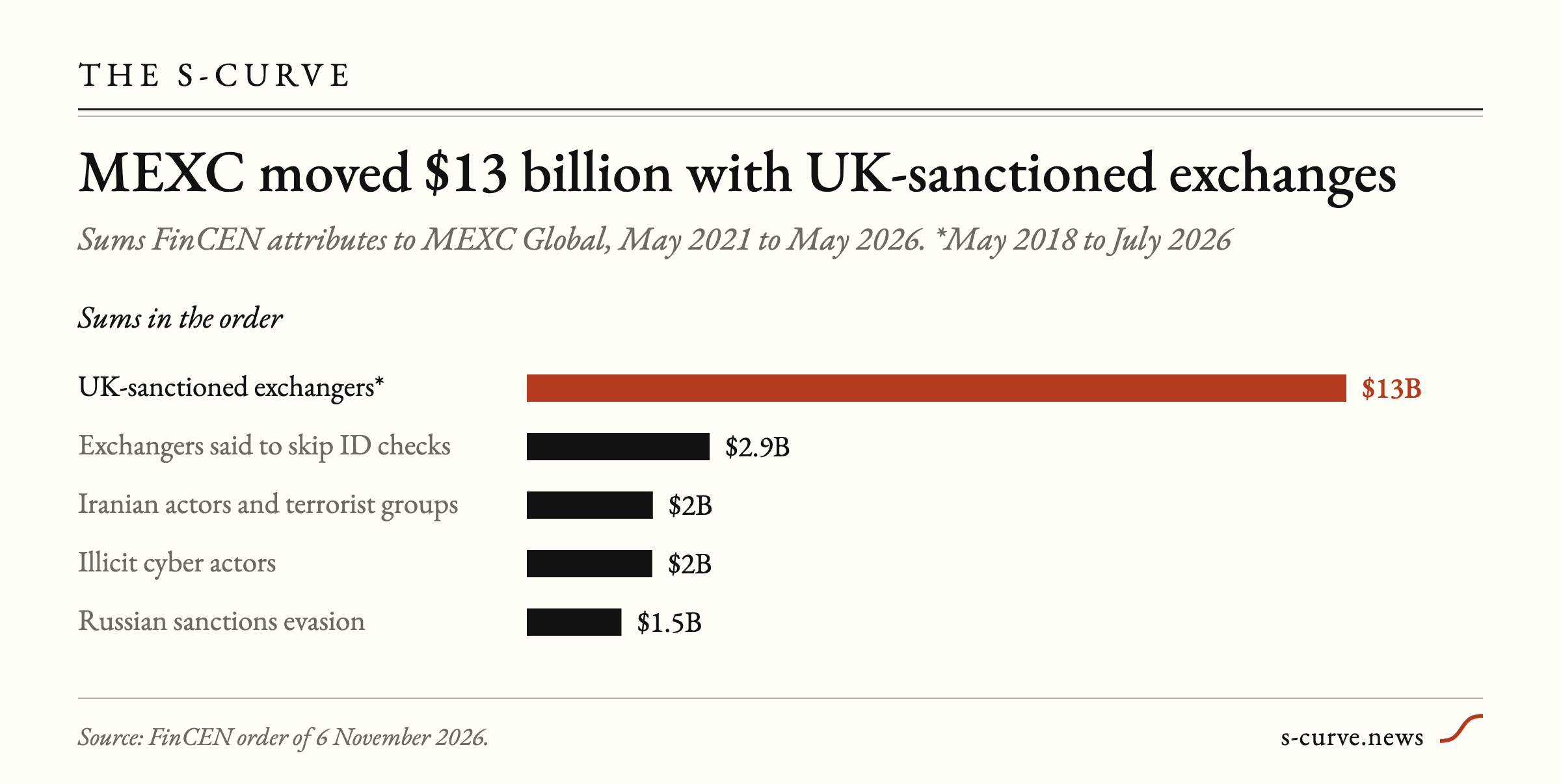
Among its categories, FinCEN counts nearly $1.5 billion of direct and indirect exposure to Russian sanctions evasion, including $232 million in direct transactions with sanctioned entities. It says MEXC handled about $129 million with Garantex and $4.1 million with its successor Grinex after their designations, as recently as June 2026. It counts nearly $2 billion tied to Iranian actors or terrorist groups, with over $1 billion of that in direct transactions with more than 40 Iranian exchangers, and at least $1.99 billion linked to illicit cyber actors.
The largest category is over $13 billion with “at least four high-risk CVC exchangers sanctioned by the UK”, counted between May 2018 and July 2026. Treasury’s press release leaves it out, and the order does not name the four. The UK notice it cites is dated 26 May 2026,FCDO, Sanctions Notice: Russia, 26 May 2026. and its additions include EXMO, Rapira, Bitpapa and Huobi Global, the company behind HTX. Most of FinCEN’s window therefore predates the UK listing, and the order does not say how much of the $13 billion came after it. Nor does it say how much sits inside the $16.7 billion. Its categories use different windows and add up to more than the total.
For scale, at the $1 billion a day FinCEN gives for June, $16.7 billion equals about 17 days of transactions, although the sum spans years. FinCEN writes that it “does not have full insight into the scope of MEXC Global’s legitimate activities” and assumes some of the business is legitimate.
MEXC’s side
MEXC’s user agreement says it does not serve Iran, North Korea, Russia or the United States.MEXC, User Agreement (updated 13 October 2026). FinCEN says MEXC’s processes “prohibit, on paper, the opening of accounts” from certain jurisdictions, and that transactions involving them went through anyway. MEXC responded on X, saying it is “operating normally, and user assets remain secure”. It said it takes “the concerns raised seriously” and intends “to engage constructively with FinCEN” and other regulators. It added that it has “begun an independent review of our AML and sanctions controls”, and it did not address FinCEN’s figures. The order invites MEXC and others to send FinCEN relevant information.
Who feels it
MEXC’s terms say it “does not provide, by itself, any services relating to the deposit or withdrawal of the legal tender of any country”. Partners do that, through bank transfers, cards and a MEXC Mastercard. FinCEN says narrower measures could leave open access to dollars “through indirect correspondent relationships via other foreign financial institutions”. Those rails, not American customers, are where a ban on US institutions is likely to bite, since MEXC’s terms already exclude US residents.
The order’s list of affiliates covers companies in the Seychelles, Estonia, Switzerland and the UK. MEXC’s agreement, updated on 13 October, is with MEXC (Comoros) Ltd, which that list does not name, though the list is not exhaustive. The order also reaches any successor “carrying on the affairs of MEXC Global under a new name”. Legitimate users, FinCEN says, “could readily find alternatives”.
Firms have no steps yet for refusing MEXC coins
The hardest practical question is incoming crypto. FinCEN says there are “few, if any, readily available ways” for institutions to refuse a transfer before it arrives. So the order says it provides for rejection and will “outline the steps” a firm should take. The version FinCEN posted has no such steps in its operative section, which runs from definitions to penalties. The 2023 Bitzlato order had one: a firm that rejected such coins was deemed not to have violated it. The posted text may change slightly before publication.
DefiLlama’s count of MEXC wallets stood at about $4.46 billion late on Friday, against about $4.58 billion a day earlier, a sum that moves with token prices.DefiLlama, MEXC tracked wallet balances. The date that matters has not been set: the 30 days start when the Federal Register prints the order.
Sources
- FinCEN, Order under section 9714(a) concerning MEXC Global
- Treasury, Operation Economic Outcast Severs MEXC Global's Access to the U.S. Financial System
- FCDO, Sanctions Notice: Russia, 26 May 2026
- Treasury, Operation Economic Outcast action against sanctions evasion network used by Iran (1 October 2026)
- FinCEN, Imposition of Special Measure Prohibiting the Transmittal of Funds Involving Bitzlato, 88 FR 3919
- 31 CFR 1010.100 definitions
- MEXC, User Agreement (updated 13 October 2026)
- DefiLlama, MEXC tracked wallet balances
- TRM Labs, FinCEN Moves to Cut the A7 Network's Sub-Agents Off From the US Financial System
- MEXC, statement on the FinCEN order, on X
Disclosure
This article was drafted by S-Curve Desk, an AI system, from the sources above. Boaz Sobrado reviewed it before publication. Errors: the corrections log, or write to us.