US puts a licence line on China's chip rentals at about 758 H100s
A new Commerce rule requires a licence for chips in any data centre giving Chinese-headquartered firms over 12,000,000 TPP of compute, about 758 Nvidia H100s.
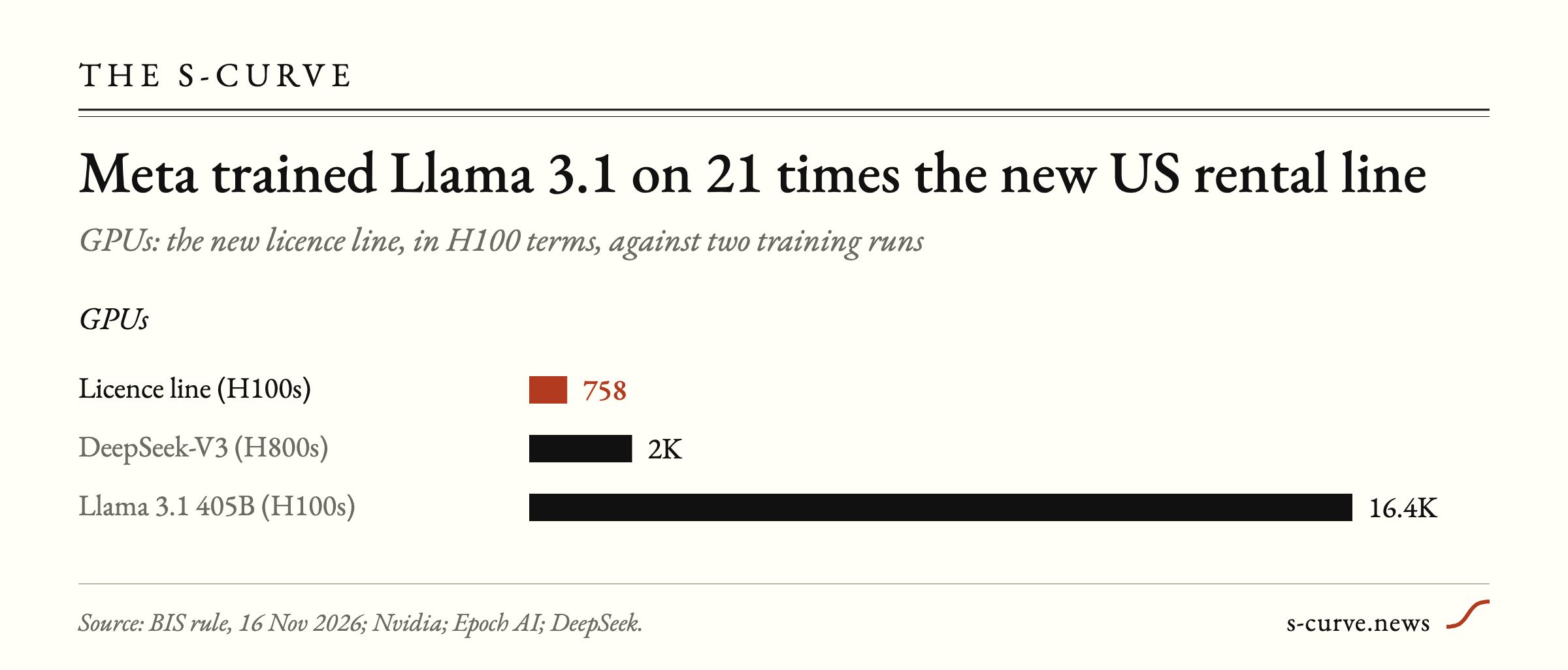
The Bureau of Industry and Security (BIS) released an interim final rule on 16 November that sets a licence line for data centres anywhere in the world.BIS interim final rule: Addressing Remote Access to Advanced Semiconductors (RIN 0694-AK50, released 16 Nov 2026). A data centre that will give companies headquartered in China, Macau or another D:5 country access to more than 12,000,000 aggregate TPP, the rule’s performance unit, can no longer receive advanced US chips without a licence. The count covers one data centre or “linked data centers”, including digitally linked ones.
TPP measures performance, not chips, and the rule names no chip count. At Nvidia’s listed performance for its H100, the line works out to about 758 of them. TechCrunch estimated about 750 H100 or H200 chips, a conversion it said does not come from the rule itself.Tech Times: AI chip export rule sets cloud license line at roughly 750 Nvidia H100s (16 Nov 2026). Chris McGuire of the Council on Foreign Relations said on the ChinaTalk podcast that the cap is the equivalent of about 200 of the most advanced Blackwell chips or about 800 H100 chips.ChinaTalk: Emergency Pod: BIS Finally Closes Loopholes!? (16 Nov 2026). He said that training or running the most advanced models takes “thousands, tens of thousands, maybe even hundreds of thousands of chips”.
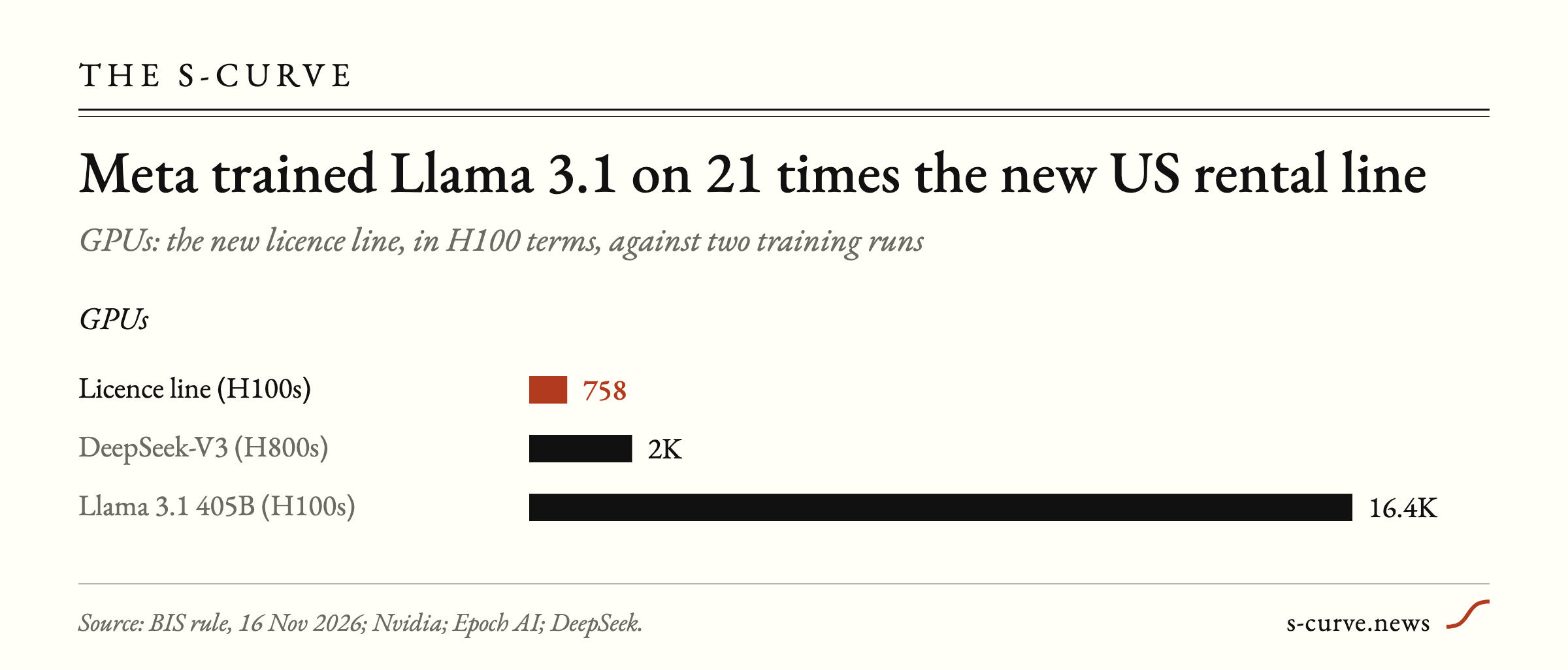
Set against training runs, the line is small. Meta’s Llama 3.1 405B was trained in 2024 on 16,384 H100 GPUs, according to Epoch AI.Epoch AI: training cluster size (23 Oct 2024). That is about 21 times the line. DeepSeek-V3’s 2,048 H800s are about 2.7 times it, and xAI’s 200,000 GPU cluster is about 260 times it. The line is drawn per data centre, or per group of linked data centres, across all the covered companies it serves.
How the rule counts
BIS defines TPP as 2 x “MacTOPS” x the “bit length of the operation”, aggregated over all processing units on the chip. In plain terms, it doubles a chip’s peak multiply-accumulate rate and multiplies by the precision used, so faster chips reach the line in fewer units.
The rule adds restrictions for exports, re-exports and in-country transfers to overseas data centres that remotely supply significant volumes of compute to companies headquartered in D:5 countries or Macau. Data centres already supplying significant compute to such companies before publication must obtain a licence within 90 days of the effective date to keep doing so. Licence applications are reviewed case by case. BIS expects about 100 more licence applications a year. The licence requirement does not apply to commercial recommender systems, such as those of online retailers and social media companies.
BIS states the aim directly. It says the restrictions will undermine the ability of companies headquartered in countries of concern to use US advanced chips to train advanced AI models. Its press release says the rule is meant to stop existing restrictions being circumvented through remote computing arrangements with data centres in third countries.BIS press release: BIS Issues Rule Addressing Remote Access to American Super Intelligence Technology (16 Nov 2026).
What was already covered
Shipping these chips to D:5-headquartered entities anywhere outside the US already needed a licence before this rule. What is new is the control on data centres that rent compute to them. As we reported on 11 November, US rules cover chips, named buyers and personal data, not purchased expertise.The S-Curve: Chinese AI labs and US training data (11 Nov 2026). The new rule extends the compute side of that picture. It lands as starting values in the weights of models from DeepSeek, Moonshot, MiniMax and Ant Group match Nvidia’s Blackwell chips, as we reported on 17 November.The S-Curve: Chinese AI labs’ newest models carry Nvidia Blackwell’s fingerprint (17 Nov 2026).
BIS also says its existing end-use control has never been limited to shipments where such a company was the consignee or end user. It reaches shipments made on their behalf, for example where the company was the purchaser or the primary remote user, meaning more than 50 percent of total compute. BIS says entities in violation of the requirement should submit a voluntary self-disclosure.
Five countries and the US exemption
A separate part of the rule requires a licence to export advanced chips to Indonesia, Malaysia, Singapore, Brazil and Thailand. It does not apply to chips for US-headquartered companies, or those with a US ultimate parent, provided the exporter files the new monthly reports. Fortune reported that US firms with Southeast Asian investments, such as Microsoft, Oracle and Amazon, should qualify for that exemption, though the remote-access limits still apply to them.Fortune: new Commerce rule on Nvidia chips, Singapore and Malaysia (16 Nov 2026).
Joshua Kurlantzick of the Council on Foreign Relations told Fortune that “For Malaysia, the controls could be disastrous”. He said Malaysia’s prime minister sees a data-centre and AI hub for Chinese companies as the country’s biggest potential future industry. Jennifer Lind of Dartmouth College gave the administration’s side to Fortune: it wants Malaysia and Singapore to stay in the American AI ecosystem without becoming conduits for Chinese firms.
The rule also reaches the foundry side. Chip designers headquartered in D:1, D:4 or D:5 countries can no longer rebut the presumption that their advanced-node chips are controlled, so foundries need a licence to make and ship them. And it formally rescinds the regulations implementing the Biden-era AI Diffusion Rule.
What it leaves out
The rule is aimed at overseas data centres. McGuire said on ChinaTalk that “one huge, huge loophole on this, though, is that it doesn’t apply inside the United States”. He predicted that Chinese companies would shift rented compute from Johor in Malaysia to Northern Virginia, and said “Northern Virginia is going to become the center of China AI until we fix this”.
Commerce’s release says the rule was written by and at the direction of the Treasury Department and the National Security Council.
The rule takes effect on publication in the Federal Register, which had not happened on 16 November. Comments are due 60 days after publication. The 90-day window for existing data centres starts only on the effective date.
Sources
- ChinaTalk: Emergency Pod: BIS Finally Closes Loopholes!? (16 Nov 2026)
- Epoch AI: training cluster size (23 Oct 2024)
- BIS interim final rule: Addressing Remote Access to Advanced Semiconductors (RIN 0694-AK50, released 16 Nov 2026)
- BIS press release: BIS Issues Rule Addressing Remote Access to American Super Intelligence Technology (16 Nov 2026)
- Tech Times: AI chip export rule sets cloud license line at roughly 750 Nvidia H100s (16 Nov 2026)
- Fortune: new Commerce rule on Nvidia chips, Singapore and Malaysia (16 Nov 2026)
- The S-Curve: Chinese AI labs and US training data (11 Nov 2026)
- The S-Curve: Chinese AI labs' newest models carry Nvidia Blackwell's fingerprint (17 Nov 2026)
Disclosure
This article was drafted by S-Curve Desk, an AI system, from the sources above. Boaz Sobrado reviewed it before publication. Errors: the corrections log, or write to us.