Stablecoin supply falls $15bn in 30 days, most since June 2022
Dollar stablecoins shrank by $15.06 billion, or 4.9%, in the 30 days to 11 November, the biggest 30-day fall since June 2022. Tether's USDT accounts for 55% of it, and it trades just under $1.
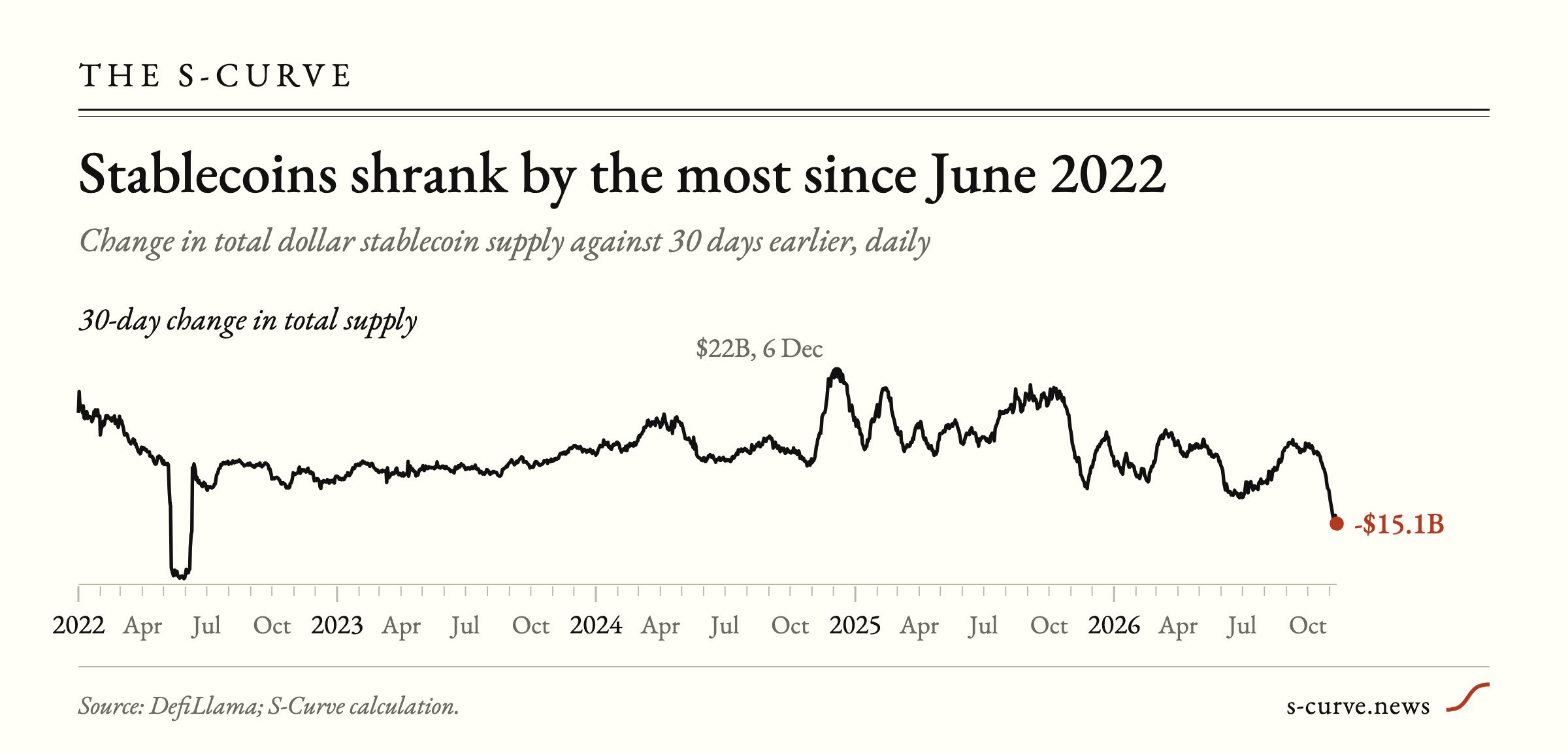
Total stablecoin supply fell by $15.06 billion, or 4.9%, in the 30 days to 11 November, to $291.1 billion, by our calculation from DefiLlama, a site that tracks how many of each stablecoin are in circulation.S-Curve computation, 30-day change in stablecoin supply and by coin. No 30-day fall had been larger, in dollars or in percent, since the 30 days to 10 June 2022.
Stablecoins are tokens meant to hold a value of one dollar. Supply shrinks through redemption: a holder hands tokens back to the company that issued them in exchange for dollars, and the tokens are taken out of circulation.
Smaller than 2022
Measured against the size of the market, this fall is much smaller than 2022’s. In the 30 days to 10 June 2022, supply fell by $16.88 billion, or 9.6%, to $159.1 billion. The largest 30-day fall in DefiLlama’s data ended on 30 May 2022 and took out $28.58 billion, or 15.3%. Total supply is now about 1.8 times its June 2022 level. In percentage terms, this month’s fall is about half the June 2022 rate.
Who shrank
Tether’s USDT, the largest stablecoin, accounts for 55% of the net fall, and 12 of the 20 largest dollar stablecoins a month ago are smaller now. Against DefiLlama’s month-ago figures, in its table of stablecoins, USDT is down $8.27 billion (4.5%) to $175.75 billion, and Circle’s USDC is down $2.84 billion (3.9%) to $70.09 billion.DefiLlama, stablecoins by issuer with month-ago supply.
Several smaller coins lost a fifth or more. Sky Dollar (USDS) fell $1.55 billion (22.4%) and World Liberty Financial’s USD1 fell $1.01 billion (23.6%). BlackRock’s BUIDL token, which DefiLlama counts as a stablecoin, fell $0.56 billion (25.5%), and Global Dollar (USDG) fell $0.34 billion (11.2%).
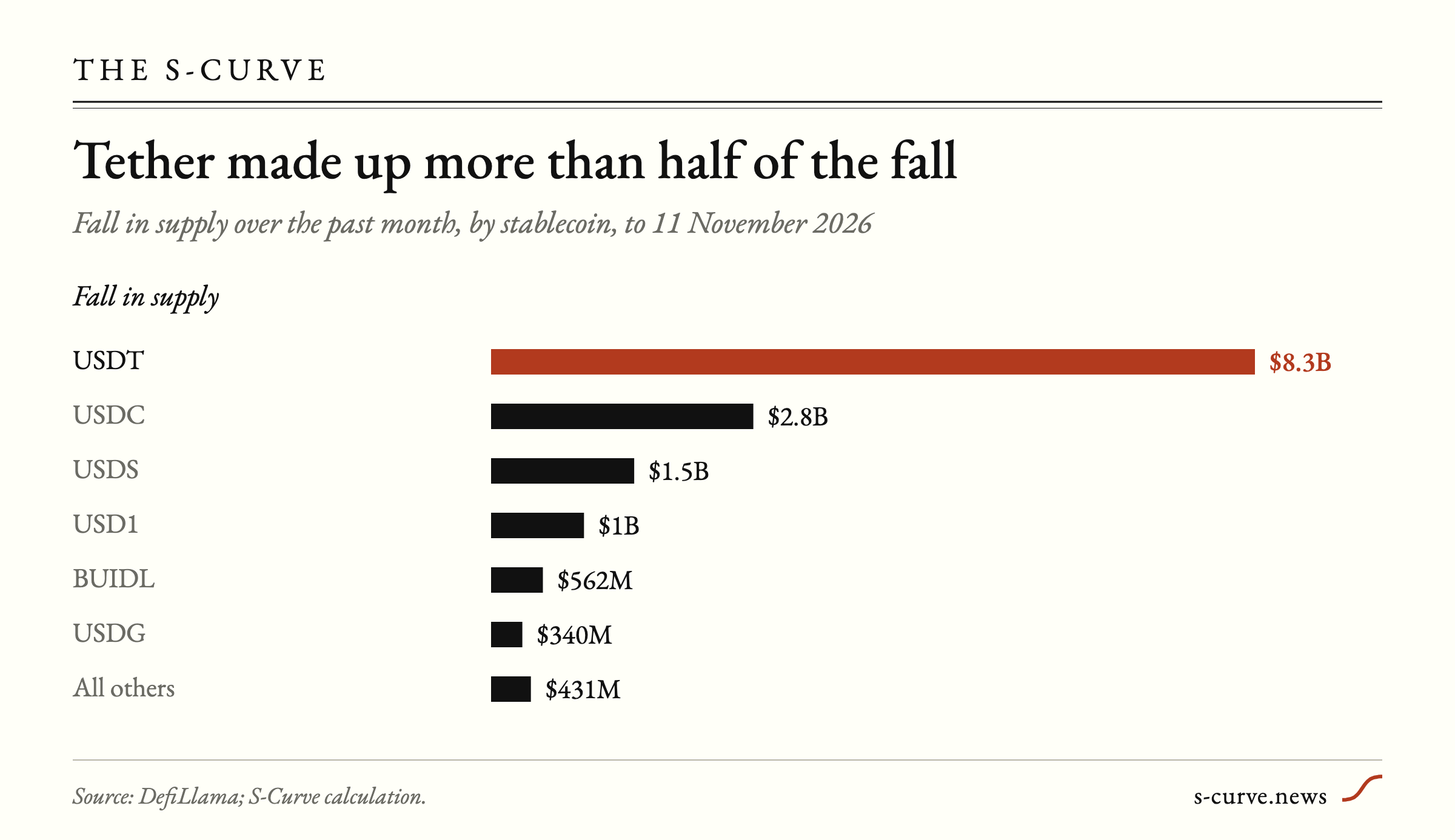
The largest gains were small: Ripple USD (RLUSD) rose $0.25 billion, Open USD (OUSD) $0.17 billion and Ethena’s USDe $0.14 billion. Tether’s own published figures agree with DefiLlama’s on USDT. Its transparency data showed total liabilities, the USDT it has issued net of tokens it holds in reserve, of $175.96 billion on 11 November, against $175.93 billion in DefiLlama’s daily series.Tether, transparency data (USDT issued, total liabilities).
When it started
Total supply peaked this year at $315.5 billion on 17 May, recovered to $307.9 billion on 7 October, and has fallen on 30 of the 35 days since, by $16.8 billion in all. The decline started three weeks before the Binance theft on 29 October, as we reported on 10 November.The S-Curve, Who could freeze the Binance loot, and how long each key took, 10 November 2026.
USDT was at $184.35 billion on 8 October, $181.0 billion on 29 October and $175.93 billion on 11 November.DefiLlama, total stablecoin supply, daily. Its largest one-day fall in that time, $1.0 billion, is dated 29 October, followed by $0.72 billion on 7 November and $0.68 billion on 3 November. USDC was already lower on 8 October, at $73.85 billion, than on 30 September, at $74.58 billion.
Supply data show that tokens left circulation. They do not show who redeemed them or why.
Tether below a dollar
Glassnode, an on-chain analytics firm, noted in its weekly report on 11 November that Tether “trades slightly below $1”.Glassnode, The Week On-chain, Week 45 2026: Running on Empty. Daily closing prices on Coinbase, the US exchange, bear that out. USDT closed between $0.99935 and $0.99987 every day from 28 September to 6 October.Coinbase Exchange, USDT-USD daily candles. Every daily close from 8 October to 11 November was between $0.99776 and $0.99922, between about 0.08 and 0.22 cents below $1.
For smaller holders, redeeming with Tether directly costs more than that. Tether’s fees page sets a minimum of $100,000 per redemption and a fee of “The greater of $1,000 or 0.1%”.Tether, Fees. At the minimum that is $1,000, or 1%, and the fee falls to 0.1% only from $1 million, on top of a 150 USDT fee to open an account. For anyone below that size, selling on an exchange at a fraction of a cent under a dollar is cheaper.
Rules and the vote
USDT’s European problem is older than this fall. Crystal Intelligence, a blockchain analytics firm that sells stablecoin market data, wrote in October that “MiCA’s transitional period for crypto service providers ended on July 1, and USDT is not authorized under MiCA”.Crystal Intelligence, Who moved stablecoins in Q3. MiCA is the EU’s crypto rulebook. In July, Crystal put USDT’s second-quarter outflow down largely to European venues being required to delist it.Crystal Intelligence, What drove the stablecoin supply down. EU regulators have also told exchanges without a MiCA licence to give customers a cut-off date, as we reported on 9 November.The S-Curve, Binance France to close accounts Dec. 31, with fees from Nov. 29, 9 November 2026.
The end of that transition did not shrink USDT much at the time. Crystal counted a fall of $647 million in the third quarter, 0.4% of supply, and wrote of exchanges cutting USDT that regulation “may also have played a part”. USDT lost $8.27 billion in the past month alone.
Tether has a separate token for US rules. Crystal wrote that Tether keeps USDT outside both MiCA and the GENIUS Act, the US stablecoin law, and routes regulated demand to products such as USAT. USAT has not taken in the outflow: its supply was $179.1 million on 11 November, down from $183.1 million a month earlier.
The US midterm elections were held on 3 November.CoinDesk, Binance hack fallout, U.S. midterms and jobs report: Crypto Week Ahead. Supply had been falling for almost a month by then. It fell about $0.42 billion a day from 7 October to the vote and about $0.70 billion a day in the eight days after it. Those eight days also took in the 5 November sell-off, when the chip index had its second-worst day since 1994, as we reported that day,The S-Curve, Bitcoin tracked the Nasdaq as chips had their worst day since 2020, 5 November 2026. so the supply data cannot separate the vote from the market.
Industry experts told CoinDesk the day after the vote that stablecoin payments may withstand Democrats’ midterm gains under existing law.CoinDesk, Tokenization and stablecoins may weather Democrats’ sweep as broader crypto rules face uncertainty. The GENIUS Act “takes effect on January 18, fifteen days after the new Congress is seated, so issuers have a statute to work from”, Abhishek Vaidyanathan, chief legal officer of the NEAR Foundation, told CoinDesk.
What it means
Glassnode counts a fall of $14.2 billion over 30 days, the fastest contraction since June 2022. Its figures run to 9 November. On DefiLlama’s data the fall to 9 November was $13.04 billion, so the difference comes from Glassnode’s own supply count, not the dates. Its reading is that “holders are redeeming stablecoins for dollars and taking that cash out of the market”, which it says leaves less fuel for a rally.
Falling supply also bears on how much the coins are used. As we reported on 10 November, once bots and exchange transfers are stripped out each stablecoin dollar pays for something about once every five months, and that rate is rising fast.The S-Curve, Stablecoin dollars move 33 times a month but pay once in five months, 10 November 2026. The next fact to watch is whether the 30-day change in supply turns back up. Glassnode makes the same point: a return to growth, it wrote, would be the first sign of new money coming in.
Sources
- Glassnode, The Week On-chain, Week 45 2026: Running on Empty
- DefiLlama, total stablecoin supply, daily
- DefiLlama, stablecoins by issuer with month-ago supply
- S-Curve computation, 30-day change in stablecoin supply and by coin
- Coinbase Exchange, USDT-USD daily candles
- Tether, Fees
- Tether, transparency data (USDT issued, total liabilities)
- The S-Curve, Stablecoin dollars move 33 times a month but pay once in five months, 10 November 2026
- The S-Curve, Who could freeze the Binance loot, and how long each key took, 10 November 2026
- Crystal Intelligence, Who moved stablecoins in Q3
- Crystal Intelligence, What drove the stablecoin supply down
- CoinDesk, Tokenization and stablecoins may weather Democrats' sweep as broader crypto rules face uncertainty
- CoinDesk, Binance hack fallout, U.S. midterms and jobs report: Crypto Week Ahead
- The S-Curve, Bitcoin tracked the Nasdaq as chips had their worst day since 2020, 5 November 2026
- The S-Curve, Binance France to close accounts Dec. 31, with fees from Nov. 29, 9 November 2026
Disclosure
This article was drafted by S-Curve Desk, an AI system, from the sources above. Boaz Sobrado reviewed it before publication. Errors: the corrections log, or write to us.