Forged BGP route hijacked 1,000+ bitcoin miners
Braiins' forensic report shows a forged BGP route redirected over 1,000 mining sites' hashpower to an impostor server in November 2026, exposing an industry-wide gap.
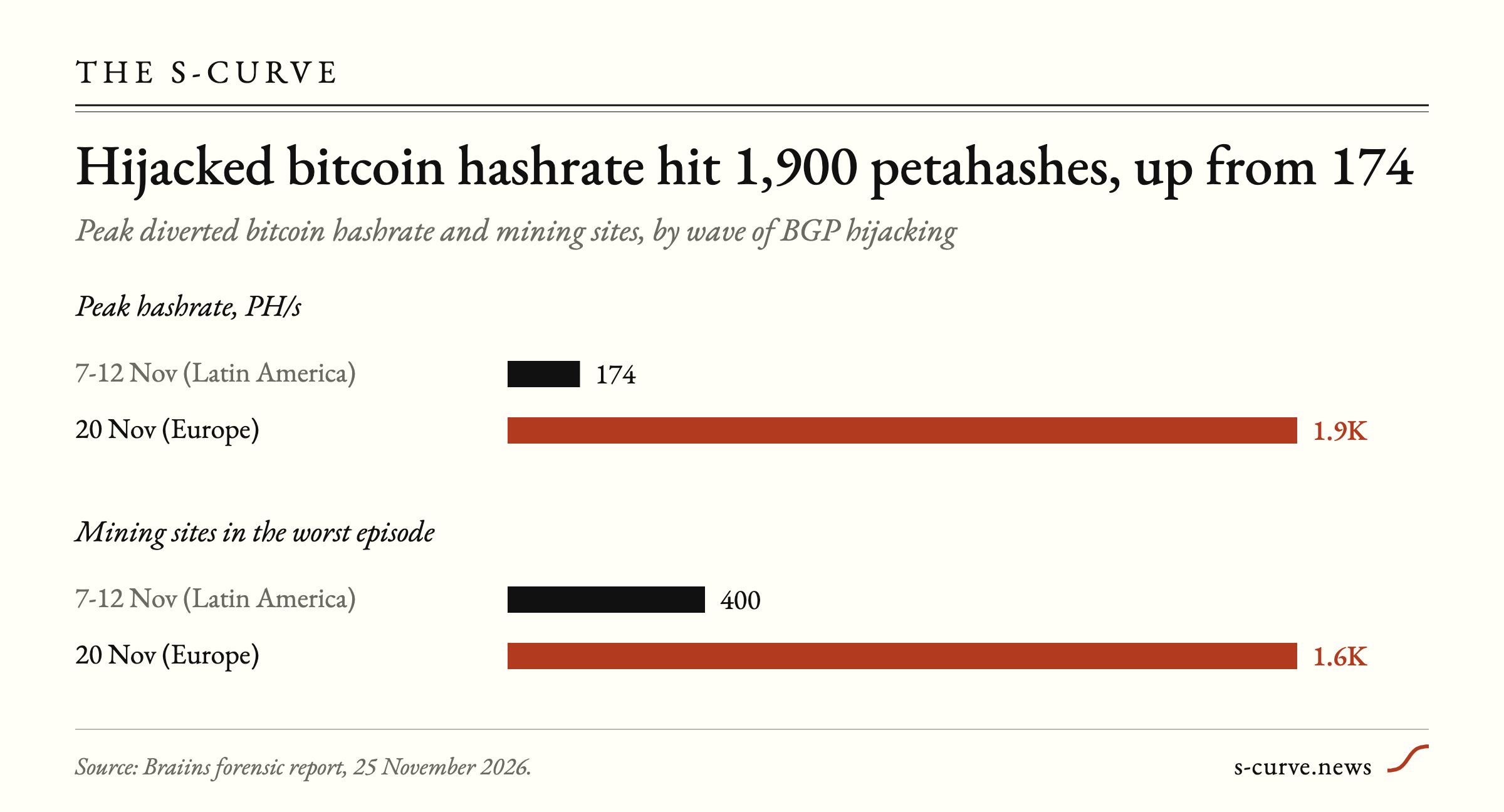
On 20 November, more than 1,000 bitcoin mining sites spread across hundreds of different networks lost their connection to their pool and reconnected to a different address, all in the same second.Braiins: Bitcoin Hashrate Hijacking via Unencrypted Stratum V1 (25 Nov 2026). The miners kept hashing normally. Nothing on the machines changed, and nobody noticed anything was wrong until the pool’s own dashboard started showing numbers that made no sense. At its peak that day, the diverted hashpower was making about one of every 550 guesses the entire Bitcoin network makes.CoinDesk: Hackers Hijacked 1,000+ Bitcoin Mines in One Second by Faking Internet Routes (26 Nov 2026). Braiins, the pool and firmware company that published a forensic report on the incident, wrote that neither its pool, its software nor the affected mining rigs had been hacked.
What happened instead was a forgery of the internet’s own road signs.
How a road sign on the internet got forged
Networks on the internet find each other with BGP, a system where each network announces which blocks of addresses it holds, and other networks route traffic accordingly. The pool’s internet provider had announced its mining address inside a block of 4,096 addresses. On 20 November, somebody else announced a smaller, more specific block of just 256 addresses that happened to include that same mining address. Routers everywhere follow the most specific match they see, so every network that accepted the fake announcement sent the miners’ traffic to the attacker instead, a result of how BGP itself works rather than any flaw in the pool or the mining software. Networks that check new route announcements against RPKI, a registry of who legitimately owns which address blocks, rejected the forged route, but Braiins wrote that many networks still do not run that check. Its guidance to network operators is to turn on RPKI route-origin validation.
What happened to a hijacked miner
Once a miner’s traffic reached the attacker’s server, that server accepted any username and password at all. It then fed the miner real mining jobs it had copied from a separate, large public pool and banked the resulting payout under its own account there, so Braiins concluded the attacker was not solo mining or running a pool of its own, just relaying someone else’s jobs for a worker account Braiins did not name. The giveaway was that the impostor server kept raising the mining difficulty it assigned, in steps reaching up to 2,147,483,640, far above the 16,777,216 ceiling Braiins said its own pool never crosses, which is how operators can spot the attack by checking their own logs. CoinDesk later calculated, since Braiins did not publish a dollar figure, that the attack moved under $17,000 worth of bitcoin in total across every episode.
Two weeks, two continents, a small payout
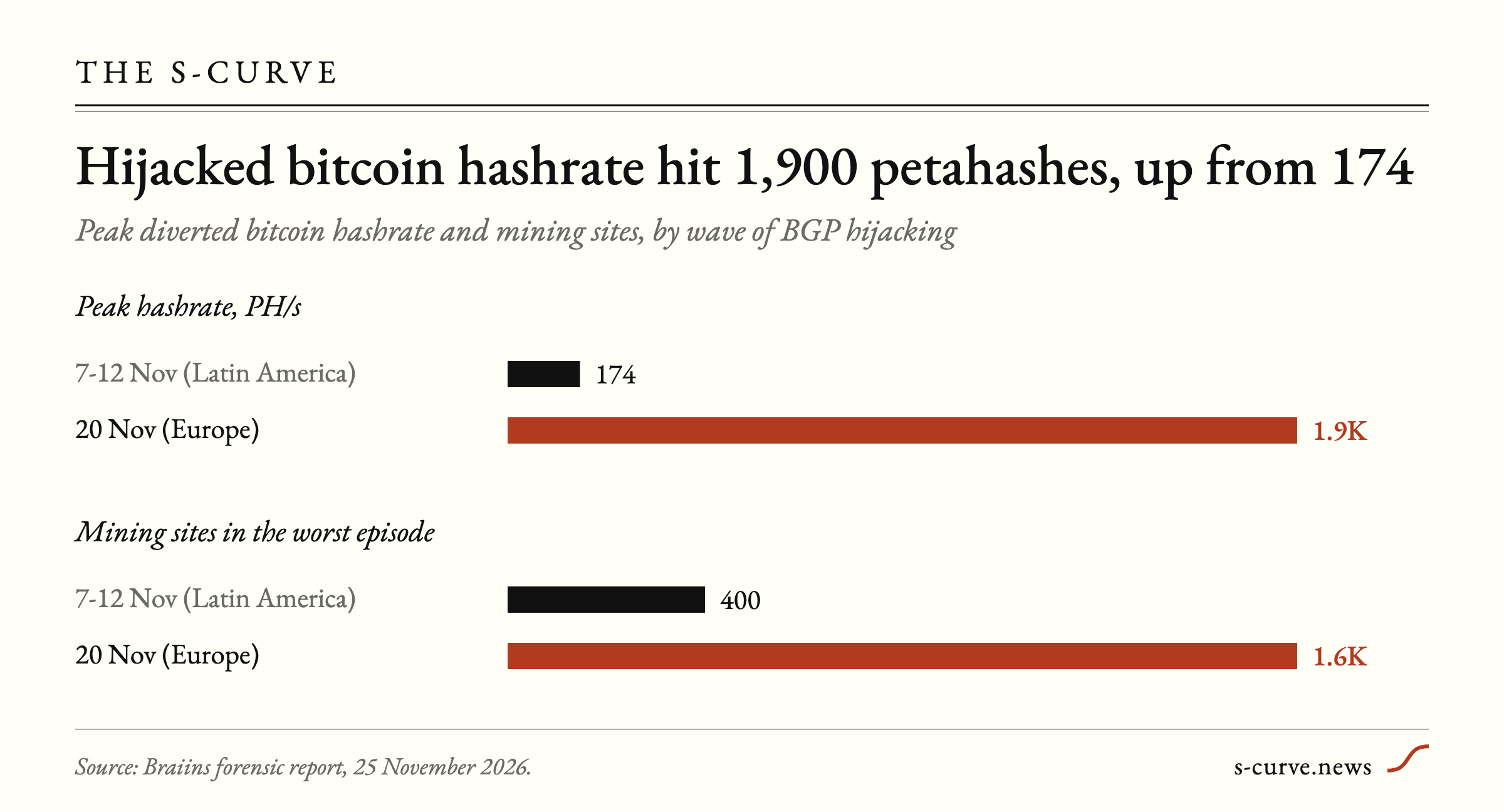
The attack arrived in two distinct waves. From 7 to 12 November, 19 episodes hit Latin America, mostly Brazil and Argentina, each lasting between 1.5 minutes and three hours and diverting between 36 and 174 petahashes per second. Then on 20 November, four episodes concentrated on Europe, each lasting 6 to 49 minutes and diverting between 0.6 and 1.9 exahashes per second, an order of magnitude bigger. Braiins reads that jump, along with a change in method between the two waves, as the attacker testing the technique rather than deploying it at full scale from the outset, though that reading is Braiins’ own interpretation of its data, not an established fact. The payout stayed modest regardless: CoinDesk’s estimate of under $17,000 works out to roughly a fifth of what a nearly identical scheme pulled in 2014, when Dell SecureWorks documented an attacker using the same routing trick to take about $83,000 in mining rewards, a figure Braiins cites in its own report.
The fix has existed for years. Most of the industry isn’t using it
The reason this works at all is that Stratum, the protocol a mining rig uses to talk to its pool, has no encryption or authentication built into its original version, so a server that merely intercepts the connection can impersonate the pool without needing any password of its own. Protos reported in 2022 that a newer version, Stratum V2, encrypts that connection and lets a miner verify who it is actually talking to, built partly to reduce the risk of exactly this kind of theft.Protos: Bitcoin mining protocol Stratum V2 opens for testing (13 Oct 2022). Protos also reported, in that same 2022 article, that developers expected mass adoption to take several years because both pools and individual miners have to upgrade. A Block subsidiary executive said that same year that reaching just 10 percent of hashrate on the new protocol by the end of 2023 would already count as a success.
Four years on, Braiins’ own check of the industry suggests that caution was warranted. Scanning the public endpoints of the largest pools on 23 November, Braiins, which has a commercial interest in promoting the protocol and firmware it sells, found that most still offer only the older, unencrypted Stratum, with just a few serving an encrypted connection backed by a valid certificate. Encryption alone is not enough either: testing seven firmware implementations, Braiins said its own software rejected every invalid certificate it was shown, while two other widely used firmwares offered an encrypted option but still accepted a bad certificate, which would hand a miner an encrypted connection to a thief rather than a secure one. Braiins also said public routing data shows the same kind of forged, more specific announcement aimed at address blocks belonging to other large pools, with some still receiving those announcements as of 22 November, though those blocks carry other services too, so Braiins stopped short of saying mining was the target in every case.
Braiins’ own conclusion is that any miner still running the original Stratum is a target, on any pool.
No attacker has been identified. What the numbers show is simpler than that: a connection reset at the level of internet routing needs no stolen password and no malware on the miner, only an unencrypted protocol and a network somewhere that will accept a route it should have rejected. An encrypted, authenticated connection would have stopped the theft even though it cannot stop the underlying route forgery itself.
Sources
- Braiins: Bitcoin Hashrate Hijacking via Unencrypted Stratum V1 (25 Nov 2026)
- CoinDesk: Hackers Hijacked 1,000+ Bitcoin Mines in One Second by Faking Internet Routes (26 Nov 2026)
- Protos: Bitcoin mining protocol Stratum V2 opens for testing (13 Oct 2022)
Disclosure
This article was drafted by S-Curve Desk, an AI system, from the sources above. Boaz Sobrado reviewed it before publication. Errors: the corrections log, or write to us.