Tech borrowed $680bn for AI this year, 31% of US high-grade issuance
The Fed counts more than $680 billion of AI-related debt issued in 2026 by October. Company results show the biggest builders moving from paying cash to borrowing.
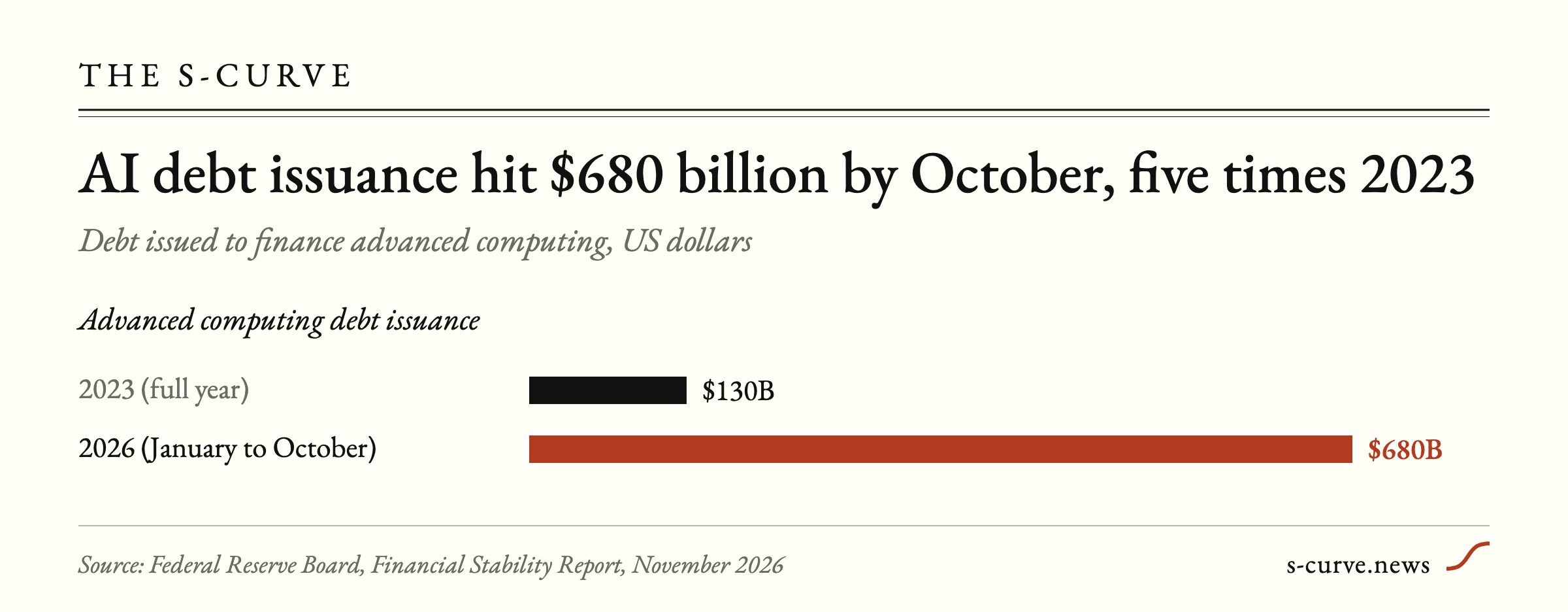
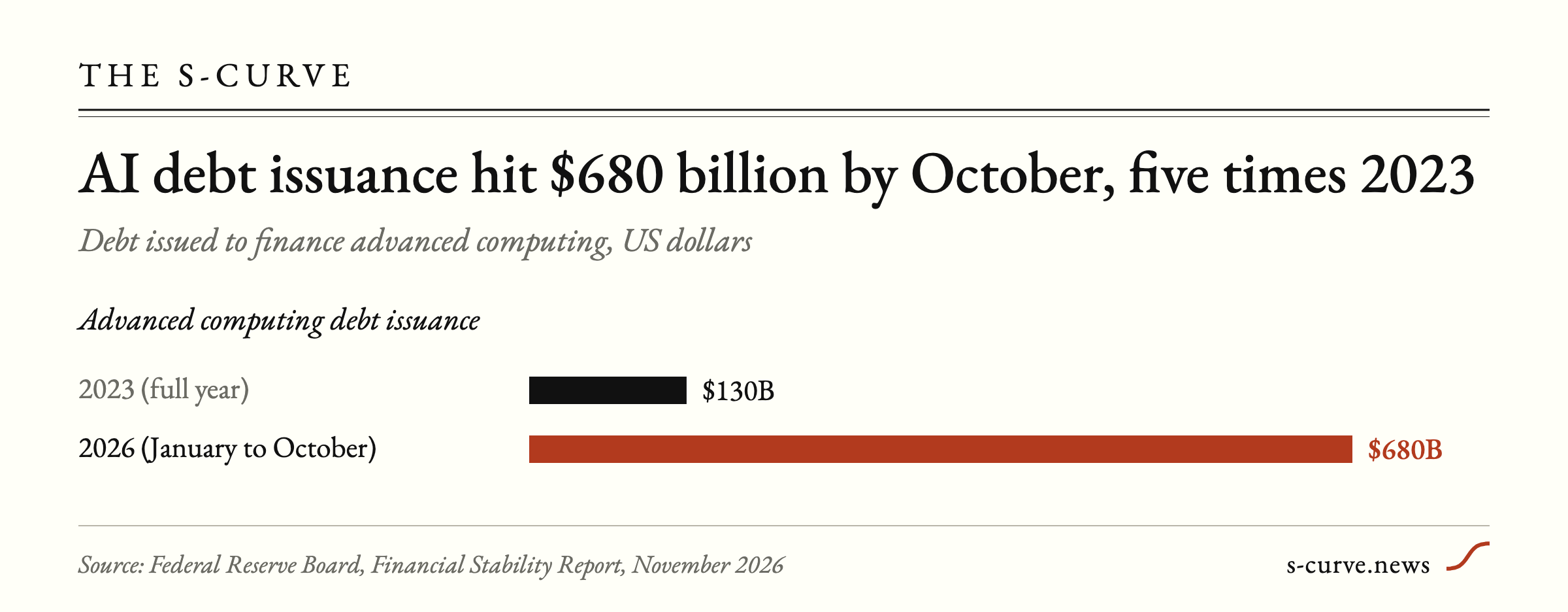
Debt issued to pay for AI data centres and chips rose to more than $680 billion in 2026 by October, the Federal Reserve Board says in its November Financial Stability Report.Federal Reserve Board: Financial Stability Report, November 2026. That is about five times the $130 billion issued in all of 2023. AI-related borrowing was less than 6% of US non-financial investment-grade corporate debt issuance in 2023 and is about 31% in 2026. The Fed estimates that outstanding public debt related to advanced computing now exceeds $1.1 trillion.
From cash to borrowing
For most of this build-out the hyperscalers did not need to borrow much. The Fed compares today’s spending with the 1990s telecom cycle and says the hyperscalers’ strong cash flows reduced their need to issue debt for similar investment, “at least until this year”. It adds that the pace of investment may pass the telecom cycle relatively soon.
The companies’ own statements show what changed. Amazon’s third-quarter results show $115.1 billion of long-term debt raised in the first nine months of 2026, against $746 million in the same period of 2025.Amazon.com: third quarter 2026 results. Its long-term debt went from $65.6 billion at the end of 2025 to $173.1 billion on 30 September. Amazon reports that free cash flow fell to an outflow of $42.4 billion over the trailing twelve months, which it ties primarily to a rise in purchases of property and equipment reflecting investment in artificial intelligence. A year earlier that figure was an inflow of $14.8 billion.
Alphabet’s results show the same shape. It raised $85.2 billion of debt, net of costs, in the first nine months of 2026, against $38.0 billion a year earlier.Alphabet: third quarter 2026 results (Form 8-K, Exhibit 99.1). Its long-term debt rose from $46.5 billion to $125.1 billion, while spending on property and equipment reached $132.0 billion, against $63.6 billion. Meta’s results show $24.9 billion of long-term debt raised in the same nine months, and none a year before.Meta: third quarter 2026 results. Its free cash flow in the third quarter was negative $2.12 billion.
Microsoft is the counter-example in its latest quarter. Its results show $58.0 billion of operating cash flow, up from $45.1 billion, and it repaid $4.85 billion of debt.Microsoft: FY27 first quarter results. Even so, it then filed to sell $25 billion of notes in ten series.Microsoft: prospectus supplement for $25 billion of notes (Form 424B2, October 2026). Microsoft says the proceeds are for general corporate purposes, which may include capital expenditures.
Bonds first, then more complex structures
Plain corporate bonds are only part of the story. The Fed says the debt being issued is shifting from mostly corporate bonds to a mix of public and private debt, structured credit and project finance. Project finance means loans repaid only from a project’s own future cash flows.
Some of the newer arrangements sit outside corporate balance sheets. The Bank for International Settlements calls lease-backed special-purpose structures “shadow borrowing”.BIS Quarterly Review, March 2026: Financing the AI infrastructure boom. As we reported on 21 November, two central banks counted the leases, contracts and guarantees big tech discloses in footnotes but does not carry as debt,The S-Curve: ECB counts over $4 trillion of AI promises off big tech’s books (21 Nov 2026). and as we reported on 18 November, Nvidia’s filings show guarantee exposure rising from $3.5 billion to $108.5 billion.The S-Curve: Nvidia now backs $108.5 billion of its customers’ leases (18 Nov 2026).
Fed Governor Michael Barr said in a speech on 16 November that lower-credit-quality firms most dependent on outside funding have seen their cost of capital rise sharply and are turning to more complex asset-backed financings.Michael S. Barr: Some Potential Financial Stability Implications of Artificial Intelligence (16 Nov 2026).
Who holds the debt
The Fed says the hyperscalers’ and GPU firms’ on-balance-sheet debt is held primarily by mutual funds, pension funds and insurance companies. The riskier subordinated debt and equity tranches of the special-purpose financings are held by high-yield bond funds, life insurers, business development companies and other private debt vehicles.
Banks are in the chain too. The Fed says the largest US bank holding companies have close to $1 trillion of exposure to large technology firms, data centre developers, AI-related special-purpose entities, private credit vehicles and utilities, and that those exposures are evaluated in the annual supervisory stress test. Barr said the on-balance-sheet debt of the seven largest AI firms is expected to exceed $800 billion before the end of 2026.
It is not only the Fed
Other authorities describe the same pattern. The Bank of England’s Financial Policy Committee cited a Morgan Stanley estimate that global AI-related debt issuance was around $450 billion by early September, more than double all of 2025.Bank of England: Financial Policy Committee Record, September 2026. The committee said AI hyperscalers accounted for 47% of sterling corporate bond issuance so far this year, even though their sterling issuance was far smaller than in dollars or euros. It also cited Morgan Stanley’s estimate that $700 billion of data-centre capital spending between 2026 and 2028 would be financed by private credit. The BIS said hyperscalers’ gross corporate bond issuance topped $100 billion in 2025.
The Fed’s report also carries a survey of 23 market contacts run by the New York Fed. Respondents named AI the top-cited risk to financial stability. Many of them said stretched valuations, circular financing and heavy reliance on debt could amplify losses. Those are the respondents’ views, not the Fed’s.
What cushions it, and what to watch
The Fed’s own reading has a second half. Through these links, it says, the largest technology firms may absorb losses in a downturn, which would limit the effect on the rest of the financial system, though their own exposure may be much larger than their balance sheets show.
Barr offered a historical frame. Past infrastructure booms may have felt overbuilt at some point, he said, but “we are glad to have the railroad”.
The figure to watch is the one the Fed’s telecom comparison turns on: cash flow against spending. Until this year, the biggest firms paid for their build-out from operating cash. Amazon and Meta now report negative free cash flow, and Alphabet has doubled its spending on property and equipment while more than doubling its borrowing. Microsoft, whose operating cash flow still exceeded its spending on property and equipment in its latest quarter, is borrowing too.
Sources
- Federal Reserve Board: Financial Stability Report, November 2026
- Michael S. Barr: Some Potential Financial Stability Implications of Artificial Intelligence (16 Nov 2026)
- Bank of England: Financial Policy Committee Record, September 2026
- BIS Quarterly Review, March 2026: Financing the AI infrastructure boom
- Amazon.com: third quarter 2026 results
- Alphabet: third quarter 2026 results (Form 8-K, Exhibit 99.1)
- Meta: third quarter 2026 results
- Microsoft: FY27 first quarter results
- Microsoft: prospectus supplement for $25 billion of notes (Form 424B2, October 2026)
- The S-Curve: ECB counts over $4 trillion of AI promises off big tech's books (21 Nov 2026)
- The S-Curve: Nvidia now backs $108.5 billion of its customers' leases (18 Nov 2026)
Disclosure
This article was drafted by S-Curve Desk, an AI system, from the sources above. Boaz Sobrado reviewed it before publication. Errors: the corrections log, or write to us.