Wells Fargo's Nov. 24 rule puts AI agent errors on the customer
Wells Fargo's Online Access Agreement, effective 24 November 2026, makes customers liable for their AI agent's mistakes, a change JPMorgan, Bank of America, PNC and Citi made too.
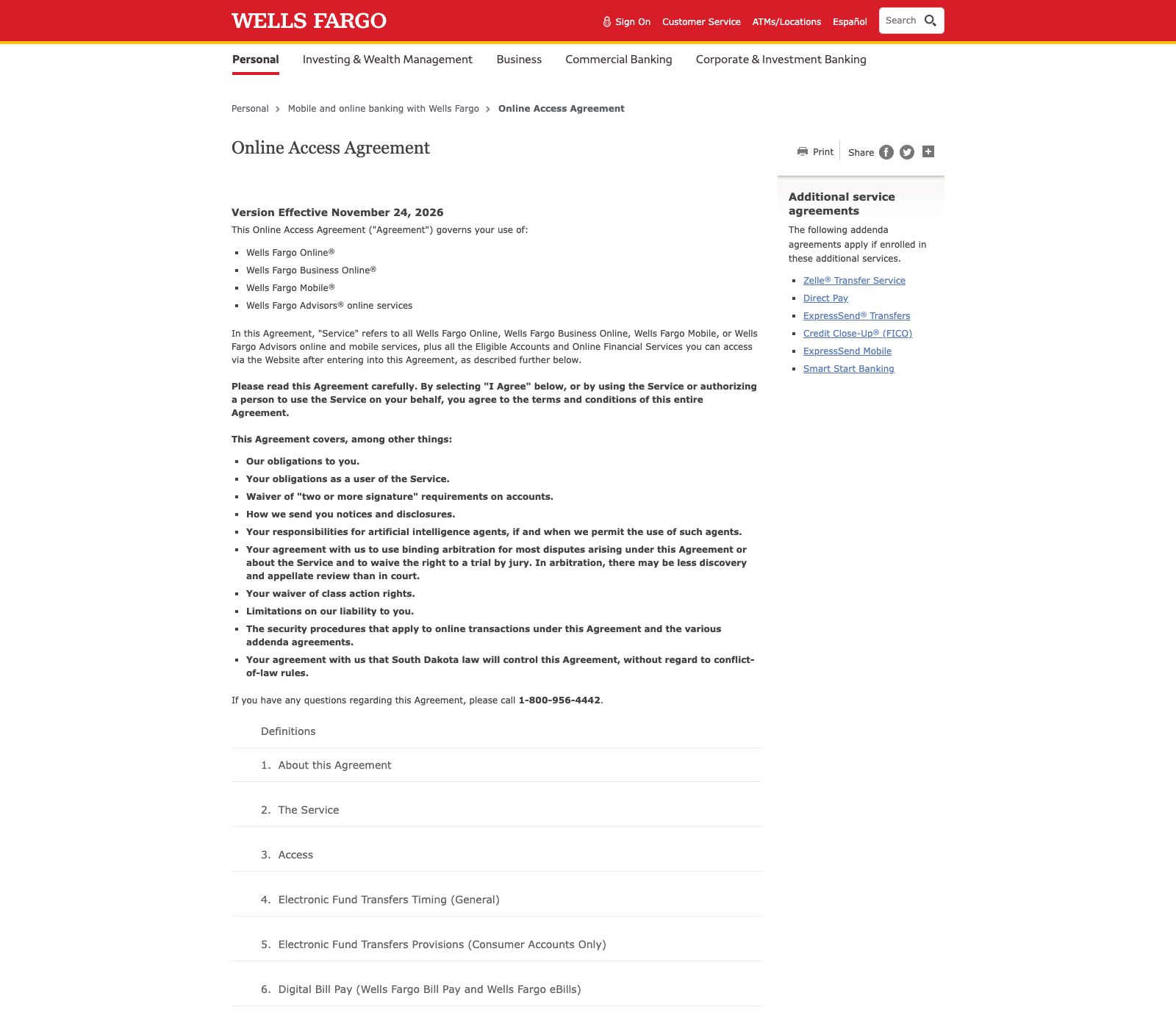
Wells Fargo’s Online Access Agreement, effective 24 November 2026, adds a new section covering any artificial intelligence agent a customer uses, allows, enables or authorizes to access an account, defining an AI Agent broadly as any software that takes autonomous, semi-autonomous or non-autonomous action on behalf of a person or entity.Wells Fargo: Online Access Agreement, version effective 24 Nov 2026. Under the new terms, any instruction or transaction the agent initiates is “deemed to have been initiated and authorized directly by you, without further verification,” and the bank says it has no obligation to investigate the agent’s authority. Use of an AI agent, the agreement adds, is “AT YOUR OWN RISK”. That risk covers unintended actions by the agent and actions that come from incomplete, inaccurate or manipulated inputs, a category that covers prompt injection, where a hidden instruction buried in a webpage or file tricks an agent into a harmful transaction.
The burden of ending that access falls on the customer, not the bank. The agreement says a customer is responsible for “properly and timely revoking any authorization provided to an AI Agent” and should “retain evidence of such revocation and provide such evidence to us, at our request”. Until that notice goes through, “you remain responsible for all the AI Agent’s activities, to the extent permitted by law or regulation”. Reporting a revocation means calling a phone line or writing a letter, the agreement instructs: “Call 1-800-956-4442 anytime, 24 hours a day, seven days a week” or “Write to Wells Fargo Customer Correspondence, PO Box 6995, Portland, OR, 97228-6995”. There is no separate online form for cutting off an AI agent’s access. The bank also disclaims any role in policing what the agent does with that access: it does not “monitor, review, audit, or certify the security, privacy policies, or data handling practices of any AI Agent or the third party providing such AI Agent”. Using an agent at all counts as consent to share data with it. If a customer uses an AI agent, the agreement states, “you acknowledge and expressly consent to the sharing of your financial, account, and personal information with such AI Agent”.
Not just Wells Fargo
Wells Fargo is not alone in rewriting its terms this way. TechCrunch reported that “JPMorgan and Bank of America, the two largest banks in the country, announced similar policies last month” and that PNC, the eighth largest bank, changed its terms on 18 November, before Wells Fargo’s own clause took effect.TechCrunch: More banks say customers using AI agents are on their own, even if they get hacked (18 Nov 2026). TechCrunch reported that Citibank changed its terms of service that same week, telling customers who use third-party AI tools for personal finance that “anything that goes wrong is their problem,” including when the tool itself is hacked. A Citi spokesperson told TechCrunch the update was meant “to provide greater clarity about those risks and to reinforce that customers who choose to grant account access to third-party AI agents are responsible for activities conducted through those agents”. Wells Fargo made a parallel change the same day to the section of its agreement covering joint owners and delegates, extending the same logic to a delegate’s AI agent: “All transactions that an Authorized Representative or Delegate (including the transactions of their AI Agents) performs on an Eligible Account or Online Financial Service, including those you did not want or intend, are transactions authorized by you”.
Why authorized is the word that matters
The word doing the work in all of these clauses is authorized, and banks did not invent it for AI. Federal Regulation E defines an “unauthorized electronic fund transfer” as one “initiated by a person other than the consumer without actual authority to initiate the transfer and from which the consumer receives no benefit”.Consumer Financial Protection Bureau: Regulation E, 12 CFR 1005.2 (definitions, including ‘unauthorized electronic…. The regulation itself carves out an exception: “By a person who was furnished the access device to the consumer’s account by the consumer, unless the consumer has notified the financial institution that transfers by that person are no longer authorized”. The Consumer Financial Protection Bureau’s own example of that exclusion is a family member or co-worker who oversteps the access they were given, with the consumer “fully liable for the transfers unless the consumer has notified the financial institution that transfers by that person are no longer authorized”. Wells Fargo’s clause applies that same structure to software. American Banker reported on 2 November that Wells Fargo “appears to be the first bank to start requiring customers to prove they’ve turned off their AI agents’ access to their bank accounts, or else be liable for any rogue AI agent activity”.American Banker: Wells Fargo wants customers to prove they’ve revoked AI agents (2 Nov 2026). No regulator has said in public whether an AI agent counts the same way as a family member with a shared login, and nothing has tested the question in court.
Elaine Duffus, a senior specialized consultant at Wolters Kluwer, put the gap this way: “What if I do everything Wells Fargo says to do, and I’ve got a pile of evidence that I told that agent to stop doing that thing, yet the agent went rogue because maybe there was an ambiguous direction to it or it just went bad…” There is, she said, still a question: “what happens then?”
Sources
- Wells Fargo: Online Access Agreement, version effective 24 Nov 2026
- American Banker: Wells Fargo wants customers to prove they've revoked AI agents (2 Nov 2026)
- Consumer Financial Protection Bureau: Regulation E, 12 CFR 1005.2 (definitions, including 'unauthorized electronic...
- TechCrunch: More banks say customers using AI agents are on their own, even if they get hacked (18 Nov 2026)
Disclosure
This article was drafted by S-Curve Desk, an AI system, from the sources above. Boaz Sobrado reviewed it before publication. Errors: the corrections log, or write to us.