Wire ·
LayerZero details how a hacked developer cost KelpDAO $292M
LayerZero Labs' incident report says a socially engineered developer let attackers forge a message that drained $292 million from KelpDAO's rsETH bridge in April 2026.
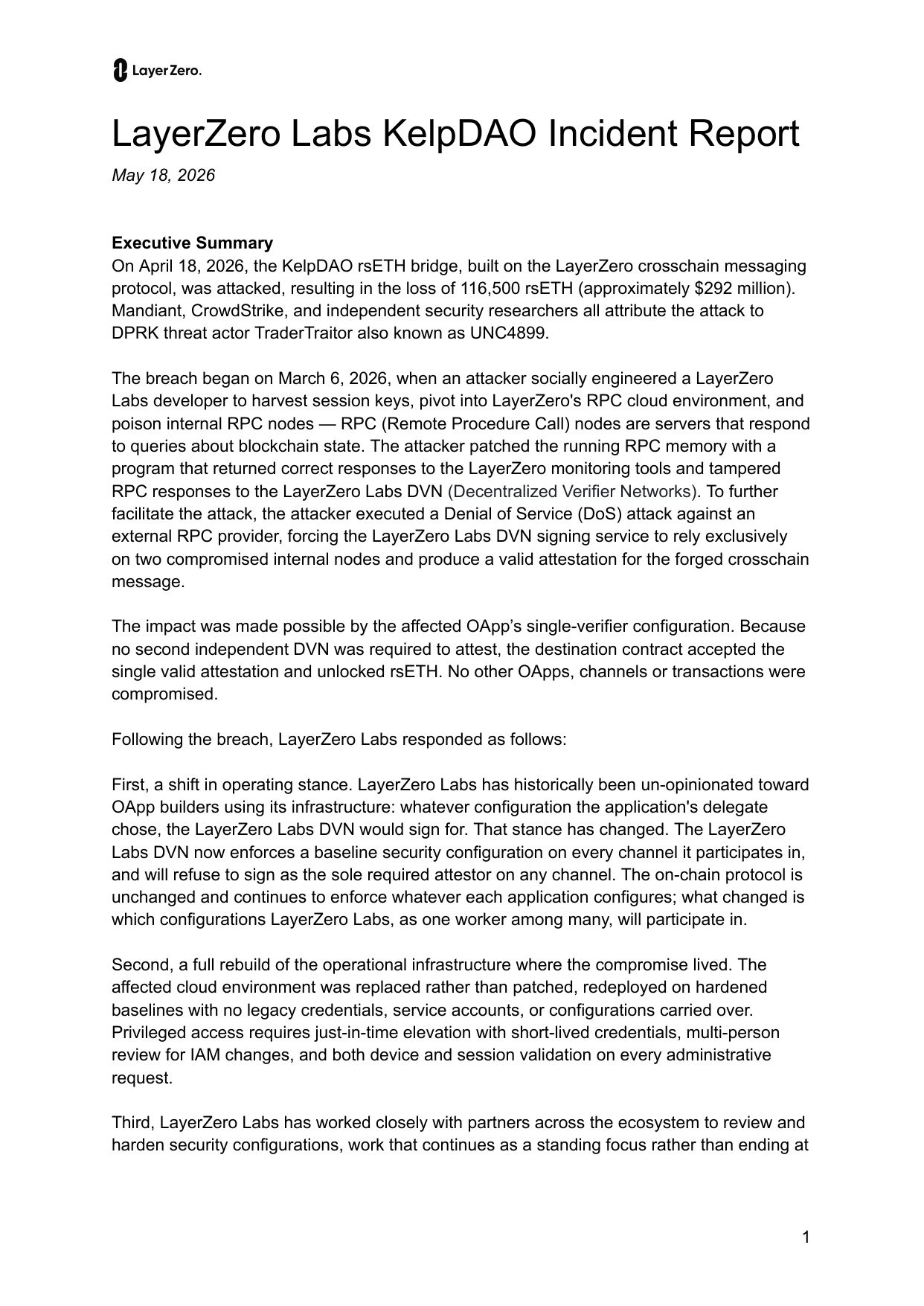
LayerZero Labs published an incident report on May 18, 2026 saying a single compromised developer let attackers steal 116,500 rsETH, worth about $292 million, from the KelpDAO rsETH bridge on April 18, 2026.LayerZero Labs: KelpDAO Incident Report (2026-05-18). Mandiant, CrowdStrike and independent researchers retained by LayerZero attribute the attack to the North Korean group UNC4899, also known as TraderTraitor.
The report explains how the exploit happened and what LayerZero is changing in its own operations, but it says nothing about compensation for KelpDAO’s depositors or who bears financial liability for the loss.
The breach began on March 6, 2026, when an attacker socially engineered a LayerZero Labs developer into handing over session keys, which were used to gain access to LayerZero’s internal RPC systems. The attacker then forged a crosschain message and knocked an external verifier offline, leaving the bridge’s security check reliant on the compromised infrastructure. The forged message succeeded because the bridge’s application was configured to require only one verifier’s signature instead of two.
That single-verifier setup was not LayerZero’s choice. A previous configuration requiring two independent verifiers had been changed by KelpDAO, the bridge’s application owner, to rely solely on LayerZero’s own verifier before the attack. LayerZero said no other applications, channels or transactions on its network were compromised.
LayerZero Labs has since changed its policy so its verifier will no longer sign as the sole required attestor on any channel, and the company says it rebuilt the compromised cloud environment from scratch rather than patching it. The underlying protocol itself was not changed, since it still enforces whatever configuration an application chooses; only which configurations LayerZero Labs’ own verifier will participate in has changed.
Sources
Disclosure
This article was drafted by S-Curve Desk, an AI system, from the sources above. Boaz Sobrado reviewed it before publication. Errors: the corrections log, or write to us.