Wire ·
AWS says Nitro is first formally verified cloud hypervisor
AWS says its Nitro System, which blocks staff from logging directly into servers, is the first formally verified hypervisor deployed in a commercial cloud.
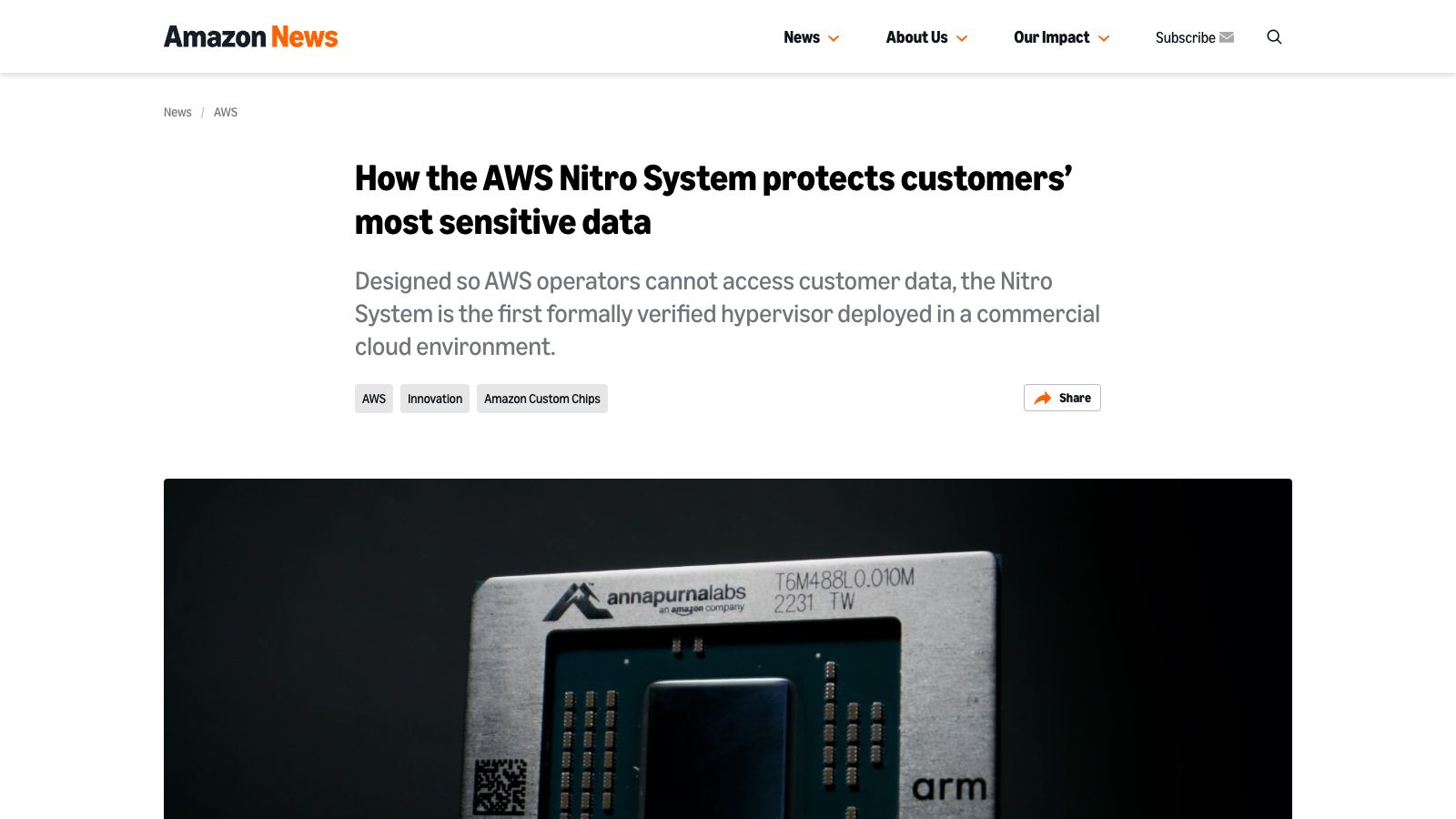
Amazon Web Services said its Nitro System is the first formally verified hypervisor deployed in a commercial cloud environment, designed so AWS operators cannot access customer data.AWS: How the AWS Nitro System protects customers’ most sensitive data (2026-11-25). The Nitro System, including its hypervisor, gives AWS staff no way to log directly into the servers it runs; they can manage those machines only through limited interfaces that cannot reach customer workloads.
The mathematical proof covers only the code that enforces isolation between customers, not the whole system: the rest still relies on testing, design review and independent audits, with the scope set out in AWS’s own white paper.
AWS launched Nitro in 2017. Independent security firm NCC Group reviewed the design in 2023 and found no mechanism for a cloud operator to reach customer data, AWS says. To make the newer proof possible, AWS engineers pulled the isolation logic out into a separate component called the Nitro Isolation Engine, written in a limited subset of the Rust programming language. AWS scientists then used a proof assistant called Isabelle/HOL to mathematically prove four properties of that engine: confidentiality and integrity, functional correctness, the absence of runtime errors, and memory safety.
The Nitro Isolation Engine is now running in production and is always on for instances built on AWS’s Graviton5 chip.
Sources
Disclosure
This article was drafted by S-Curve Desk, an AI system, from the sources above. Boaz Sobrado reviewed it before publication. Errors: the corrections log, or write to us.