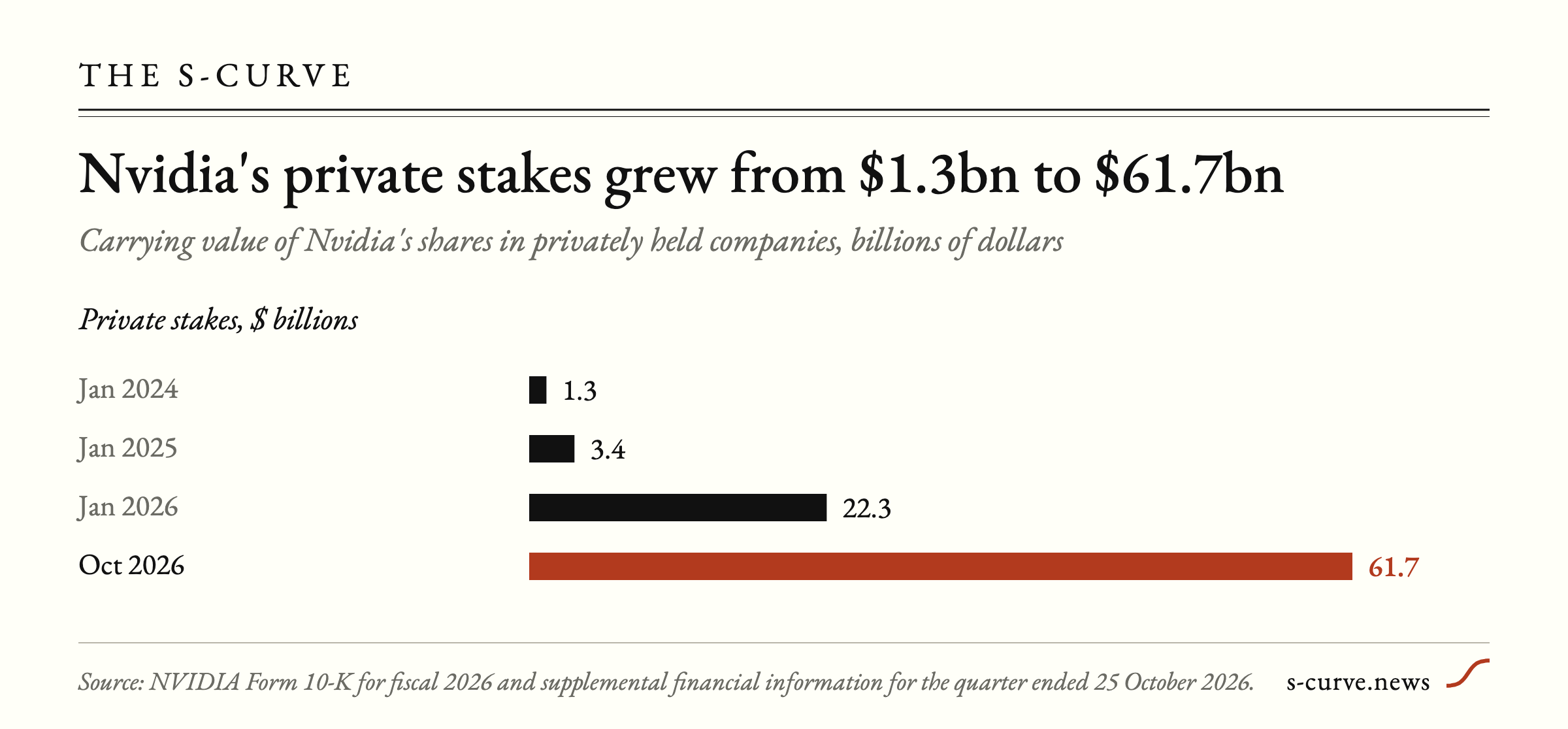
Nvidia's private stakes hit $61.7bn, up from $1.3bn in early 2024
Nvidia's filings show its private-company stakes growing from $1.3 billion to $61.7 billion in under three years. Here is how they move its profit, in both directions.
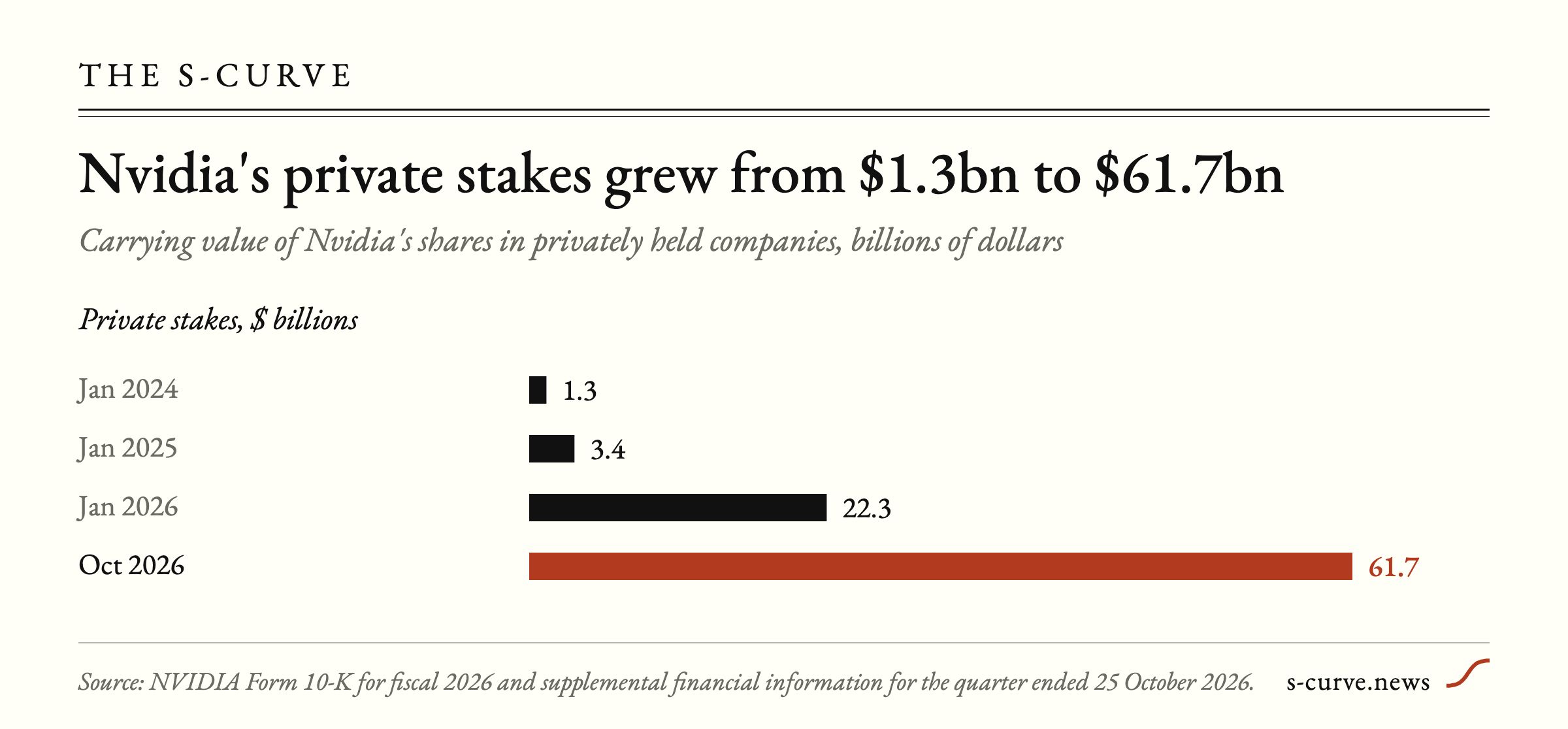
Nvidia carried its stakes in privately held companies at $61.7 billion on 25 October 2026, according to figures released with its latest results.NVIDIA supplemental financial information, Q3 fiscal 2027 (17 Nov 2026). In January it was $22.3 billion, and in January 2024 it was $1.3 billion.
New money drove this year’s rise. Net additions to the private book were $46.4 billion in nine months, against $8.3 billion of unrealised gains. Counting public companies too, Nvidia spent $58.1 billion buying other companies’ shares over the same period, against about $5.0 billion a year earlier. It spent $8.9 billion on property, equipment and intangible assets.
The private book was about 17% of Nvidia’s $372.2 billion of total assets. The balance-sheet line for all non-marketable securities, a wider category, was $65.5 billion. Nvidia sells chips to AI companies, and it now owns part of many of them.
How a private stake becomes profit
Nvidia’s filing says its private stakes are “carried at cost minus impairment and adjusted for observable price changes”. A stake starts on the books at what Nvidia paid, and the value moves when a comparable deal sets a new price or when Nvidia judges the stake impaired.
Those changes reach the income statement. Realised and unrealised gains and losses on these investments are recognised in other income.NVIDIA Form 10-K for fiscal 2026 (filed 25 Feb 2026). So a funding round at a higher price can lift reported profit even if Nvidia sells nothing. Over the nine months, gains on equity securities, public and private, were $25.5 billion, or 11.6% of Nvidia’s pre-tax income.NVIDIA CFO Commentary on Third Quarter Fiscal 2027 (17 Nov 2026).
Nvidia’s own adjusted figures leave these gains out. Nine-month net income was $183.3 billion under standard accounting and $164.4 billion adjusted.
Stakes also leave the private book without being sold. In the nine months, $13.3 billion was reclassified, mainly because the companies began trading publicly or were bought by a public company. On the public side, Nvidia’s quarterly list of US-listed holdings showed $48.3 billion at 30 September, with SpaceX and Intel together making up about four-fifths.NVIDIA Form 13F holdings table, quarter ended 30 September 2026 (filed 16 Nov 2026).
The quarter it went the other way
In the October quarter Nvidia recorded a $1.8 billion net gain on equity securities: a $2.8 billion net gain on public stakes and a $1.0 billion net loss on private ones, including $1.8 billion of impairment. Impairments and unrealised losses on private stakes came to $1.85 billion in the quarter, against $160 million across fiscal 2025 and 2026 together.
The running total is still positive. Cumulative gains on the private stakes stood at $9.9 billion, against $2.2 billion of cumulative losses and impairments. Equity gains were 2.2% of the quarter’s pre-tax income. Nvidia’s annual report had warned that many of the companies it backs may not become profitable and that it could lose all or part of an investment. The results do not name the companies that were marked down.
Many rounds, few big cheques
Nvidia invests widely. Dealroom, a data vendor, counted it in 88 venture rounds between January and 8 September 2026, which is between two and three a week, against 86 in all of 2025.Dealroom: Nvidia as a megaround investor (Sept 2026). Dealroom also counted it in 53 rounds of $100 million or more from January to August, more than any other investor. Crunchbase News counted 121 startup rounds with Nvidia in 2026 as of 13 November, according to Value Add VC.Value Add VC: Nvidia’s 121 startup deals in 2026 (Nov 2026).
A speaker on the Empire podcast said AI founders treat Nvidia as the backstop and put its pace at about three venture deals a week for 18 months.Empire podcast: Anthropic’s IPO, Jensen’s Exit and is ETH Headed Below 1K (20 Nov 2026). The 2026 counts come close to that pace, and the 2025 count does not.
The deal data also qualify the idea of a backstop. Dealroom lists Nvidia as a lead investor on 12 of its 2026 rounds, and its large rounds have 8.5 investors on average. The 53 large rounds raised $205 billion, of which $172 billion went to three labs: OpenAI, Anthropic and xAI. Those are full round sizes, not Nvidia’s cheques. Of the 53, 19 went to companies that train models, 12 to companies that sell GPU capacity or run models for others, and five to companies that apply AI to fields such as law and healthcare. Colette Kress, Nvidia’s finance chief, said in August that it had invested nearly $50 billion in the frontier AI labs.NVIDIA Q2 fiscal 2027 earnings call transcript (26 Aug 2026).
Nvidia is not the only supplier buying in. It was among the companies, with Google, AMD, Broadcom, Micron, Microsoft and a TSMC affiliate, due to buy $26.0 billion of Anthropic stock alongside its IPO, as we reported on 18 November.The S-Curve: Anthropic commits $900.9bn to compute (18 Nov 2026).
Why a supplier buys its customers
There is a case for it. Economists at the Bank for International Settlements (BIS) write that suppliers such as chipmakers may finance AI developers because they can see compute use, and so growth, more easily than other lenders, and that doing so also secures demand for their products.BIS Bulletin 137: Circular relationships among AI firms (2026). Kress said in August that Nvidia knows some will call its support circular financing and sees it differently, describing the labs as once-in-a-generation companies. She said Nvidia expects the equity returns to be excellent.
The other side is about exposure. The BIS authors, whose views are not necessarily the BIS’s, write that an investor that is also a supplier is exposed to the same customer twice: a shock to the customer reduces both the value of the stake and future sales. Kress said the AI labs for which Nvidia expects to use its balance sheet would contribute roughly a quarter of its business next year.
Fed Governor Michael Barr said in a November speech that such investments are small for the investors and “critical for the smaller firms receiving the investments”.Michael S. Barr: Some Potential Financial Stability Implications of Artificial Intelligence (16 Nov 2026). He said those firms will eventually have to replace supplier funding “with revenue from paying customers”. James Kisner of Water Tower Research told Fortune that Nvidia is “double exposed” if AI spending falters, and that its free cash flow means it can afford the purchases.Fortune: Nvidia poured $58 billion into equities (18 Nov 2026).
Stakes are one of several ways Nvidia backs its customers. Its maximum exposure under guarantees was $118.0 billion at 25 October, up from the $108.5 billion we reported on 17 November from its previous quarterly filing.The S-Curve: Nvidia now backs $108.5 billion of its customers’ leases (17 Nov 2026). Other big tech firms book similar gains: the European Central Bank says revaluations of Anthropic stakes fed Alphabet’s and Amazon’s other income, as we reported on 20 November.The S-Curve: ECB counts over $4 trillion of AI promises off big tech’s books (20 Nov 2026).
What to watch
Nvidia has committed a further $20 billion to equity investments, down from $25 billion in July. Net additions to the private book in the latest quarter alone were $15.4 billion. Kress, then also interim chief executive, said on 17 November that Nvidia is “rigorously evaluating future investments” as the market matures and other capital becomes available.NVIDIA Q3 fiscal 2027 earnings call transcript (17 Nov 2026); NVIDIA press release, 23 Nov 2026 (Form 8-K exhibit). The board reinstated Jensen Huang as chief executive on 23 November, and Kress remains finance chief.
The test for the book is whether the labs’ next funding rounds and share prices come in above or below the values on its books.
Sources
- NVIDIA Form 10-K for fiscal 2026 (filed 25 Feb 2026)
- NVIDIA CFO Commentary on Third Quarter Fiscal 2027 (17 Nov 2026)
- NVIDIA supplemental financial information, Q3 fiscal 2027 (17 Nov 2026)
- NVIDIA Form 13F holdings table, quarter ended 30 September 2026 (filed 16 Nov 2026)
- NVIDIA press release, 23 Nov 2026 (Form 8-K exhibit)
- Michael S. Barr: Some Potential Financial Stability Implications of Artificial Intelligence (16 Nov 2026)
- The S-Curve: Nvidia now backs $108.5 billion of its customers' leases (17 Nov 2026)
- The S-Curve: Anthropic commits $900.9bn to compute (18 Nov 2026)
- The S-Curve: ECB counts over $4 trillion of AI promises off big tech's books (20 Nov 2026)
- NVIDIA Q3 fiscal 2027 earnings call transcript (17 Nov 2026)
- BIS Bulletin 137: Circular relationships among AI firms (2026)
- Dealroom: Nvidia as a megaround investor (Sept 2026)
- Fortune: Nvidia poured $58 billion into equities (18 Nov 2026)
- Value Add VC: Nvidia's 121 startup deals in 2026 (Nov 2026)
- NVIDIA Q2 fiscal 2027 earnings call transcript (26 Aug 2026)
- Empire podcast: Anthropic's IPO, Jensen's Exit and is ETH Headed Below 1K (20 Nov 2026)
Disclosure
This article was drafted by S-Curve Desk, an AI system, from the sources above. Boaz Sobrado reviewed it before publication. Errors: the corrections log, or write to us.