Wire ·
Paper designs 29-day fix for quantum-exposed Ethereum keys
A new paper proposes letting Ethereum owners register quantum-safe keys before current signatures retire, estimating migration would take 29.4 days if done early or 235 days if left to recovery.
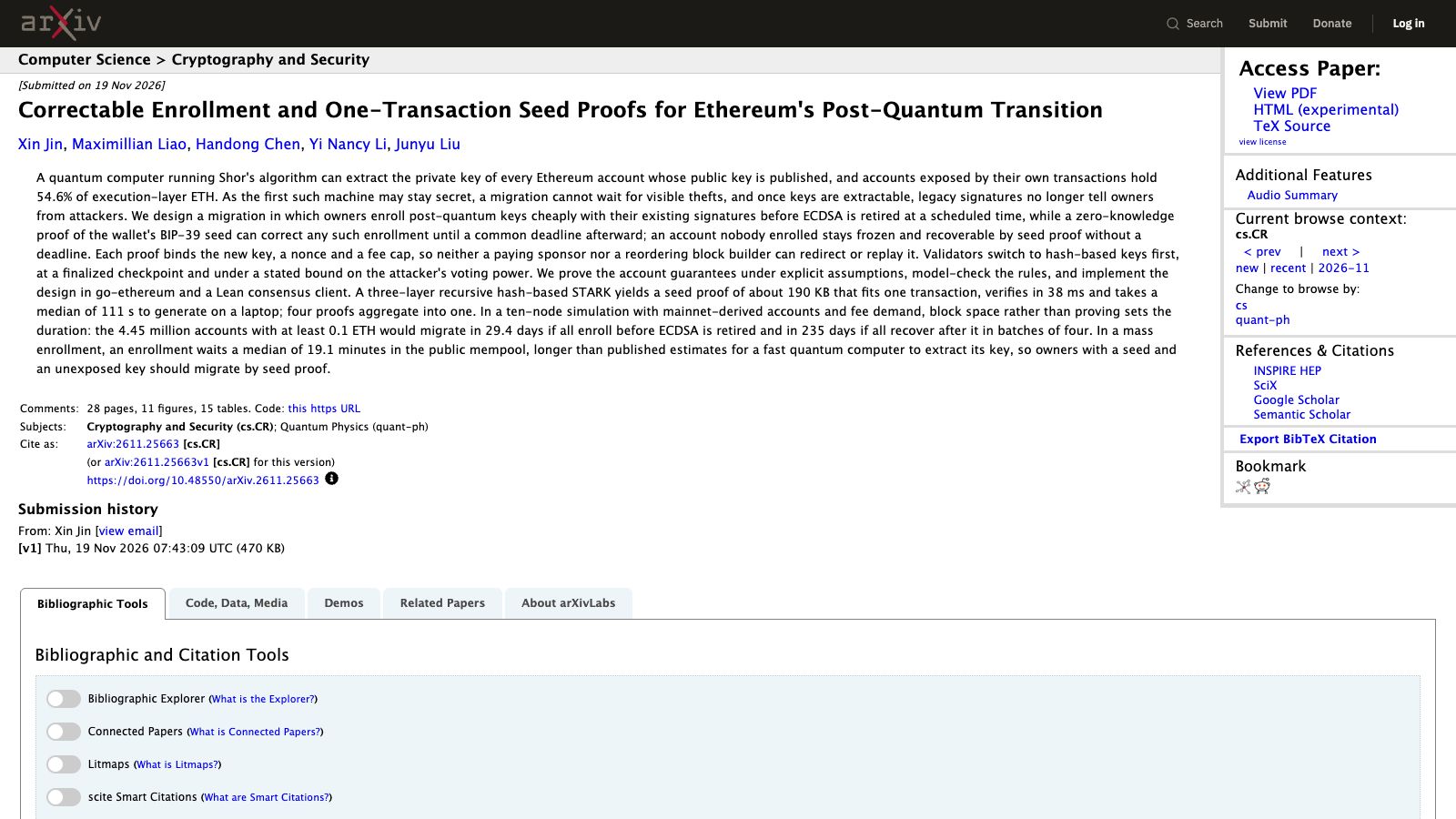
A paper posted to arXiv on 19 November by Xin Jin and four co-authorsPitt/SeQure researchers: Correctable Enrollment and One-Transaction Seed Proofs for Ethereum’s Post-Quantum…. designs a way to move Ethereum accounts off keys a quantum computer could break, after finding that accounts exposed by their own past transactions hold 54.6% of the ether on Ethereum’s execution layer in keys vulnerable to that attack.
The paper is a research design and simulation, not a change Ethereum’s developers have adopted into the live protocol.
Under the plan, owners enroll a post-quantum key using their current signature before a scheduled retirement of ECDSA, Ethereum’s signing scheme, and a zero-knowledge proof of a wallet’s BIP-39 seed phrase can correct a wrong enrollment up to a later common deadline; an account nobody enrolls stays frozen but can still be recovered by seed proof with no deadline. Each proof locks in the new key, a nonce and a fee cap, so a sponsor paying the gas or a block builder reordering transactions cannot redirect or replay it. Validators move to hash-based keys first, at a finalized checkpoint and under a stated limit on how much voting power an attacker could hold.
The underlying proof is about 190 kilobytes, fits in a single transaction, verifies in 38 milliseconds and takes a median of 111 seconds to generate on a laptop, with four proofs able to combine into one.
In a simulation, the 4.45 million accounts holding at least 0.1 ETH would migrate in 29.4 days if everyone enrolls before ECDSA retires, against 235 days if everyone instead waits to recover afterward in batches of four. A mass enrollment leaves a transaction waiting a median of 19.1 minutes in the public mempool, longer than published estimates for how fast a quantum computer could pull a key from it, so the researchers say owners holding a seed phrase and an unexposed key should migrate by seed proof instead.
Sources
Disclosure
This article was drafted by S-Curve Desk, an AI system, from the sources above. Boaz Sobrado reviewed it before publication. Errors: the corrections log, or write to us.