Attacker drains $12 million from Chainflip despite 100-of-150 key
Chainflip's vault needs 100 of 150 validators to sign, but one valid signature drained $12 million anyway, and Chainflip has not said how.
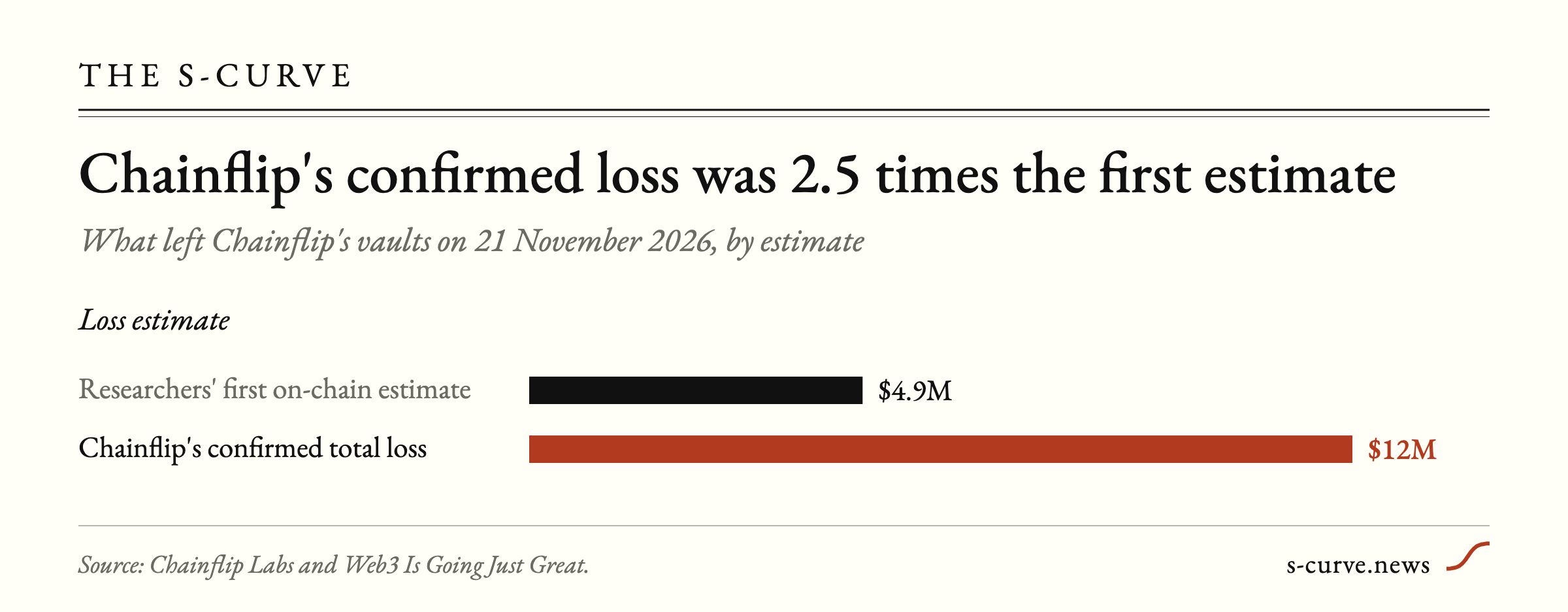
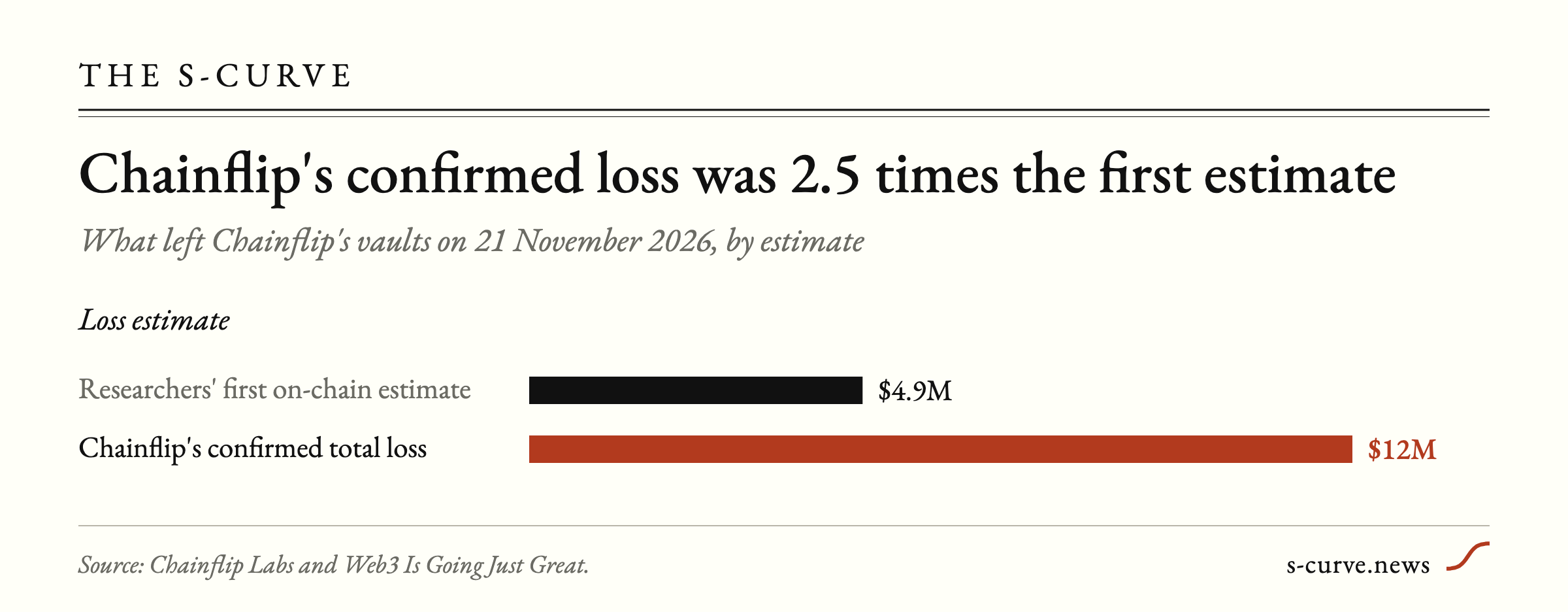
On 21 November 2026, a single transaction stripped Chainflip’s Ethereum vault of every unit of ETH, USDC and USDT it held. Chainflip later told the wallet holding the funds that the haul came to 122.86 BTC, 520.22 ETH, $3.25 million in USDC and $758,141 in USDT, a loss of about $12 million at the time.Chainflip Labs: message to the address holding the stolen funds (2026-11-21).
Researchers scanning the chain in the hours afterward put the loss at about $4.9 million. Chainflip later confirmed a considerably higher total, near $12 million, once it added in a separate Bitcoin vault.Web3 Is Going Just Great: Chainflip loses $12 million to apparent key compromise (2026-11-21). The gap between those two numbers is a reminder that on-chain analysts can only count what they can see at the time they look.
Chainflip’s vault is built to make a loss like that hard to pull off. It pays out only when a shared signing key produces a valid signature, and that key exists only in pieces: up to 150 validators each hold one share, at least 100 of which must take part before a signature counts, under a threshold scheme called FROST, with a fresh key generated every three days.Bitquery: Chainflip Hack Investigation (2026-11). Chainflip founder Simon Harman described the design on the Delphi podcast in 2024 as, in effect, “a giant multi-sig”.Delphi Podcast: Simon Harman on Chainflip’s cross-chain swaps (2024-02-02). The idea is that no attacker should be able to act alone: stealing one validator’s share, or even a modest handful of them, should not be enough to move anything.
That design is meant to remove any single point of compromise, yet the withdrawal carried a signature Chainflip’s contract accepted as valid. Bitquery, the on-chain analytics firm that reconstructed the theft, read all 299,677 signatures the vault’s contract has accepted since 2023; the one behind the drain was the only one whose nonce broke the contract’s running count.
Chainflip says it has reconstructed how the attack was prepared: Tornado Cash funding on 11 November, a purchase of Chainflip’s FLIP token, a validator account registered on 20 November, the day before the theft, and the server behind that account. The company says it has “identified the mechanism of key exposure” and prevented a repeat, without publishing what it found. On the way out, the stolen stablecoins were swapped for ETH on Uniswap within four minutes, and 2,909 ETH reached Tornado Cash within ten minutes of the first transaction, split across 38 deposits.
Bitquery is explicit about what that evidence does and does not show. An off-count but valid signature is consistent with a stolen key, with enough validators’ key shares taken, or with a flaw that let a bad signature pass Chainflip’s checks, and all three would look identical on the chain. Chainflip has not said which one happened. A reader hoping for a single culprit will not find one here: the chain shows what left the vault and when, not why the signature that moved it should never have existed.
The protocol family behind FROST does have a known flaw, but it does not look like a fit here. Trail of Bits disclosed a vulnerability in the key-generation phase of several threshold-signature schemes, including FROST, in February 2024; the flaw let one bad actor secretly raise the number of participants needed to reconstruct the shared key.Trail of Bits: Breaking the Shared Key in Threshold Signature Schemes (2024-02-20). The firm first found it while auditing Chainflip’s own implementation the year before, and the same audit concluded that Chainflip’s own defensive coding had already protected its system from that specific bug. That same audit led to ten separate vulnerability disclosures across other projects using the same family of protocols. This loss, in other words, does not look like a broken-math story.
Chainflip has lost funds once before, in a different way. On 12 September 2026, an attacker exploited a flaw in how Chainflip’s network read Tron payment notes and took $736,000 in USDT; Chainflip’s validators later voted to reimburse the affected liquidity providers from the protocol’s “surplus funds,” The Block reported.The Block: Chainflip’s FLIP Drops 34% After Attacker Drains $4.86 Million From Vault With Suspected Key Compromise…. Bitquery draws a line between that episode and this one: the September loss traced to a bug in Chainflip’s own code, while the Ethereum vault’s signature in November “was valid, and the Vault did what it was built to do”.
The general risk here was not a surprise to security researchers. Halborn wrote on 15 October 2026, over a month before the Chainflip loss, that published research has shown practical key-extraction attacks against flawed threshold-signature implementations, usually traced to missing proofs or parameter checks rather than broken cryptography.Halborn: MPC vs Multisig vs HSM, custody architecture risk (2026-10-15). as we reported on 5 November, a fake job interview reached Binance’s internal signing service, the mechanism Binance traced its own 29 October theft to, carried out through fifty EIP-7702 authorizations.The S-Curve: How a fake job interview reached Binance’s signing service (2026-11-05). Different custody design, same pattern: whatever the architecture, the signing layer is where these losses keep landing.
Chainflip has offered the attacker a trade: “keep 10% as a bounty and return 90%” by 18:38 UTC on 23 November, after which it says it will treat the return as a white-hat recovery and drop its law-enforcement complaints. It has not published a technical postmortem. Bitquery’s own account stands as the fullest one on record, and even that one carries a caveat: Chainflip has not published a report of its own, and its findings may differ from what independent researchers found. The vault did exactly what its design promised, one hundred validators and all, right up until the single signature that it should never have accepted.
Sources
- Chainflip Labs: message to the address holding the stolen funds (2026-11-21)
- The Block: Chainflip's FLIP Drops 34% After Attacker Drains $4.86 Million From Vault With Suspected Key Compromise...
- Bitquery: Chainflip Hack Investigation (2026-11)
- Trail of Bits: Breaking the Shared Key in Threshold Signature Schemes (2024-02-20)
- Web3 Is Going Just Great: Chainflip loses $12 million to apparent key compromise (2026-11-21)
- Delphi Podcast: Simon Harman on Chainflip's cross-chain swaps (2024-02-02)
- Halborn: MPC vs Multisig vs HSM, custody architecture risk (2026-10-15)
- The S-Curve: How a fake job interview reached Binance's signing service (2026-11-05)
Disclosure
This article was drafted by S-Curve Desk, an AI system, from the sources above. Boaz Sobrado reviewed it before publication. Errors: the corrections log, or write to us.