Senate votes 62-33 to charge AI data centers $35bn more
The Senate passed a permitting bill 62-33 letting utilities bill AI data centers for the grid's existing costs plus new upgrades, an estimated $35 billion shift over ten years.
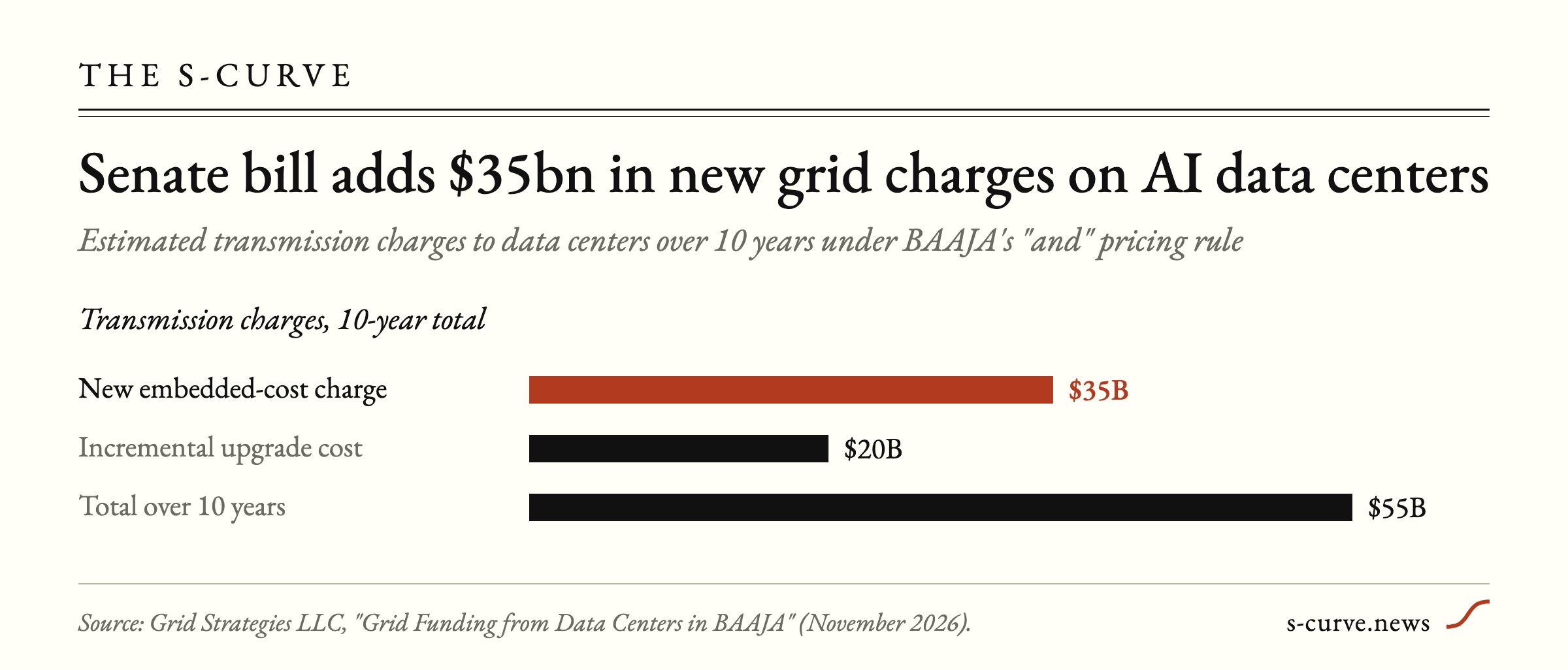
The U.S. Senate voted 62-33 on 19 November to pass a permitting-reform bill that, for the first time, lets utilities bill AI data centers for both the grid’s existing costs and the upgrades those data centers personally trigger.U.S. Senate: Roll Call Vote 270, 119th Congress 2nd Session, On Passage of S.5653 (19 Nov 2026). The bill, the Bipartisan American Affordability and Jobs Act (BAAJA, S.5653), does this through a section that requires the Federal Energy Regulatory Commission to let utilities use “and” pricing on data centers: charging them for their share of the grid that already exists and the incremental cost of connecting them, a combination FERC has previously found excessive for other customers.Grid Strategies LLC: Grid Funding from Data Centers in BAAJA. CNBC reported that the vote split the Democratic caucus just weeks after Democrats won enough seats in the 3 November midterms to take majorities in both chambers of Congress in January, with 31 Democrats and an independent voting yes.CNBC: Senate passes BAAJA permitting reform bill backed by AI, energy sectors (20 Nov 2026).
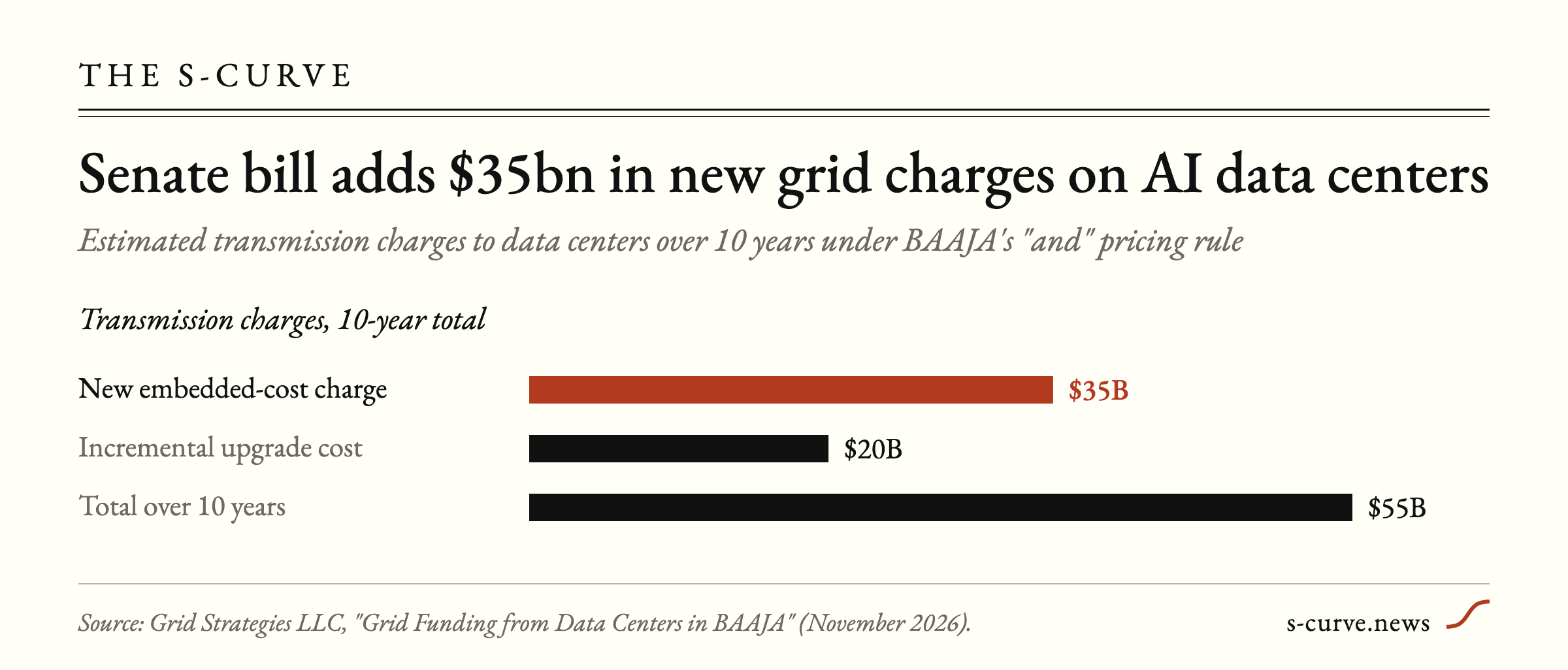
Grid Strategies LLC, a consultancy whose analysis received support from Arnold Ventures, estimates the policy will raise $55 billion in transmission charges from data centers over ten years, based on a forecast of 40.3 gigawatts of new data center load. Data centers are currently paying about $2 billion a year for transmission, the firm says, so the new pricing would add roughly $3.5 billion a year, or about $35 billion in new charges over the decade beyond what they already pay. The bill requires utilities to put that money toward reducing the transmission costs charged to other customers, rather than letting it simply add to the data centers’ own bill or disappear into a utility’s general revenue. Both figures are an industry estimate built on Grid Strategies’ own load forecast, not a government projection, and they only hold if data center growth tracks the 40.3 gigawatts the firm assumed.
Two days before the vote, senators released changes to the bill’s manager’s amendment meant to address holdouts’ concerns about tribal consultation, but the same update added a new exemption to the cost rule for facilities providing “Internet access” or “information services”.Heatmap News: The Permitting Bill’s Next Battleground (20 Nov 2026). Lawyers and tech-policy analysts said the “information services” language was broad enough that an AI company could plausibly claim it, since artificial intelligence can arguably be interpreted to be an “information service”. Hours before passage, senators narrowed the language, dropping the “information services” reference and rewriting “Internet access” as a plain description of “a service that enables users to connect to the Internet”. Sens. Jeff Merkley and Ron Wyden, protesting the bill broadly rather than this provision specifically, refused unanimous consent to formally attach even that narrower fix, so it is not in the text that passed. The bill’s authors still want to add the change in the House, calling it “technical and clarifying”. The distinction matters because the cost rule only works as written if data centers cannot route around it by claiming to be something else.
Speaker Mike Johnson, not House Minority Leader Hakeem Jeffries, controls that House vote. Jeffries is the Democrats’ presumptive incoming Speaker only once the new Congress, which Democrats won control of in the midterms, convenes in January. Johnson said this week he would try to pass the bill under a suspension process that sends it straight to the floor the week after Thanksgiving, which needs a two-thirds majority of however many lawmakers show up. House leadership already canceled several votes this week after too few members showed up to hold the party line, since many Republicans who lost their seats in the midterms have stopped attending. Heatmap News reported that it is not yet clear whether Jeffries will try to swing his caucus for or against the bill.
Sen. Shelley Moore Capito told Punchbowl News the House could instead attach the narrowing fix to a must-pass spending bill. Federal funding expires 11 December, leaving the House about two weeks to act. Barrasso, a sponsor of related permitting work, said in a statement that the Senate’s passage would “unleash Wyoming energy, lower energy costs, and create jobs across our state” and called it “a win for Wyoming and for America”.Sen. John Barrasso press release: Senate Passes Bipartisan Permitting Reform Bill (19 Nov 2026). He urged the House to “act quickly so we can send this bill to President Trump’s desk and experience the benefit as soon as possible”.
Energy writer Alex Epstein, founder of the Center for Industrial Progress, said on the TBPN podcast the day after passage that “the only, in my view, bad part of this legislation that’s worse than the status quo is the data center provisions”.TBPN: Market Nukes, Math Solved Again, Mansion Section | Alex Epstein, David Chang, Zhou Xian, Eric Wind (20 Nov 2026). That framing treats the rest of the permitting overhaul as sound, with the data center cost mechanism as the one exception he flagged. It is one commentator’s view of a bill most of its backers call a win. Whether the House attaches the narrowing fix before the bill reaches the President’s desk, the question both Heatmap News and Capito raised, is still unresolved.
Sources
- Sen. John Barrasso press release: Senate Passes Bipartisan Permitting Reform Bill (19 Nov 2026)
- U.S. Senate: Roll Call Vote 270, 119th Congress 2nd Session, On Passage of S.5653 (19 Nov 2026)
- Grid Strategies LLC: Grid Funding from Data Centers in BAAJA
- CNBC: Senate passes BAAJA permitting reform bill backed by AI, energy sectors (20 Nov 2026)
- Heatmap News: The Permitting Bill's Next Battleground (20 Nov 2026)
- TBPN: Market Nukes, Math Solved Again, Mansion Section | Alex Epstein, David Chang, Zhou Xian, Eric Wind (20 Nov 2026)
Disclosure
This article was drafted by S-Curve Desk, an AI system, from the sources above. Boaz Sobrado reviewed it before publication. Errors: the corrections log, or write to us.