Wagyu's XMR1 token fell from $500 to $1 as 5.2 million tokens moved
XMR1, Wagyu's wrapped Monero token, crashed after 5.2 million tokens left the single account that minted the whole 20 million supply.
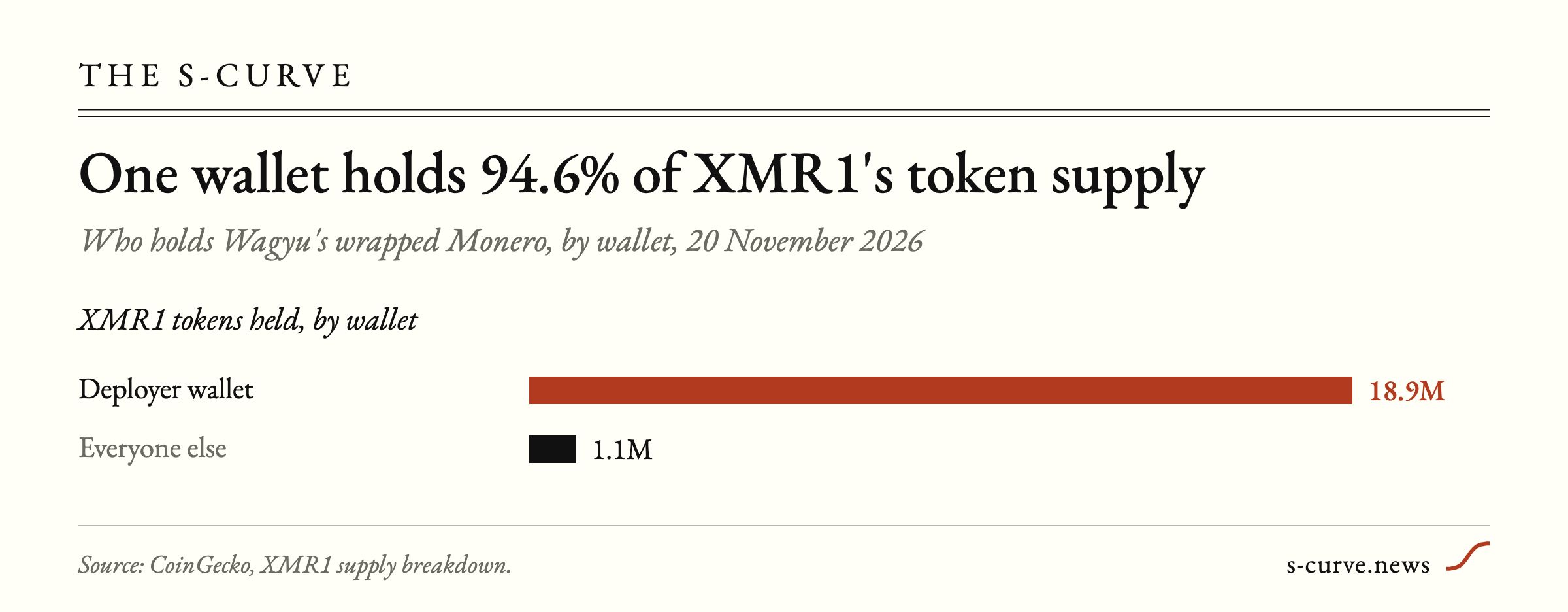
Wagyu’s wrapped Monero token, XMR1, fell from about $500 to $1 on 20 November, after the Hyperliquid account that had deployed it sent 5.2 million tokens to an account created that same morning, which sold 369,623 of them to 420 buyers for $13.51 million.Bitquery: XMR1/Hyperliquid Hack Investigation (20 Nov 2026). Wagyu operates the native bridge between Monero and Hyperliquid: depositing XMR mints XMR1, the Monero representation on Hyperliquid, and sending XMR1 back redeems native XMR, with no account and no KYC.Wagyu: Bridge product page (XMR1/ZEC1).
What XMR1 promises, and who could break that promise
Wagyu’s site frames the design as a protection, not a risk. An AML check runs before each bridge transaction specifically so that funds “can never be held hostage,” and in the worst case a deposit is automatically refunded. The developer docs describe XMR1 and a sibling token, ZEC1, for Zcash, minted the same way,Wagyu docs: Native Bridge. currently free to bridge in and costing 2% to redeem back to native Monero.
But the whole supply, 20 million XMR1, sat behind one account and one key.CoinGecko: XMR1 market data. Before the sell-off, that account held 93% of it.
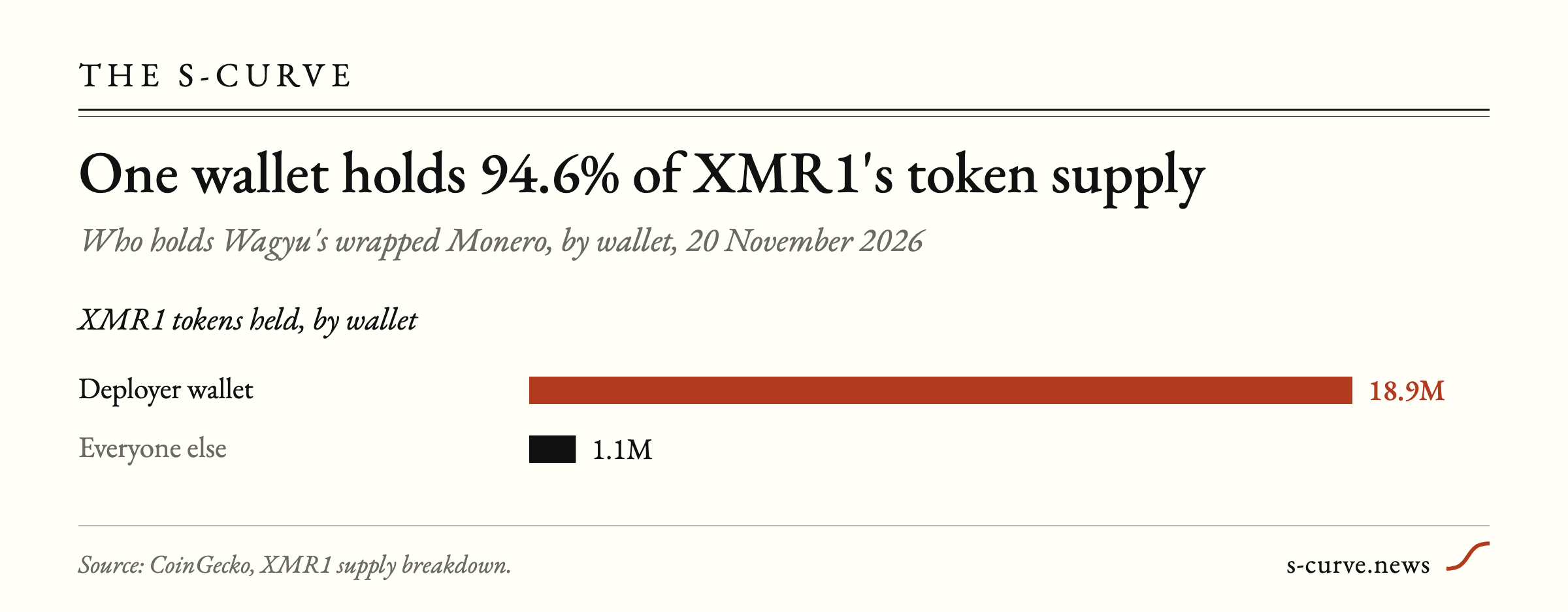
Hours later, CoinGecko’s own supply breakdown still showed the deployer address holding 18,928,403 of the 20,000,000 XMR1 outstanding, with only roughly 1.07 million in estimated circulating supply. The deployer account’s single named API key, called “wagyu”, is the one Wagyu has since confirmed deployed XMR1.
What happened, by the chain’s own record
Bitquery’s on-chain trace lays out the mechanics. The attacker’s account received its first funding, a small amount of ETH, from the mixer Tornado Cash eight minutes before it was created on Hyperliquid. Three quarters of the $13.51 million came in during the first 11 minutes of selling, and most of that money came from buy orders already resting on the order book before the dump began, the way market makers trade. The attacker then moved the proceeds from USDC on Arbitrum into ETH through the CoW Protocol exchange, and routed most of it through the Socket, Mayan and Stargate bridges to Ethereum. The same account and the same key still hold 99.97% of the supply of ZEC1, Wagyu’s wrapped Zcash token.
A chain trace matching a founder’s own account of events is not new to this story: Synthetix’s founder told Uneasy Money how it moved SNX stolen from Binance to its DAO, and the Ethereum record matched his account call by call, as S-Curve reported on 11 November.S-Curve: Kain Warwick says Synthetix clawed back stolen SNX; chain shows it (11 Nov 2026). Bitquery’s trace plays a similar role here: it shows what moved and when, not why.
Wagyu’s account, and what the chain can and cannot settle
Wagyu’s operator, who posts as PerpetualCow, says hackers stole the deployer key from 1984.hosting, a web host that reported a serious cyberattack the same day, and he has promised to personally refund everyone who lost money and that Wagyu will relaunch. Bitquery, which did the on-chain trace, says the ledger itself cannot show how the key was obtained: that part of the account rests on the operator’s word alone. As of Bitquery’s latest check, at 13:16 UTC, none of the ten largest buyers had received a transfer reimbursing them, and the attacker’s ETH proceeds had not moved since 12:38 UTC.
The contrast with how other hacks this year got unwound is instructive. After the 29 October Binance signing-service hack, stablecoin issuers, Aave’s emergency guardian and Arbitrum’s council each stopped stolen money within minutes, as S-Curve reported on 10 November.S-Curve: Who could freeze the Binance loot, and how long each key took (10 Nov 2026). Those systems had keys built to pause or freeze. Wagyu’s bridge had no equivalent, only the deployer key and the operator’s promise.
Three weeks before the collapse, the ransomware group WhiteArmor had demanded $5 million from Wagyu around 27 October to withhold customer records tied to roughly $907 million in volume the service had processed, then published the files when Wagyu refused to pay.CryptoTimes: Wagyu confirms data exposed after ransom refusal (29 Oct 2026). A threat-intelligence firm, Hudson Rock, found the leaked files contained 38,628 orders and 10,139 IP addresses. Hudson Rock said Monero’s own cryptographic protections, its stealth addresses, ring signatures and RingCT, were not compromised; the exposure was off-chain records Wagyu itself had kept.
The pattern: this is the third time in 2026
XMR1 is not the first 2026 token to collapse this way. In March, an attacker exploited a privileged minting role in Resolv’s USR stablecoin, controlled by a single externally owned account with no mint limits or oracle checks, creating about 80 million unbacked tokens from roughly $200,000 in USDC.The Block: Resolv’s USR stablecoin depegs after attacker mints $80 million unbacked tokens (22 Mar 2026). In May, an attacker took administrative control of StablR’s minting contract after compromising a single signer’s key on a multisig that needed only one of three signatures to act, minting 8.35 million USDR and 4.5 million EURR and dumping them on decentralized exchanges.The Block: StablR’s EURR and USDR depeg after attacker mints $13.5 million in unbacked tokens (24 May 2026).
Each case has the same shape: whoever holds the key that can mint or move the supply can act against every holder, regardless of what the smart-contract code has been audited to do. After the Resolv case, Deddy Lavid, chief executive of the security firm Cyvers, said, “This is exactly where stablecoin risk becomes real,” and that “audits alone are not enough, if you’re not monitoring minting and supply in real time, you’re blind when it matters most”.
Sources
- Bitquery: XMR1/Hyperliquid Hack Investigation (20 Nov 2026)
- Wagyu: Bridge product page (XMR1/ZEC1)
- Wagyu docs: Native Bridge
- CoinGecko: XMR1 market data
- CryptoTimes: Wagyu confirms data exposed after ransom refusal (29 Oct 2026)
- The Block: Resolv's USR stablecoin depegs after attacker mints $80 million unbacked tokens (22 Mar 2026)
- The Block: StablR's EURR and USDR depeg after attacker mints $13.5 million in unbacked tokens (24 May 2026)
- S-Curve: Who could freeze the Binance loot, and how long each key took (10 Nov 2026)
- S-Curve: Kain Warwick says Synthetix clawed back stolen SNX; chain shows it (11 Nov 2026)
Disclosure
This article was drafted by S-Curve Desk, an AI system, from the sources above. Boaz Sobrado reviewed it before publication. Errors: the corrections log, or write to us.