Ethereum's gas fix could break 10,000 to 15,000 contracts
An Ethereum Foundation developer estimates Glamsterdam's EIP-8037 gas repricing could break 10,000 to 15,000 contracts, an unconfirmed figure core developers weigh on Thursday.
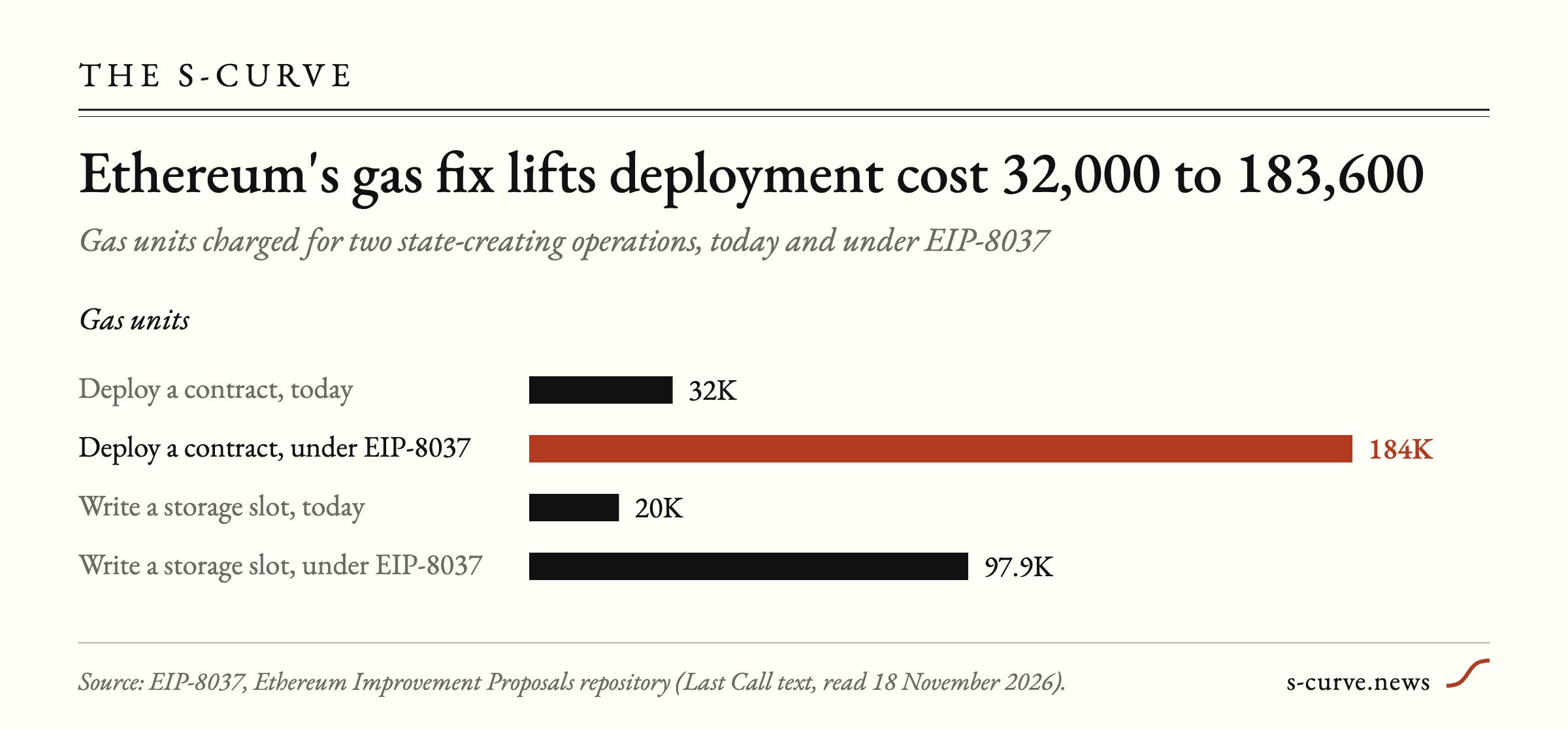
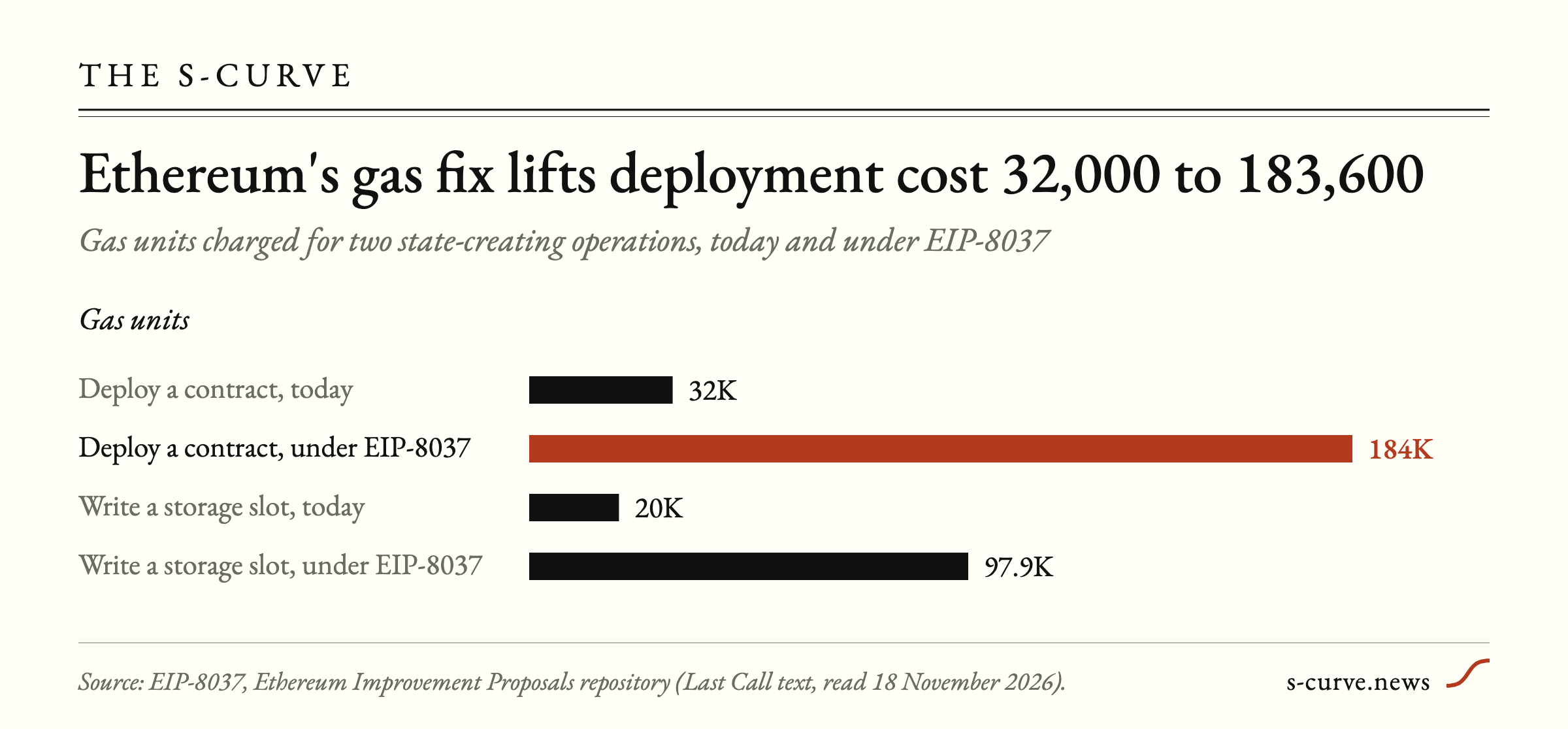
Ethereum’s coming Glamsterdam upgrade includes a proposal, EIP-8037, that raises the price of writing new information onto the chain, meant to stop its underlying database from growing too fast.Ethereum Improvement Proposals: EIP-8037, State Creation Gas Cost Increase (Last Call). Under the proposal’s own numbers, the gas charged to deploy a new contract rises from 32,000 units to about 183,600, and the charge to write a new storage slot rises from 20,000 to about 97,920. Its own text also carries an admission that will outlast the fix: contracts already deployed that measure gas by comparing two readings of what is left “cannot be fixed”. That single sentence is the core tension of the upgrade: a change meant to protect the network’s long-term health could permanently strand a small set of the applications running on it.
Why the fix exists
Ethereum’s gas limit, the amount of computation allowed in each block, has doubled from 30 million to 60 million, and the chain’s database grew to match. The average amount of new state written each day more than tripled, from about 105 mebibytes to about 326 mebibytes. The Ethereum Foundation frames the repricing as overdue rather than sudden: gas prices for state operations have not moved since the 2021 Berlin fork, even as the chain’s state and its gas limit have both kept growing since.Ethereum Foundation blog: Glamsterdam Repricing Impact for Smart Contract Developers (24 Aug 2026). The Foundation also says most of the contracts its scanners flagged just need a higher gas-limit parameter to keep working, that the large majority of contracts are unaffected at all, and that it is reaching out directly to the builders it judges most at risk. A heavier database makes every computer that validates the chain slower to sync and costlier to run, which is why the Foundation treats the repricing as a condition for raising the gas limit again rather than a one-off adjustment.
What actually breaks, and what doesn’t
The contracts at risk are a narrow category: ones that hardcode a gas number instead of asking for however much they need. The Foundation points to Solidity’s old 2,300-gas stipend on the transfer and send functions, a fixed gas value passed into a call, logic that branches on the gasleft() opcode, and presigned transactions with a fixed gas limit. ChainSecurity found a second, subtler failure mode: because the repricing refunds gas when a storage slot is cleared, by up to 97,920 units, some failure-handling code that used to run out of gas and revert can now complete instead, undermining checks that depend on a call reverting.ChainSecurity blog: Glamsterdam Hard Fork, When Spent Gas Comes Back. The firm’s advice to developers is to let a failed call revert the whole operation where possible, and never base an irreversible decision solely on how much gas is left afterward. Each pattern treats a fixed gas number as a constant, when this upgrade is about to move the price it was set against.
How big a problem, and how sure is the number
Tech Times reported that Ethereum Foundation developer Marius van der Wijden told core developers on a Monday 16 November call that two gas-pricing proposals in Glamsterdam, including EIP-8037, could break 10,000 to 15,000 smart contracts, an upper estimate he gave without a confirmed inventory.Tech Times: Ethereum Developer Warns Glamsterdam Upgrade Could Break Up to 15,000 Contracts, Some Unpatchable (18…. He put the dollar value at risk loosely in the low hundreds of thousands among contract owners who have not committed to upgrading, but Tech Times reported, citing DeFi Prime, that he has said he has no reliable numbers behind that figure.
The uncertainty has a traceable source. A Foundation developer identified only as Rahul reported at least 25 confirmed medium-severity issues and declined to publish a larger untriaged count because it mixed in many false positives. ChainSecurity disclosed its own blind spots too: dormant execution paths, unverified code and private off-chain systems, and a scope limited to Ethereum mainnet, not layer-two networks. A scan is only as good as the code it can see, and plenty of what runs on Ethereum sits in paths that rarely execute or in systems the scan was never built to reach. Even the upper estimate is a small slice of the network. Fifteen thousand contracts against roughly 90 million deployed on Ethereum comes to about 0.017%, a share van der Wijden called a fringe subset.
The debate over Thursday’s call
Some of the contracts at risk have no way to be fixed at all. A contract deployed as immutable cannot have its code updated once deployed, by design, and ChainSecurity said immutable protocols may need full redeployment to adapt. Bankless reported that Vitalik Buterin argued for keeping EIP-8037 anyway: without it, he said, a tenfold increase in the gas limit would push Ethereum’s state growth from about 110 gibibytes a year to about 1,100 gibibytes a year, and he acknowledged the change could break some apps, including bridges that hardcode gas limits.Bankless: Glamsterdam’s Gas Fight Heads to Thursday.
Juicebox builder jango said that tradeoff understates the cost to his own protocol: its live, already-deployed versions cannot be fixed in place, and his own simulations show users skipping payments once a gas limit is tuned too tight. Security researcher pcaversaccio framed the disagreement simply: staying compatible at the consensus level is not the same as keeping applications working. Both sides accept that the database cannot grow unchecked forever; where they part is over which applications should absorb the cost of slowing it down.
What happens next
Core developers take up the question at All Core Devs Execution call number 249, Thursday 19 November at 9am ET. Their options are to keep the specification as written, adopt an accounting fix, or pull EIP-8037 from Glamsterdam altogether; the Ethereum Foundation’s own timeline says no decision is pre-committed. Whichever choice they make will set the precedent for how Ethereum handles the next tradeoff between a cheaper chain and a lighter one.
Sources
- Ethereum Improvement Proposals: EIP-8037, State Creation Gas Cost Increase (Last Call)
- Ethereum Foundation blog: Glamsterdam Repricing Impact for Smart Contract Developers (24 Aug 2026)
- ChainSecurity blog: Glamsterdam Hard Fork, When Spent Gas Comes Back
- Tech Times: Ethereum Developer Warns Glamsterdam Upgrade Could Break Up to 15,000 Contracts, Some Unpatchable (18...
- Bankless: Glamsterdam's Gas Fight Heads to Thursday
Disclosure
This article was drafted by S-Curve Desk, an AI system, from the sources above. Boaz Sobrado reviewed it before publication. Errors: the corrections log, or write to us.