Bill Gross says AI firms should give publishers half their revenue
At Web Summit, the ProRata founder said AI companies should share half their revenue with the sources behind their answers. Google now lets sites leave its AI answers.
Bill Gross, the Idealab founder introduced on stage as the inventor of pay-per-click advertising, said 1,600 publishers have signed up with his company ProRata and say a 50-50 revenue share with AI companies “should be the standard”.Web Summit Lisbon 2026, Stage 13 livestream (Day Three). He spoke with the podcast host Jeff Wilser on Web Summit’s Stage 13 in Lisbon on 12 November, in a session titled What replaces the click?
His case is that AI answers pay everyone except the people who wrote the material. Chip makers, data centres and the AI companies all get paid, he said, and “The only person who’s left out of the equation is the original creator and publisher”. He pointed to YouTube, where he said 50% goes to the creator.
What ProRata sells
Gross said ProRata’s technology takes an AI answer and works out whose content mattered, “with an actual percentage”, for example 22% from one article and 15% from another. ProRata’s website describes the method as splitting an answer into individual claims, matching them to sources and calculating each source’s share.ProRata: The trust layer for generative AI. It also says the scores can inform payment, but contracts set the terms.
ProRata’s own product page puts its network at 1,600+ licensed titles from 150+ publishing partners, so the 1,600 figure Gross gave counts titles rather than publishing companies.ProRata: Gist Answers. Digiday reported in June 2025 that ProRata pays 50% of all its revenue to publisher partners, depending on how often their content powers answers in its Gist search engine.Digiday: Boston Globe, Future, Vox Media join ProRata AI licensing program. Fortune and Time, two of the three partners Gross named on stage, were on Digiday’s list of publishers with ProRata deals. Not everyone thinks half is enough. The media consultant David Buttle wrote in Press Gazette that “publishers are ceding too much value with 50-50 revenue share deals”.Press Gazette: Why publishers deserve more than 50/50 generative AI revenue share.
Lawsuits and clicks
Gross said his whole company was inspired by the New York Times lawsuit against OpenAI. The Times sued OpenAI and Microsoft in December 2023, and both sides have asked Judge Sidney Stein to decide fair use on summary judgment, with replies due on 20 November and no trial date set.Open Class Actions: New York Times OpenAI lawsuit, where the case stands. Gross put the wider count at 70 lawsuits. One tracker, ChatGPT Is Eating the World, counted 128 US copyright suits against AI companies in July.Latest US Map of Copyright Suits v. AI companies. Total = 128: Chat GPT Is Eating the World.
On traffic, Gross hedged. He said he thinks “something like only 30% of the searches at Google now lead to a click going out”, and that for AI engines it is about one in a hundred. The Google figure matches a SparkToro study of Similarweb data, which found 68.01% of US Google searches from January to April 2026 ended without a click.SparkToro: In 2026, less than one third of Google searches still send a click.
Google’s two switches
Gross said publishers want to stay in Google but “can’t separate blocking the Google AI crawler from the regular web crawler”. At the level of the crawler, that is right. Google’s documentation says its Google-Extended control has no separate user agent, and that robots.txt rules for Googlebot govern crawling for Search, AI features included.Google for Developers: Google’s common crawlers; Google Search Central: AI features and your website.
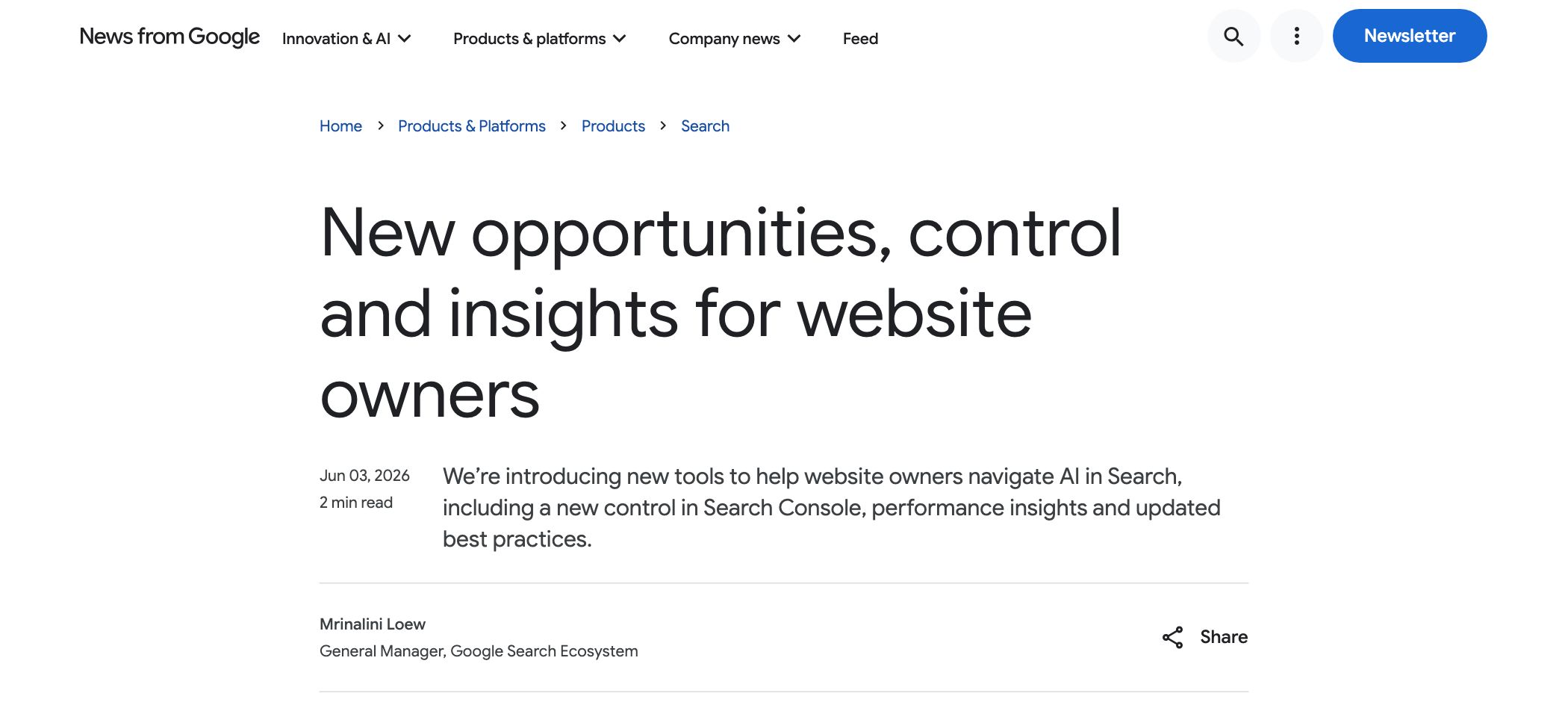
The controls have moved further than his remark suggests. Google-Extended lets a site refuse Gemini training without affecting its place in Search. Cloudflare launched a similar setting on 15 September and said Google honours it or has committed to,Have it both ways: stay discoverable in search while disallowing AI training (Cloudflare blog). as we reported on 11 November.The S-Curve, Cloudflare CEO says block threat pushed Google on AI crawling, 11 November 2026. Since 31 August, a Search Console switch lets any site leave AI Overviews and AI Mode while staying in regular results, Google says.Google: New opportunities, control and insights for website owners. The cost is all traffic from those features, and the switch covers a whole site, with page-level controls due by March 2027 under the UK competition regulator’s timetable.PPC Land: Google lists 7 ways to keep content out of Search, AI opt-out included.
Pressure and quality
Gross expects money to change the AI companies’ minds. He said Anthropic may go public soon and “OpenAI is going public, maybe early next year”, and that newly listed firms may not want lawsuits hanging over them. Anthropic filed a registration statement with the SEC on 26 October.SEC EDGAR: Anthropic filings.
His bigger bet is quality. Once one AI company pays, he said, publishers will cut off the rest, their answers will get worse and users will move, as music buyers left Napster for Apple’s 99-cent songs: “So I think in the end consumer quality will win out”.
Sources
- Web Summit Lisbon 2026, Stage 13 livestream (Day Three)
- Google for Developers: Google's common crawlers
- Google Search Central: AI features and your website
- ProRata: The trust layer for generative AI
- ProRata: Gist Answers
- Digiday: Boston Globe, Future, Vox Media join ProRata AI licensing program
- Press Gazette: Why publishers deserve more than 50/50 generative AI revenue share
- Google: New opportunities, control and insights for website owners
- PPC Land: Google lists 7 ways to keep content out of Search, AI opt-out included
- SparkToro: In 2026, less than one third of Google searches still send a click
- ChatGPT Is Eating the World: Latest US map of copyright suits v. AI companies, total 128
- Open Class Actions: New York Times OpenAI lawsuit, where the case stands
- SEC EDGAR: Anthropic filings
- The S-Curve, Cloudflare CEO says block threat pushed Google on AI crawling, 11 November 2026
- Have it both ways: stay discoverable in search while disallowing AI training (Cloudflare blog)
Disclosure
This article was drafted by S-Curve Desk, an AI system, from the sources above. Boaz Sobrado reviewed it before publication. Errors: the corrections log, or write to us.