Arkansas and Utah test who regulates Kalshi's sports bets
Arkansas sued Kalshi on 4 November and Utah has both a lawsuit and criminal charges. Underneath all of it is one question: do federal derivatives rules or state gambling law apply?
Arkansas is the latest state to test whether a sports contract on Kalshi is a bet or a federally regulated swap. Attorney General Tim Griffin sued the prediction market on 4 November, accusing it of running an illegal gambling operation.Arkansas Advocate: Arkansas accuses prediction market, online gaming platform of operating illegal gambling; crypto.news: Arkansas sues Kalshi; Finance Magnates: Arkansas sues Kalshi. “Arkansas law is concerned with substance, not semantics,” Griffin said in a statement.Arkansas Attorney General: Griffin sues prediction market Kalshi. The suit asks a judge to declare that Kalshi violated the state’s deceptive trade practices act and to award restitution. It also seeks civil penalties, unpaid taxes and an injunction. The Arkansas Advocate reported that the complaint accuses Kalshi of operating a “pocket-sized bookie” and allowing users as young as 18 to wager real money on sporting and entertainment events.
Kalshi has said in other state cases that its sports contracts are swaps regulated by the CFTC, not bets. That disagreement, not any one complaint, is what the courts are deciding. Utah, which CoinDesk names as one of the states already in the fight, has taken a different route from Arkansas’s.CoinDesk: The pile of lawsuits against Kalshi just grew by one.
What Utah has done
Utah moved in three steps, and a federal court came first. Kalshi sued Utah in federal court in February.KUER: Utah sues Kalshi. In August a judge ruled that Utah’s anti-gambling laws apply to the sports contracts Kalshi offers, and that the federal law Kalshi relied on does not preempt the state’s ability to enforce its statutes.Deseret News: Utah sues Kalshi. Kalshi appealed and asked for an injunction while the appeal runs, and the Tenth Circuit denied that request in September.
On 20 October, Attorney General Derek Brown filed a civil suit against Kalshi in state court, not under a consumer-protection statute but on the theory that its operation is a public nuisance. The 63-page suit, filed in the 3rd District Court in Salt Lake City, seeks to stop Kalshi operating in Utah and to collect millions of dollars in damages. The state estimates that Kalshi earned between about $30.6 million and $61.2 million in fees from what it calls illegal wagers placed by Utah accounts.Stateline: Utah sues Kalshi. Brown framed the case as a question of state choice: “every state can choose how they treat this issue”.
Kalshi responded the same day. “Kalshi is a federally regulated financial exchange, like the stock market. Our customers trade with each other and set the prices,” a spokesperson, Jacki McGavick, said. “As a national derivatives market overseen by the CFTC, Kalshi answers to federal law, and no single state should have a veto over it. This latest state court action does not affect our ongoing federal litigation.”
On 28 October Utah added criminal charges. Fox 13 reported that the charges name KalshiEx LLC and two of its co-founders, and include a second-degree felony count, 12 third-degree felony counts of online gambling promotion and one misdemeanor.Fox13: Utah criminal charges Kalshi executives. These are charges, not findings. Kalshi called them “a crazy overreach” and said “Utah is clearly playing politics”.
The federal side
The Commodity Futures Trading Commission (CFTC) holds that the question is already settled in its favor. In its words, Congress “long ago decided that a national framework for commodity derivatives markets was preferable to a fragmented patchwork of state regulations”.CFTC press release: sues Arizona, Connecticut, Illinois to reaffirm exclusive jurisdiction. On 27 October it sued Utah, the tenth state it has sued.Covers: CFTC sues Utah. It first sued Arizona, Connecticut and Illinois in April, and later Kentucky, Minnesota, New Mexico, New York, Rhode Island and Wisconsin. CFTC Chairman Michael Selig said Congress “entrusted the CFTC to be the federal regulator with sole responsibility to oversee these markets”. He has also said the agency is “prepared to fight these challenges all the way up to the Supreme Court,” according to Crypto Briefing.Crypto Briefing: Selig vows Supreme Court.
Where the courts stand
The appeals courts disagree, and they disagree about one phrase. The law treats a contract as a swap if it depends on an event “associated with a potential financial, economic, or commercial consequence”.Pillsbury: Indian gaming and prediction markets circuit split.
On 6 April a divided Third Circuit sided with Kalshi, affirming an injunction that stopped New Jersey from enforcing its sports-gambling laws against it. The majority held Kalshi was likely to show its sports contracts are swaps under that phrase, and Judge Jane Roth dissented.
The Ninth Circuit went the other way on 28 August in a case brought by Nevada, finding that Kalshi’s sports contracts amount to gambling rather than federally regulated swaps.gambling.com: New Jersey asks Supreme Court to rule on Kalshi. On 4 November the panel refused to rehear the case, and its order said “no judge has requested a vote on whether to rehear the matter en banc”.NextPredict: Ninth Circuit denies Kalshi rehearing; Ninth Circuit Denies Kalshi Rehearing in Nevada Case. Legal Sports Report said that leaves in place a ruling allowing Nevada’s Gaming Control Board to enforce state gambling laws against Kalshi.US Appeals Court Denies Kalshi Request For Rehearing - Legal Sports Report. DeFi Rate noted that the denial does not turn the preliminary injunction ruling into a final judgment. In September the Sixth Circuit, ruling on Ohio and Tennessee, found Kalshi’s sports contracts are not swaps and that, even if they were, the act does not preempt state sports betting laws.Courthouse News: Sixth Circuit says states can regulate Kalshi.
The Second Circuit has not ruled on the question. A day before the Ninth Circuit’s order, it declined to grant injunctions pending appeal in Kalshi’s New York and Connecticut cases and in a Coinbase case in Connecticut, DeFi Rate reported, in a brief order that did not resolve preemption.
The Supreme Court has not yet agreed to hear any of the cases. New Jersey filed a petition on 2 September, and Robinhood and Crypto.com have also petitioned.
How many states
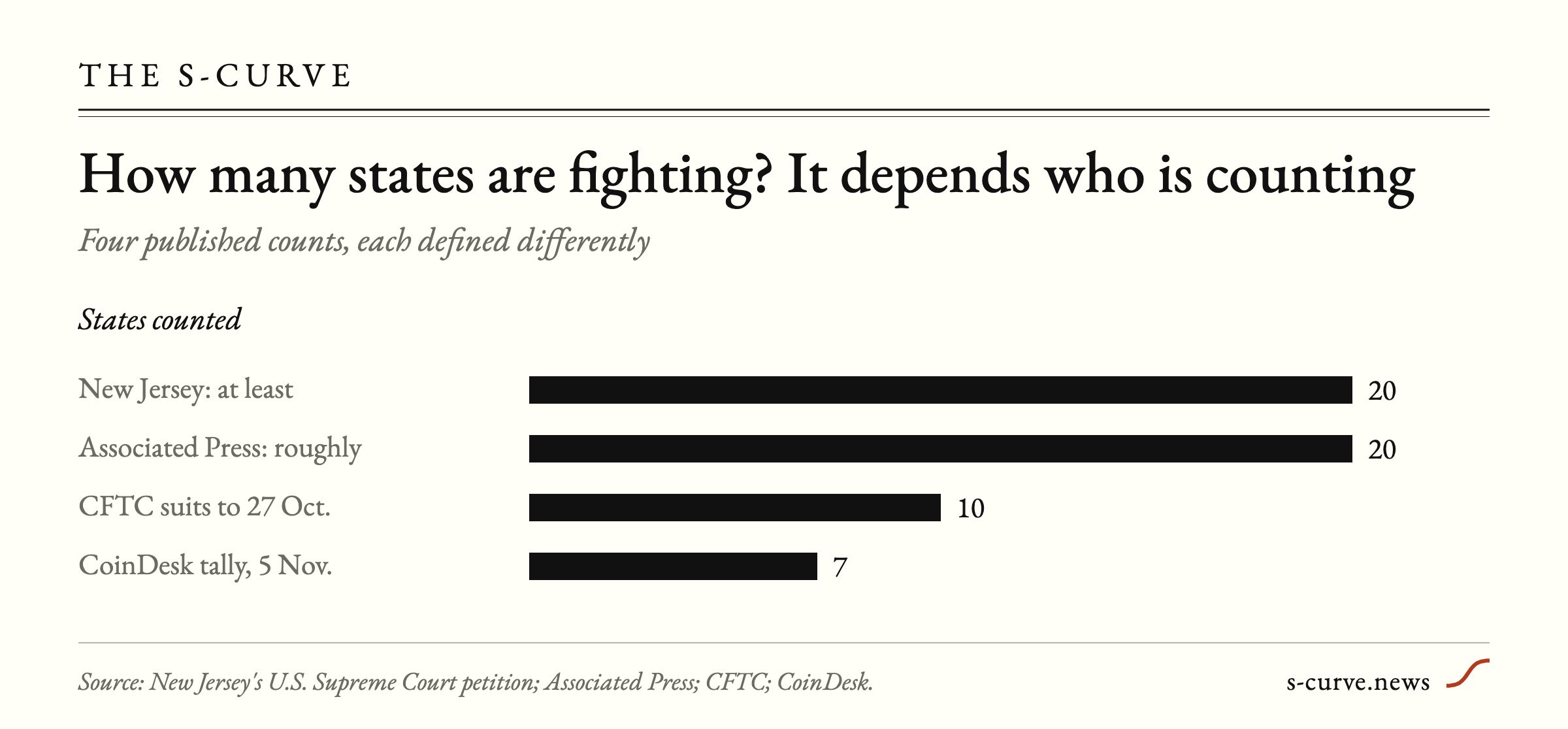
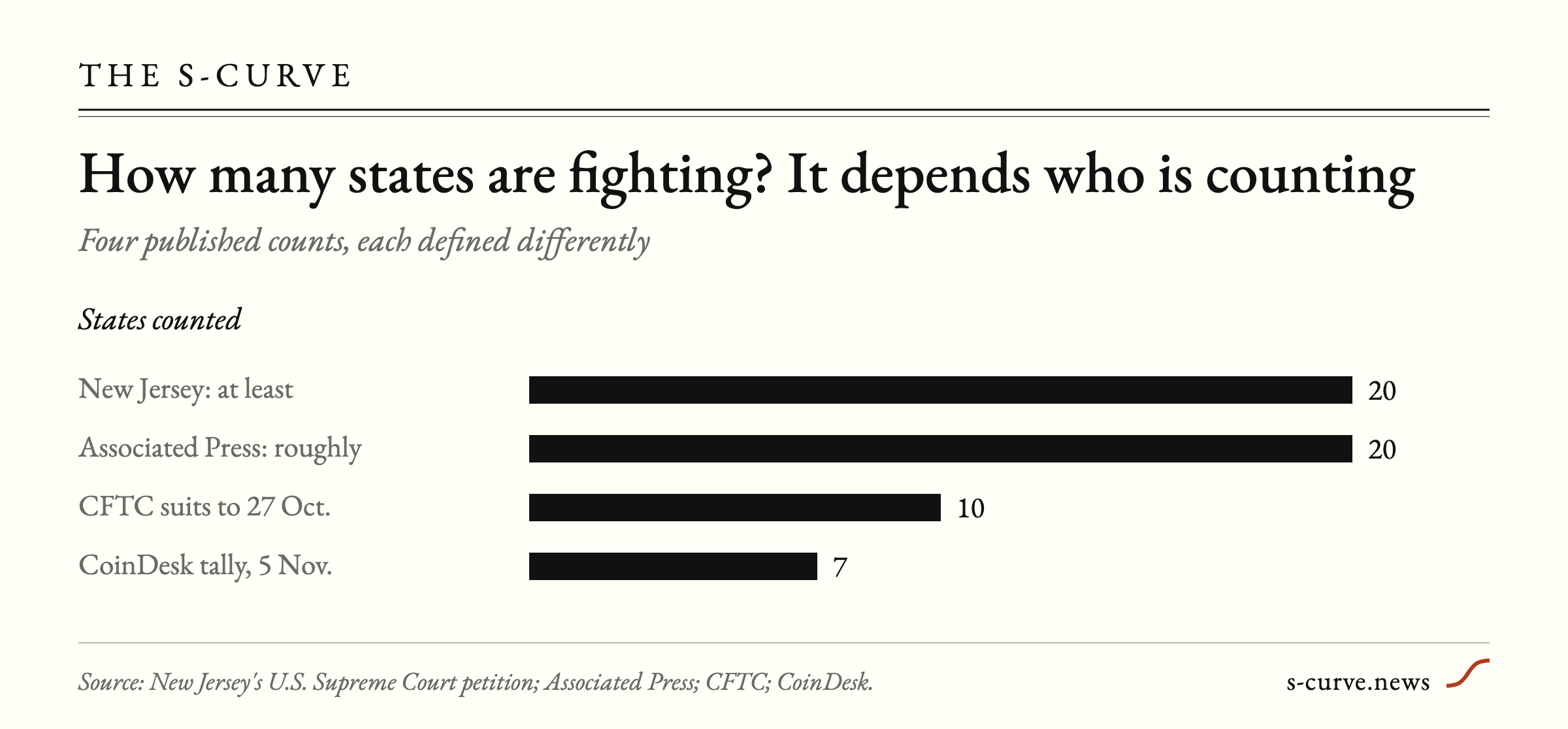
No single number exists, because each count defines the fight differently. By the CFTC’s own tally as of 27 October, it has sued 10 states. New Jersey’s petition to the Supreme Court says litigation over prediction markets’ sports contracts has reached at least 20 states. The Associated Press, reporting on Utah’s charges, put it at roughly 20 states.AP via KSAT: Utah charges Kalshi and founders. CoinDesk’s tally, which counts states that charged, sued or restricted Kalshi, makes Arkansas the seventh.
Arkansas’s own position predates the suit. A formal opinion from its attorney general in October 2025 said a business model like Kalshi’s amounts to gambling and needs a state license. What a court will say about that is the open question. NextPredict reports that Kalshi has until 7 December to respond to New Jersey’s petition. DeFi Rate puts its deadline to ask the Supreme Court to review the Ninth Circuit ruling at 2 February 2027, unless extended.
Sources
- Arkansas Advocate: Arkansas accuses prediction market, online gaming platform of operating illegal gambling
- KUER: Utah sues Kalshi
- Stateline: Utah sues Kalshi
- Deseret News: Utah sues Kalshi
- crypto.news: Arkansas sues Kalshi
- Finance Magnates: Arkansas sues Kalshi
- CFTC press release: sues Arizona, Connecticut, Illinois to reaffirm exclusive jurisdiction
- gambling.com: New Jersey asks Supreme Court to rule on Kalshi
- Pillsbury: Indian gaming and prediction markets circuit split
- Crypto Briefing: Selig vows Supreme Court
- Fox13: Utah criminal charges Kalshi executives
- Covers: CFTC sues Utah
- AP via KSAT: Utah charges Kalshi and founders
- NextPredict: Ninth Circuit denies Kalshi rehearing
- Courthouse News: Sixth Circuit says states can regulate Kalshi
- CoinDesk: The pile of lawsuits against Kalshi just grew by one
- Arkansas Attorney General: Griffin sues prediction market Kalshi
- US Appeals Court Denies Kalshi Request For Rehearing - Legal Sports Report
- Ninth Circuit Denies Kalshi Rehearing in Nevada Case
Disclosure
This article was drafted by S-Curve Desk, an AI system, from the sources above. Boaz Sobrado reviewed it before publication. Errors: the corrections log, or write to us.